-
E-mail
Yl@monchtec.com
-
Phone
18917639396
-
Address
Room 803, Building 1, No. 199 Guangfulin East Road, Songjiang District, Shanghai
Shanghai Mingce Electronic Technology Co., Ltd
Why does the Impac infrared thermometer need to be wavelength separated? How to match the radiation characteristics of materials at different temperatures
Date: 2025-09-19Read: 0
The Impac infrared thermometer is different from other brands of infrared thermometers in that it is divided into wavelengths (or bands) mainly for the following key reasons, which are the basic principles of infrared temperature measurement technology:
1. Match the radiation characteristics of objects at different temperatures:
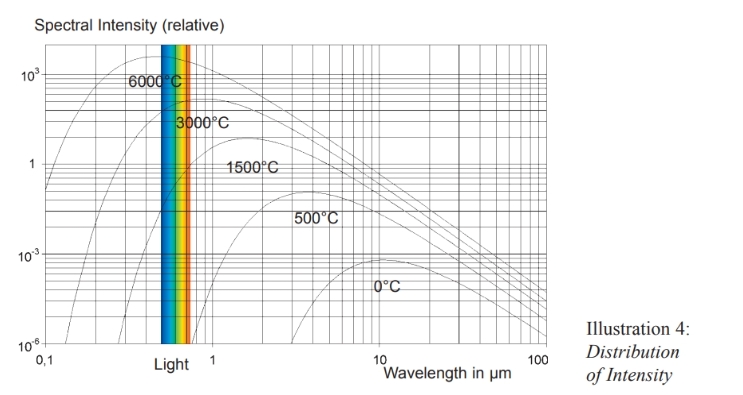
Wien's displacement lawIt is the core principle. Simply put, the higher the temperature of an object, the shorter the peak wavelength of the infrared radiation energy it emits.
Low temperature objects (such as human body, normal temperature objects):The infrared radiation is mainly concentrated inlong waveRange (e.g. 8-14 μ m).
Medium temperature objects (such as hot metals, glass):Radiated infrared radiationMedium waveMove (e.g. 3-5 μ m).
High temperature objects (such as molten metal, flames):The infrared radiation will be more biased towardsshortwave(例如1.0 μm, 1.6μm, 2.3μm)。
In order to accurately capture the infrared radiation signal emitted by the measured object, it is necessary to select a wavelength that matches the peak radiation at that temperature range. If the wavelength selection is improper, the received signal will be weak and the measurement accuracy will be greatly reduced.
2. Avoid interference from the atmosphere and environment:
The air around us contains gases such as water vapor (H ₂ O) and carbon dioxide (CO ₂), which absorb specific wavelengths of infrared radiation.
In order for the thermometer to "see" the target object clearly, it is necessary to choose those bands with weaker atmospheric absorption, which are called'Atmospheric Window'The most common "atmospheric window" is3-5μmand8-14μm.
If the measurement distance is far, or in a humid and dusty environment, choosing a suitable "atmospheric window" is particularly important, otherwise the measurement results will be severely underestimated.
3. Measurement requirements for specific materials:

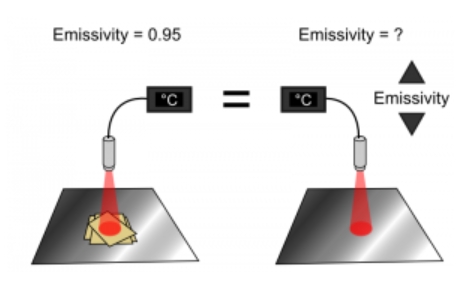
Different materials have different emission, reflection, and transmission characteristics for infrared radiation, which is calledemissivityChoosing the appropriate wavelength can better address the measurement challenges of different materials.
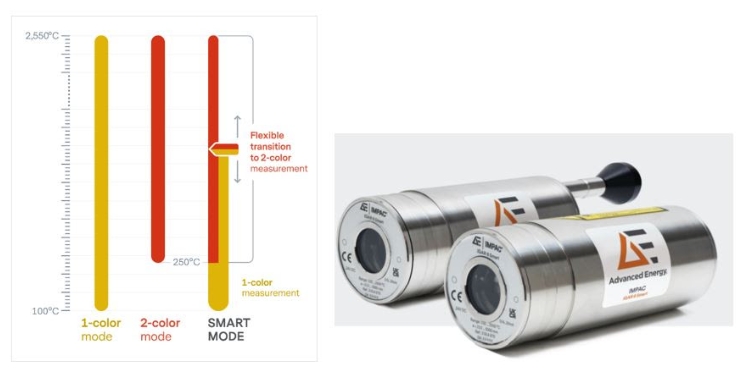
Measuring metals:Metals have higher and more stable emissivity at short wavelengths at high temperatures. Therefore, when measuring high-temperature metals, short wavelength infrared thermometers (such as 1.0 μ m or 1.6 μ m) are usually chosen to obtain more accurate results and be less affected by changes in emissivity.
Measuring glass:Glass is opaque at long wavelengths (8-14 μ m) and its surface temperature can be accurately measured. But at medium waves (about 5 μ m), glass is semi transparent and can measure the temperature inside or in its molten state.
Measuring plastic film:Some thin films have strong absorption peaks in specific mid wave bands (such as 3.43 μ m or 7.9 μ m), and using thermometers with these specific wavelengths can accurately measure the temperature of the film without interference from background radiation.
Measuring flames:The CO ₂ in the flame has strong radiation around 4.5 μ m, so a thermometer with this wavelength can be used specifically to measure the temperature of the flame.
In summary, the purpose of wavelength division in Impac infrared thermometers is to "prescribe the right medicine":
What temperature to measure and what wavelength to choose.
In what environment to measure and what wavelength to choose.
What material to test and what wavelength to choose.
By accurately selecting the working wavelength, the Impac infrared thermometer can provide high-precision and high stability temperature measurement solutions for various complex industrial and scientific applications.