-
E-mail
fangyong1016@163.com
-
Phone
18516101356
-
Address
Room 502, Building 1, No. 199 Guangfulin East Road, Songjiang District, Shanghai
Shanghai Hanling Intelligent Technology Co., Ltd
Laboratory parallel light reactor: precise control of light "reaction chamber", empowering efficient breakthroughs in photochemical research
Date: 2025-10-19Read: 1
In laboratory research fields such as photocatalysis, organic synthesis, and material modification, precise light source control and uniform light distribution are the core to ensure the efficiency of photochemical reactions and the reliability of experimental results. Traditional photoreaction devices often face problems such as unstable light sources, uneven illumination, and cumbersome parameter control, making it difficult to meet the needs of refined scientific research.Laboratory parallel light reactorBecoming a professional assistant for photochemical experiments, providing researchers with a stable and controllable photoreaction environment, and assisting in the efficient advancement of scientific research.
The primary highlight of a parallel light reactor is its high-precision light source control and uniform illumination. The equipment is equipped with high stability xenon lamp, mercury lamp or LED light source, which can select specific wavelengths according to experimental needs. The light source intensity is continuously adjustable, and the parallel light output angle deviation is less than ± 2 °, ensuring that the uniformity of light in the reaction area reaches over 95%. By using advanced optical lens systems, the light source is focused into parallel beams, avoiding the problem of uneven local reactions caused by traditional divergent light. For example, in the experiment of photocatalytic degradation of pollutants, the intensity and irradiation time of ultraviolet light can be accurately controlled to ensure uniform illumination on the catalyst surface, and the repeatability error of experimental data can be controlled within ± 3%; In organic light synthesis reactions, by adjusting the wavelength and power of the light source, the reaction substrate can be accurately activated, the yield of the target product can be improved, and the experimental period can be shortened.
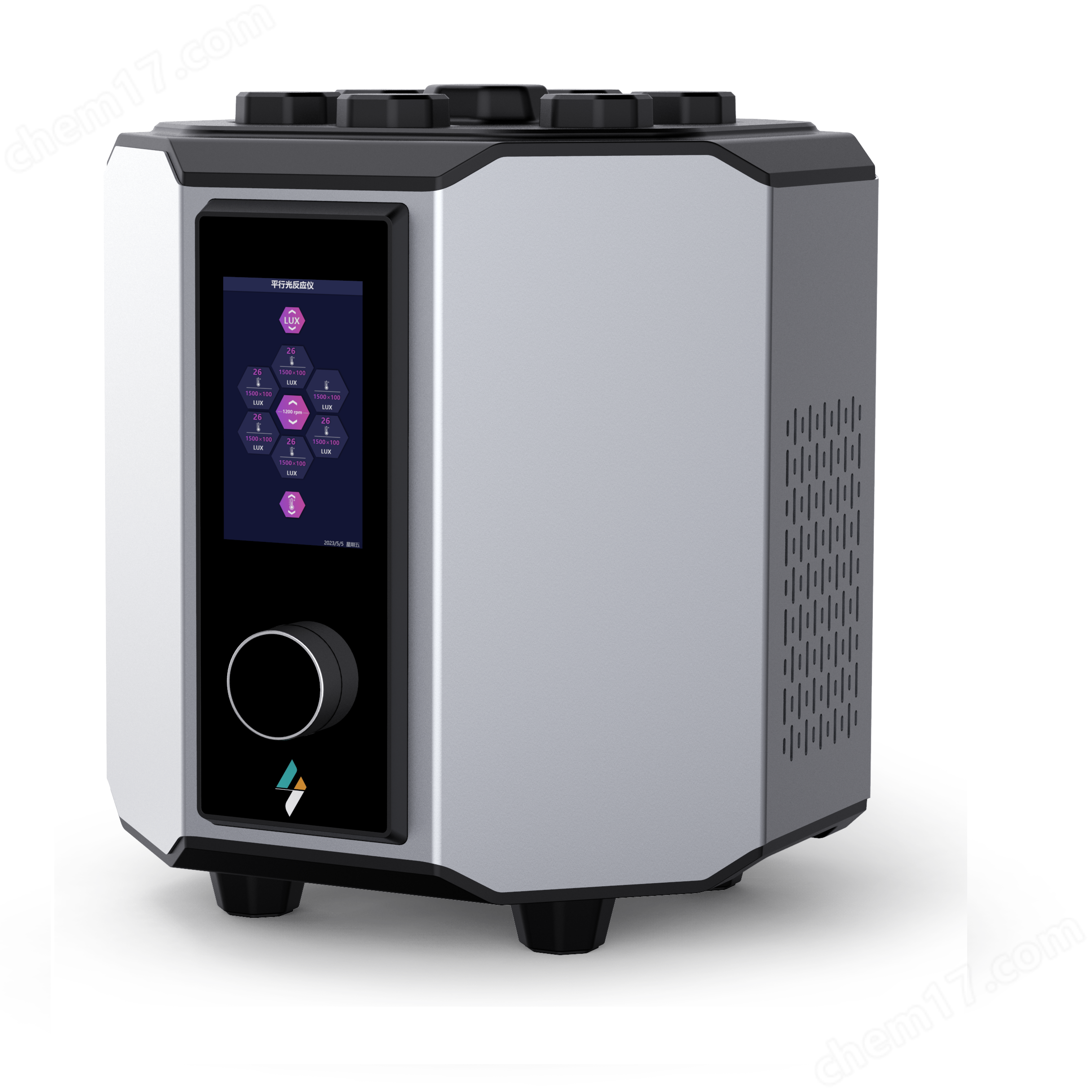
Secondly, multi station design and intelligent control enhance experimental efficiency. The equipment is equipped with 4-12 independent reaction stations, supporting parallel experiments on multiple sets of samples simultaneously. Each station can independently control temperature, stirring rate, and lighting parameters to meet the requirements of comparative experiments under different variable conditions. Equipped with an intelligent touch system, it can display and accurately control key parameters such as light intensity, reaction temperature, and stirring rate in real time. It supports preset experimental programs and automatic data recording to avoid manual operation errors. Some models are equipped with a condensation system, which can quickly remove the heat generated during the reaction process and maintain the temperature stability of the reaction system, especially suitable for exothermic photochemical reactions.
In terms of safety and practicality, the detailed design of the laboratory parallel light reactor meets the needs of scientific research. The equipment casing is made of UV resistant material and equipped with a protective observation window to prevent strong light from causing harm to operators; Built in safety devices such as over temperature protection and light source overload protection. When the temperature exceeds the set range or the light source is abnormal, the power will be automatically cut off and an alarm will be issued; The reaction vessel is compatible with various specifications such as quartz tubes and beakers, and supports reactions of samples of different volumes; In addition, the device is compact in size and can be easily placed in a laboratory fume hood, making it suitable for limited laboratory space.
From the research and development of photocatalytic materials to organic photochemical synthesis, and then to the study of photocatalytic degradation of environmental pollutants, the laboratory parallel light reactor has become an important equipment for photochemical research with "precise light control, efficient parallel, safe and reliable" as its core. Choosing a professional reactor is not only a choice to improve experimental efficiency, but also a key step to ensure the accuracy of scientific research data and promote innovation and breakthroughs in the field of photochemistry, helping researchers to quickly achieve results in photochemical research.
Last Article: Laboratory UV analyzer: UV "perspective eye" unlocks new dimensions of sample analysis
Next Article: Usage of UV analyzer