-
E-mail
shboonsci@126.com
-
Phone
13816245807
-
Address
3rd Floor, Building 6, No. 537 Songda Road, Qingpu District, Shanghai
Shanghai Bono Biotechnology Co., Ltd
A complete solution for the extraction of total RNA from plants using a desktop high-throughput tissue grinder
Date: 2025-11-24Read: 1
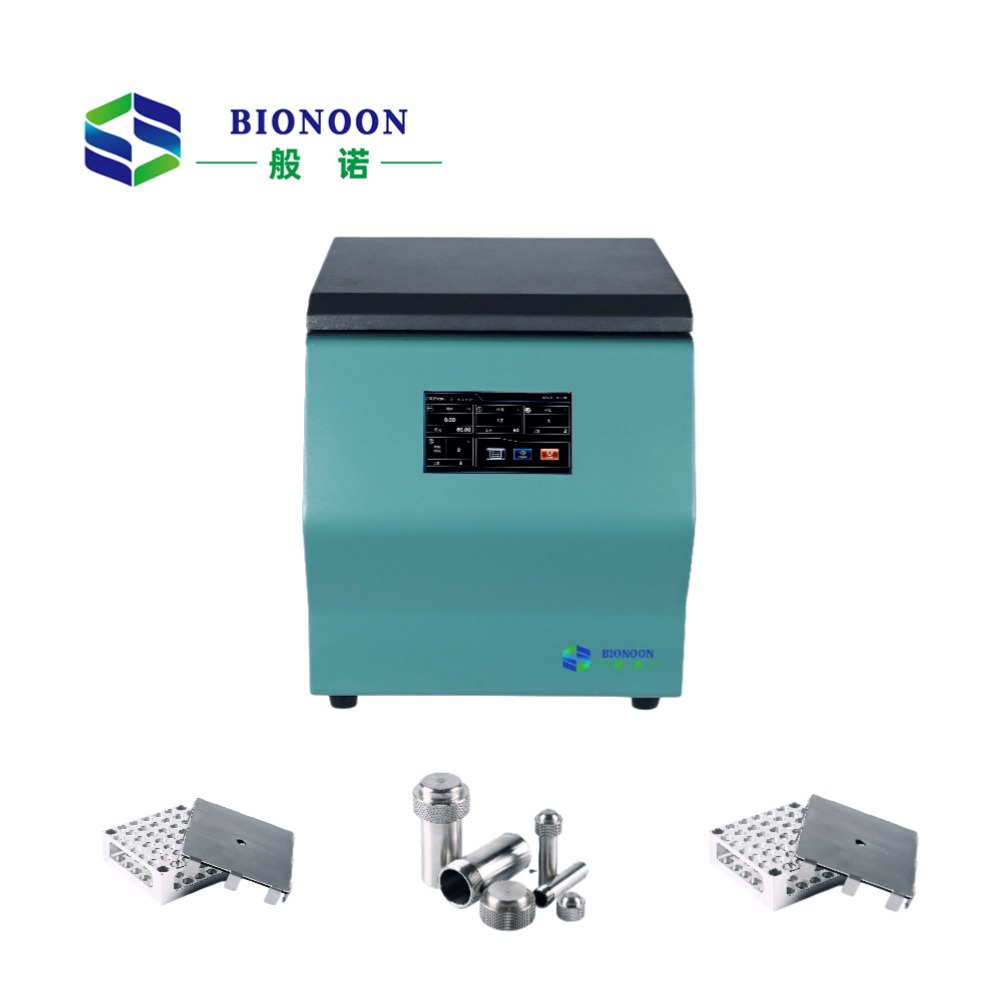
Total PlantsRNAExtraction is the core fundamental step in molecular biology research, and its quality directly determines transcriptome sequencing and real-time fluorescence quantificationPCRWaiting for the success or failure of downstream experiments. However, plantsThe tough cell wall and active endogenousRNaseAnd the abundant secondary metabolites of polysaccharides and polyphenols often lead to low efficiency in traditional extraction methods. Especially traditional liquid nitrogen manual grinding has the disadvantages of low processing flux, poor operational repeatability, and susceptibility to temperature rise during grindingRNADegradation and other issues have become bottlenecks that constrain research.
This plan optimizes the operating parameters and process of the desktop high-throughput tissue grinder through system optimization, and constructs a set of integratedEfficient crushing, full low-temperature protection, standardized outputThe integrated sample pre-processing system aims to systematically address the aforementioned technical challenges.
1、 Analysis of technical difficulties and response mechanism of grinding equipment
To clearly demonstrate the technical principles of this solution, we will include plantsRNAThe main challenges of extraction and the targeted design mechanism of the grinder are compared as follows:
core challenge |
Technical response mechanism of grinder |
1. Physical fragmentation obstacleThe cell wall structure is sturdy and difficult to fully break down using conventional methods. |
High frequency vibration for efficient crushingVertical oscillation system(10–70 HzAdjustable drive zirconia/Tungsten carbide grinding beads, through high-speed impact and shearing, can be used to30Achieve sufficient fragmentation of fibrotic tissue within seconds, improving efficiency10More than double. |
2. Biodegradation risk: EndogenousRNaseStrong activity, grinding heat production and operational exposure can easily lead toRNADegradation. |
Low temperature inhibition of enzyme activity throughout the processEquipped with liquid nitrogen pre cooling or compressor cooling module, the grinding chamber temperature can be stably controlled within-30℃to-50℃Inhibit from a physical perspectiveRNaseActivity. |
3. Chemical pollution interferencePolyphenols are prone to oxidation, polysaccharides are prone to co precipitation, which affectsRNAPurity and downstream reactions. |
Anti pollution structure designUsing fully enclosed grinding tanks and disposable grinding beads to avoid cross contamination; High purity zirconia material reduces metal ion adsorption. |
4. Experimental scale limitationManual grinding has low flux, long time consumption, and significant differences between batches. |
High throughput parallel processing: Support96/192The orifice plate runs synchronously, and a single batch of grinding can be carried out10Completed within minutes, increased efficiency20Multiple times or more, and can store parameters for standardization. |
2、 Standardized operating procedures (taking plant leaves as an example)
1. Experimental preparation
Equipment and consumablesDesktop high-throughput tissue grinder (recommended)7inchTFTTouch screen), liquid nitrogen pre cooling adapter, zirconia grinding beads (diameter)3–5 mm), NoneRNase 2 mLCentrifugal tubeRNAExtraction kit.
safety protectionWear anti freezing gloves, impact goggles, and protective clothing throughout the operation to ensure that the hood is closed and the emergency braking function is normal.
2. Core operational steps
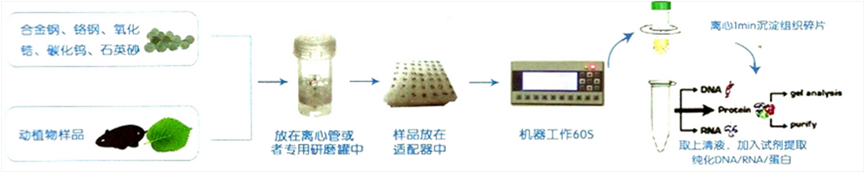
Sample pretreatment: Yu WuRNaseWorkbench, retrieve50–100 mgFresh leaves, cut into1–2 mmFragments, quickly thrown into the container1 mLCracking solution and1Cover and mark the centrifuge tube with grinding beads tightly.
Adapter pre coolingImmerse the adapter of the symmetrically placed sample tube into liquid nitrogen as a whole1–2Wait for minutes until the liquid nitrogen stops boiling, ensuring that the sample is frozen.
Instrument parameter settingStart the low-temperature mode of the grinder and wait for the chamber temperature≤-30℃Afterwards, set the parameter: frequency30–35 Hz, Time45–60Second, enable acceleration/Deceleration program(2Switching within seconds.
Start grinding programQuickly remove the adapter from liquid nitrogen(This step needs to be controlled during startup30Within seconds)Immediately install and close the hood, and start the program. After completion, quickly transfer the sample tube to the ice box.
RNAPreliminary recycling:4℃, 5000 rpmcentrifugation30Mix the lysate and homogenate in seconds, then directly enter the reagent kitRNAPurification steps.
3. Key precautions
time controlStrictly observe“gold30second”Principle: Avoid thawing the sample before startup.
Principle of BalanceThe sample tubes are symmetrically placed, with a weight difference of no more than one hole10 mg.
Parameter adaptationDifferent organizations need to optimize parameters, please refer to the following table for details:
plantRNAExtract grinding parameter optimization table
Plant tissue type |
Grinding bead material |
Recommended frequency(Hz) |
Grinding time(second) |
Special optimization suggestions |
Young leaves (Arabidopsis, tobacco) |
zirconium oxide |
28–32 |
30–45 |
Standard process to avoid excessive grinding and release of pigments |
Mature leaves (rice, wheat) |
zirconium oxide |
30–35 |
45–60 |
Can be ground twice (with ice bath intervals)1Minutes) |
Lignified root system (apple, poplar) |
zirconium oxide |
32–38 |
60–90 |
Cut the sample first1 mmShort section, liquid nitrogen pre cooling extended to3minute |
Hard seeds (corn, soybeans) |
tungsten carbide |
35–40 |
90–120 |
Adopting intermittent grinding mode (working)30second/pause10Seconds), enhance fragmentation |
Multi pulp tissue (tomato pulp, kiwi fruit) |
zirconium oxide |
25–30 |
20–40 |
Reduce the amount of cracking solution to800 μLTo avoid excessive dilution |
3、 Advantages of the Plan and Quality Assessment
1. Core strengths
stable qualityFull process low-temperature and efficient crushing guaranteeRNAIntegrity,AlsoThe value is stable at8.5The above (traditional methods are about)6.0); Agarose gel electrophoresis display28S/18S rRNAThe strip is clear and there is no degradation tailing.
High yield and good purity: per milligram of tissueRNAYield rate4–6 μg,NanodropdetectionOD260/280for2.0–2.1,OD260/230 ≥ 1.8Reduced polysaccharide residue60%The above.
Excellent efficiency: Single batch192Sample grinding only requires15Minutes, save80%Time; Intra batch coefficient of variation(CV)below5%High repeatability.
Widely applicableBy adjusting parameters, it can be adapted to special plants with high polyphenol content such as herbs, woody plants, algae, and Salvia miltiorrhiza.
2. Standardized Quality Assessment Process
integrity: UseAgilent 2100Bioanalyzer,≥ 8.0(Transcriptome sequencing standards) or≥ 7.0(Ordinary)PCR)To be qualified.
purityUV spectrophotometer detection,OD260/280ratio1.9–2.2And there are no impurity peaks,OD260/230 ≥ 1.7.
Yield rateFluorescence quantification method is used to accurately determine concentration, and the extraction efficiency is calculated based on the initial sample weight.
4、 Summary and Prospect
Desktop high-throughput tissue grinder “High frequency fragmentation-cryoprotection-Anti pollution design” The triple technology collaboration systematically conquered plantsRNAThe four core challenges of extraction. Its standardized process not only ensuresRNAThe high quality and stability of the samples, coupled with excellent flux for large-scale plant molecular biology research (such as...)GWASThencRNAThe research provides strong support.
Looking ahead to the future, with the development of intelligent control and IoT technology, such devices will be integratedAIParameter adaptive systemTo achieve intelligent matching of grinding schemes and real-time traceability of experimental data, promoting higher standardization, automation, and intelligence in botanical research.