-
E-mail
sdrnyq@163.com
-
Phone
13656375202
-
Address
No. 2828, Parallel North Road, Tengzhou City, Shandong Province
Shandong Ruineng Instrument Co., Ltd
Experimental plan for CHCl ∝ and CCl ₄ in drinking water of Shandong Ruineng Instrument
Date: 2025-12-15Read: 2
Drinking water in daily lifeCHCl₃、CCl₄
——Gas chromatography method
Experimental ProtocolAccording to HJ 620-2011
GB 5749-2022
China's "Sanitary Standards for Drinking Water"GB5749-2022Method for Testing Standards of Drinking WaterGB/T 5750.8-2023regulation,The content of CHCl ∝ in tap water cannot exceed per liter0.06Milligrams(0.06mg/L). Rapid detection of drinking water by gas chromatography method(CHCl ∝) and(CCl ₄)Content. ① Ensure access to drinking water; ② To address the increasingly serious problem of drinking water pollution and improve the level of water quality testing; ③ Gas chromatography, as a rapid, accurate, and sensitive detection method, is widely used in the field of water quality detection.
This method is based on the combination of headspace sampling technology and gas chromatography analysis technology for quantitative detection of (CHCl3) and (CCl ₄) in drinking water. Using headspace sampling technology, volatile organic compounds in the water sample are heated in a closed system to achieve equilibrium between gas and liquid phases, and the gas phase is quantitatively extracted and injected into the gas chromatograph. After separation by capillary chromatography column, the target substance generates a signal response in ECD due to electron capture, and its peak area is linearly related to concentration, which can be quantitatively analyzed by external standard method.
2.1 Gas chromatograph

2.1.1Fully automatic headspace sampler

Brown glass bottles should be used for collecting water samples, and an appropriate amount of ascorbic acid (0.1-0.2 g/L) should be added immediately after sampling to eliminate residual chlorine interference, and sealed and stored away from light.
The sample needs to be refrigerated at 4 ℃ and analyzed within 48 hours.
Standard solution preparation and calibration
● Accurate preparation(CHCl ∝) and(CCl ₄) mixed standard solution, with a concentration gradient covering the range of 0.1-10 μ g/L (adjusted according to actual needs).
Add sodium chloride to the sample and standard solution (saturated concentration or appropriate amount) to enhance the salting out effect and improve the gas phase distribution coefficient of the target substance.
● Headspace bottle temperature: 70-80 ℃ (recommended 75 ℃)
● Balance time: 15-30 minutes (optimized based on the volatility of the target compound)
Injection needle temperature: not less than 100 ℃, to avoid condensation
Injection volume: usually 1.0 mL
● Chromatography column: non-polar or weakly polar capillary column (SE-54 30 * 0.32 * 0.5)
Column temperature program: Initial temperature of 40 ℃ is maintained for 2 minutes, then raised to 180 ℃ at a rate of 5 ℃/min and maintained for 5 minutes
Injection port temperature: 220 ℃
Detector temperature: 300 ℃
● Carrier gas: high-purity nitrogen (purity ≥ 99.999%), flow rate 1.0-2.0 mL/min
Injection mode: Split injection (split ratio 5:1 or optimized based on sample concentration)
Using an ECD detector, set appropriate sensitivity and polarity mode (usually negative ion mode).
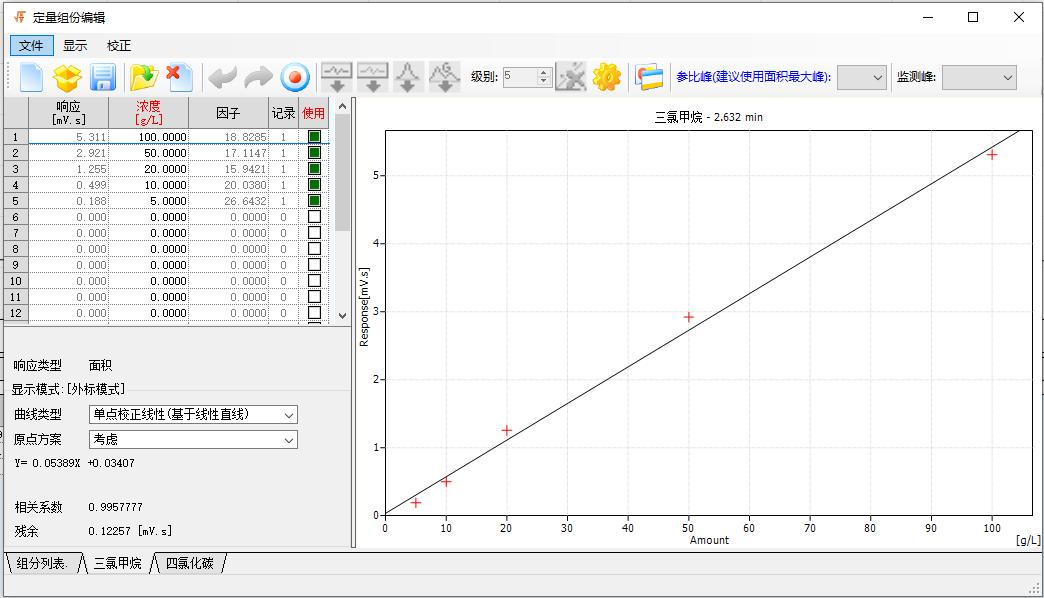
Calculate the sample concentration using the standard curve linear regression equation (r ≥ 0.995) to ensure that the quantitative limit meets the method requirements.
Evaluate the precision and accuracy of the method using parallel sample determination and spiked recovery experiments.
CHCl₃ |
100 |
50 |
20 |
10 |
1 |
ug/L |
CCl₄ |
10 |
5 |
2 |
1 |
0.1 |
ug/L |


Regularly use certified reference materials to calibrate instruments and ensure stable response of ECD detectors.
The entire experiment uses a blank sample monitoring system to monitor contamination, and each batch of samples contains at least one laboratory blank.
● Avoid exposing samples to high temperatures or prolonged storage to prevent loss of target substances due to volatilization.
Regularly maintain the airtightness of the headspace sampling device and the temperature control accuracy of the heating module.
For samples with high chloride ion concentration, matrix interference needs to be evaluated and corrected using a matrix matching standard curve.