-
E-mail
87692680@qq.com
-
Phone
15689208778
-
Address
3rd Floor, Building 1, Weifang High tech Zone Optoelectronic Industry Accelerator (Phase I), No. 155 Guangdian Road, Yuqing Community, Xincheng Street, Weifang High tech Zone, Shandong Province
Shandong Leiente Intelligent Technology Co., Ltd
Operation Specification for Grain Safety Detector
Date: 2025-12-22Read: 0
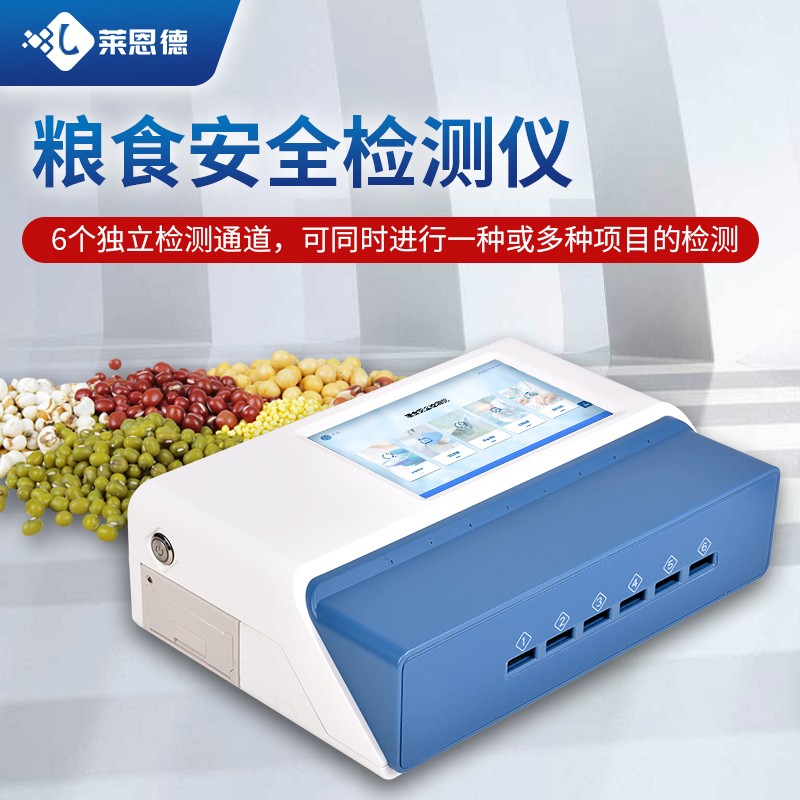
The food safety detector adopts the principle of fluorescence quantitative rapid detection, mainly detecting the content of fungal toxins and heavy metals in grain, oil, grain and feed, including aflatoxin B1, aflatoxin M1, zearalenone, vomitoxin, fumonisin, etc. The heavy metals in grain include heavy metals such as lead and cadmium, and the detection samples cover grain (rice, corn, wheat, barley, sorghum, etc.) and their products, feed and its raw materials, edible oils and fats, milk and its products, etc; The sample pre-treatment is simple, and the entire testing process takes 12 minutes. The product is suitable for local grain depots, grain production enterprises, feed mills, various animal husbandry enterprises, flour mills, food processing plants, third-party testing institutions, and regulatory departments at all levels. Below are the operating specifications for the food safety detector:
1、 Instrument preparation and inspection
1. Appearance and accessory inspection
Before use, carefully inspect the appearance of the instrument to ensure that there are no damages, cracks, or loose parts, and confirm that all accessories are complete (such as power cords, sample cups, calibration standards, cleaning tools, etc.). If missing accessories or abnormal instruments are found, the supplier or professional maintenance personnel should be contacted in a timely manner for handling.
Example: If the sample cup is missing or broken, it may cause sample leakage or deviation in test results, and needs to be replaced immediately.
2. Installation and Connection
Place the instrument on a stable, dry, and electromagnetic interference free workbench, connect the power cord, and ensure that the voltage meets the requirements of the instrument. For instruments equipped with wireless transmission function, network connections should be set up according to the instructions to ensure smooth data transmission.
Principle: Strong electromagnetic interference may affect the stability of instrument signals, leading to fluctuations in detection data.
3. Power on preheating and self check
After turning on the power switch, the instrument will automatically perform a self-test program to check the internal hardware and software systems. Observe the prompt information on the display screen. If an error code or alarm appears, it is necessary to troubleshoot according to the operation manual. After completing the self check, preheat the instrument as required (usually 10-15 minutes) to achieve a stable working state.
Purpose: Preheating can eliminate the internal temperature gradient of the instrument and ensure the consistency of the detection results.
4. Calibration instrument
Use matching calibration standards to calibrate the instrument. Pour the standard sample into the sample cup, place it in the testing chamber, and start the calibration program according to the prompts on the operating interface. After calibration is completed, take out the standard sample, rinse the sample cup with distilled water and dry it to avoid contamination.
Importance: Calibration can correct instrument system errors and ensure the accuracy of test results. For example, if the fluorescence detector is not calibrated, it may cause deviation in fluorescence intensity readings, affecting the calculation of target substance content.
2、 Operating standards and procedures
1. Sample collection and preparation
Collection: Randomly collect representative samples from the batch of grain to be tested, avoiding selecting particles that are moldy, spoiled, or severely affected by pests. Different types of grains (such as wheat, corn, and rice) need to refer to the sampling methods and quantities specified in the standards.
Preparation: Shelling of shelled grains (such as rice); For larger grain particles, use grinding equipment to crush them into a uniform powder. The prepared sample needs to be thoroughly mixed evenly to ensure consistency in detection. Use clean tools and containers during the processing to avoid contamination.
Example: If the sample is not fully mixed, it may cause the detection results to deviate from the true values, such as local heavy metal content being too high and not detected.
2. Sample weighing and testing
Accurately weigh a certain amount of prepared sample using a high-precision balance and place it in a clean sample cup. Place the sample cup into the testing chamber and ensure it is in place before closing the chamber door. Click the "Start Detection" button, and the instrument will begin detection (such as fluorescence detection, spectral analysis, etc.). Maintain a quiet and stable environment during the testing process, avoiding human interference or vibration.
Key point: The sample size should meet the requirements of the instrument. Excessive sample size may cause blockage of the detection chamber, while insufficient sample size may affect signal strength.
3. Monitoring of the detection process
Real time viewing of detection progress and related data (such as fluorescence intensity, detection time, etc.) through the display screen. If any abnormalities occur (such as prolonged detection time or abnormal fluctuations in fluorescence intensity), immediately stop the detection and check for any problems with the sample (such as unevenness, sample cup contamination, etc.), reprocess the sample and retest.
Cause analysis: Abnormal data may be caused by sample contamination, instrument malfunction, or improper operation, and should be investigated one by one.
4. Result reading and judgment
After the detection is completed, the instrument automatically calculates and displays the results (such as the content of the target substance and whether it meets safety standards). If the results are presented in numerical form, they need to be converted to actual content units (such as μ g/kg, mg/kg) according to the instrument conversion formula. Compare the results with national or industry standards to determine if the sample is qualified. If the result exceeds the safe range, retesting is required to eliminate errors or accidental factors.
Example: If the test result shows that the content of aflatoxin exceeds the standard, further processing measures (such as destruction or downgrading) should be taken on the sample after confirmation through retesting.