-
E-mail
87692680@qq.com
-
Phone
15689208778
-
Address
3rd Floor, Building 1, Weifang High tech Zone Optoelectronic Industry Accelerator (Phase I), No. 155 Guangdian Road, Yuqing Community, Xincheng Street, Weifang High tech Zone, Shandong Province
Shandong Leiente Intelligent Technology Co., Ltd
Is the soil nitrogen, phosphorus, and potassium detection instrument accurate
Date: 2025-12-23Read: 0
The soil nitrogen, phosphorus, and potassium detection instrument can provide highly accurate detection results when used reasonably and in compliance with standard specifications. The specific analysis is as follows:
1、 Detection error range
The error range of soil nitrogen, phosphorus, and potassium detection instruments is usually controlled within the following standards:
Soil nitrogen, phosphorus, and potassium: error ≤ 1%. For example, when a certain instrument detects the available nitrogen content in soil as 50mg/kg, the actual value may be between 49.5-50.5mg/kg.
Organic matter: Error ≤ 2%. If the soil organic matter content is detected as 2%, the actual value may be between 1.96% and 2.04%.
Trace elements: relative error ≤ 5%, for example, when detecting zinc content in soil at 10mg/kg, the actual value may be between 9.5-10.5mg/kg.
Fertilizer nutrients: The single error is ≤ 0.5%, and the error of nitrogen, phosphorus, and potassium is ≤ 1%. If the nitrogen content in the compound fertilizer is detected to be 15%, the actual value may be between 14.925% and 15.075%.
Heavy metals: Relative error ≤ 5%. For example, when detecting lead content in soil at 30mg/kg, the actual value may be between 28.5-31.5mg/kg.
These error ranges comply with the general standards for agricultural testing and can meet the needs of scientific fertilization and soil management.
2、 Technical guarantee for testing accuracy
1. Rotating color pool design
By rotating the colorimetric cell, multi-channel synchronous detection is achieved, reducing human operational errors while ensuring light source consistency and avoiding detection deviations caused by light source fluctuations.
2. High precision filter technology
Filter can accurately screen light signals of specific wavelengths, eliminate interference wavelengths, improve the signal-to-noise ratio of detection signals, and thus enhance detection accuracy.
3. Intelligent constant current calibration system
The system automatically calibrates the current stability during the detection process to ensure consistent current conditions for each detection and avoid differences in detection results caused by current fluctuations.
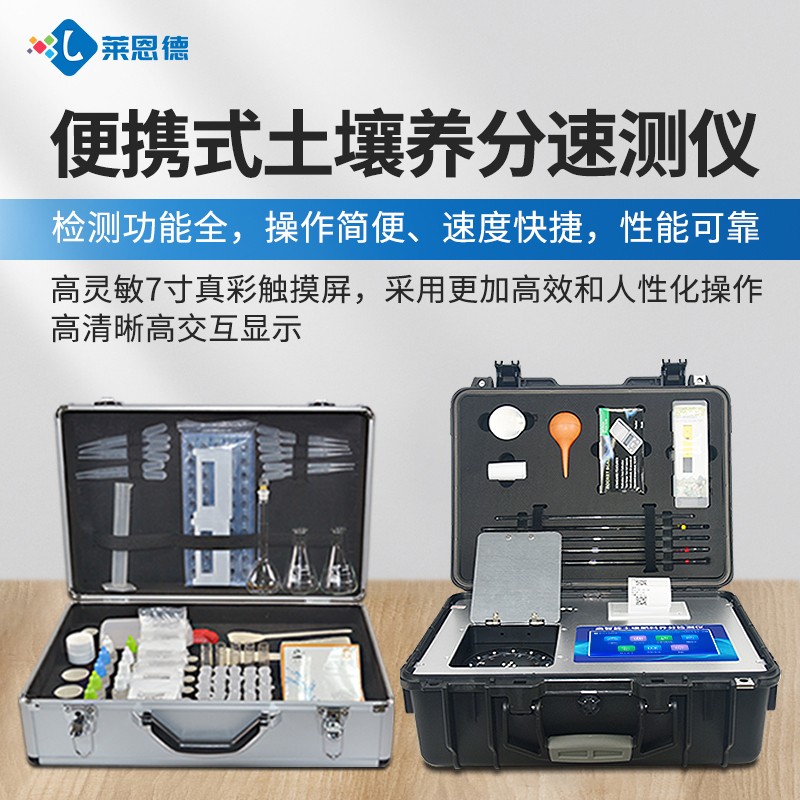
3、 Functional features enhance detection efficiency and reliability
1. Multi sample synchronous determination
The instrument has multiple built-in detection channels, which can simultaneously detect multiple soil or fertilizer samples, shortening the detection time. For example, the determination of nitrogen, phosphorus, and potassium in a single sample takes about 20 minutes, and the detection of 8 samples can be completed within 1 hour.
2. Android system and touch screen operation
Adopting the Android intelligent operating system, the user interface is intuitive and easy to use, reducing operational errors; The touch screen design supports direct input of data, improving operational convenience.
3. Data Upload and Cloud Platform Management
Built in data upload function, which can transmit the detection results in real-time to the cloud platform, realizing data visualization analysis and long-term storage, making it easy for researchers to trace historical data and optimize fertilization plans.
4、 Precautions in practical applications
1. Instrument selection and usage specifications
It is necessary to select instruments that comply with national standards (such as GB/T 5009.199-2003) and strictly follow the instructions to avoid errors caused by instrument quality or improper operation.
2. Regular calibration and maintenance
Regularly calibrate the instrument with standard samples to ensure accurate detection of linear range; Clean the colorimetric cell and filter to prevent dust or stains from affecting detection accuracy.
3. Sample processing and testing environment
The sample should be thoroughly mixed evenly to avoid local concentration differences; The testing environment should maintain stable temperature and humidity (such as 15-30 ℃, humidity ≤ 70%) to avoid environmental factors interfering with the testing results.
Last Article: Application of portable pesticide residue detector in market circulation
Next Article: Usage of particle strength tester