-
E-mail
topthreegeoscience@163.com
-
Phone
18302175139
-
Address
Minhang Industrial Park, Shanghai
Sanjia Diyan (Shanghai) Instrument Equipment Co., Ltd
XRF analysis of salt damage (chloride/sulfate) in reinforced concrete
Date: 2025-09-19Read: 4
Due to various human or non-human factors, reinforced concrete and other structures are subject to corrosion by chloride ions, sulfate ions and other corrosive ions in the external environment (such as marine environment, groundwater environment, and winter salt spraying and de icing environment), which greatly reduces their overall strength and impermeability, affecting the durability and service life of building materials.
The existing reinforced concrete structures generally suffer from the problem of decreased durability due to chloride corrosion of steel bars and carbonation of concrete. There are many major safety accidents caused by corrosion of steel structures. The 1-35W reinforced concrete highway arch bridge spanning the Mississippi River, built in Minnesota, USA in 1967, experienced severe corrosion of the bridge body after only 20 years of use. Shortly after being repaired using local repair methods, corrosion and concrete cracking problems occurred, and a major collapse accident occurred in 2007; The Beijing Xizhimen Overpass, built in 1979, was forced to be demolished and rebuilt after less than 20 years of use due to the "salt damage" caused by salt spraying and ice removal in winter. In the 2003 China Corrosion Investigation Report, it was revealed that the corrosion situation of buildings in China is relatively serious. Corrosion damage accounts for 74% of 27 seaports and approach bridges in East and South China. Within 7 to 25 years of use, corrosion damage accounts for 56% of 22 water gates. Due to severe corrosion in the factory building, a salt factory in Qinghai stopped production after only 6 years of use, resulting in economic losses of 100 million yuan.
The salt corrosion of building materials usually includes steel corrosion and concrete corrosion:
1、 Corrosion damage caused by chloride salt on steel reinforcement 1
Due to the highly alkaline (pH>12.5) pore fluid in concrete, a passivation layer can be formed on the surface of steel bars, effectively preventing them from being corroded. In the later stage of use, due to the carbonation of concrete and the invasion of chloride ions, the passivation layer will be damaged, thereby accelerating the corrosion of steel bars.
The invasion of chloride ions causes corrosion of steel bars, which is essentially an electrochemical corrosion process that can be divided into two stages: cathodic and anodic corrosion. Oxidation reaction occurs at the anode of steel bars, converting iron atoms into iron ions and causing loss of the iron matrix; A reduction reaction occurs at the cathode, generating hydroxide ions (as shown in the schematic diagram of electrochemical corrosion of steel bars). During the chloride salt corrosion reaction of steel bars, chloride ions not only destroy the passivation layer film on the surface of the steel bars to form a corrosion electrode, but also play a catalytic role in the electrochemical corrosion process, without consuming chloride ions throughout the entire corrosion reaction process. Therefore, the presence of chloride ions greatly enhances the corrosion efficiency of steel bars.

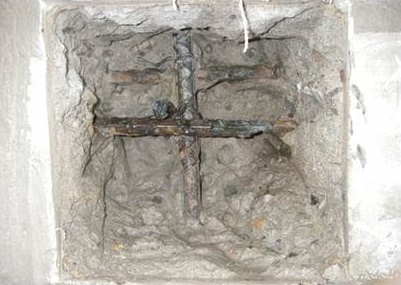
The corrosion of steel bars invaded by chloride ions is manifested as local pitting and pit corrosion. Although the corrosion area of pitting is small, the corrosion depth is large, which can easily cause structural stress concentration and lead to asymptomatic brittle failure. Moreover, chloride ions mainly play a catalytic role in the corrosion process of steel bars, and the presence of trace amounts of chloride ions can greatly accelerate the corrosion rate of steel bars. At the same time, the corrosion products of steel bars will undergo volume expansion, which is 2-4 times the original volume. This expansion force of steel bar corrosion not only affects the bonding performance between the steel bar and the concrete interface, but also seriously damages the strength of the concrete, causing it to peel off, crack and other damages.
2、 Influence of Salt Corrosion Performance on Concrete 3
The common cause of corrosion leading to the deterioration of concrete structure performance is the erosion of chloride ions and sulfate ions. Chloride ions and sulfate ions enter the interior of concrete through diffusion and permeation, reacting with compounds in the concrete to produce hydrated chloroaluminate and insoluble salts such as gypsum or calcium vanadate. These compounds fill the voids inside the concrete, increasing its compressive strength. But with the passage of time, the generated hydrated chloroaluminate and insoluble compounds will crystallize and undergo volume expansion, forming a great crystallization pressure inside the concrete. When the expansion reaches a certain degree, it will cause cracking or carbonization of the concrete, which further provides conditions for salt ion invasion and accelerates the damage of concrete structures.
In some marine and saline soil environments, external corrosive ions can easily diffuse from the outside to the inside through the porous structure of reinforced concrete, causing serious damage to the strength and stability of concrete and steel materials enclosed in concrete structures. Therefore, it is particularly important to regularly detect and monitor the content of chloride ions and sulfate ions in reinforced concrete in specific environments using X-ray fluorescence analyzers.
Case analysis of salt damage to bridge piers
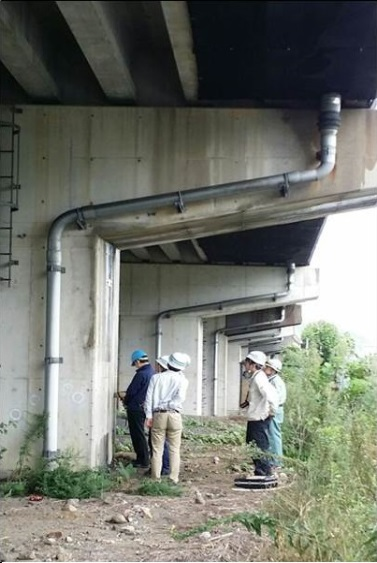
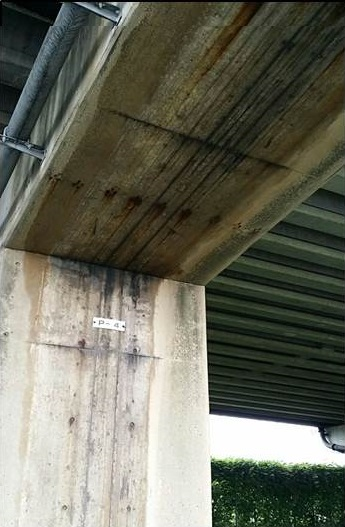
In coastal areas or northern inland regions where snow removal agents are commonly used in winter, reinforced concrete structures such as bridge piers are highly susceptible to salt damage and erosion. A road management company in western Japan and Professor Kubo from Kanazawa University in Japan jointly studied the salt damage effects on reinforced concrete structures such as bridges and piers in coastal and inland areas of Japan.
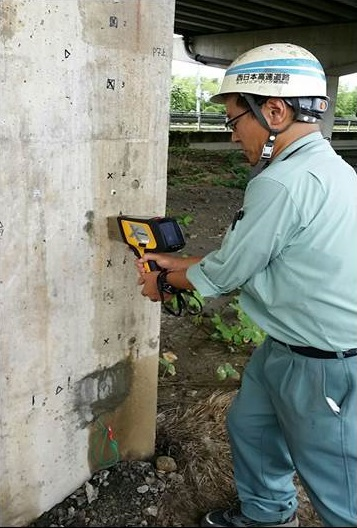
The chlorine content on the surface of bridge piers was analyzed using an Inos handheld X-ray fluorescence analyzer, and the chlorine content in concrete layers of different thicknesses from the outside to the inside was compared. Through analysis, it can be concluded that in environments with high chlorine content in concrete, the corrosion of steel bars in concrete is much more severe than in low chlorine content concrete.
By using Inos DPO to analyze the chlorine content in concrete and establish the relationship between different chlorine contents and the degree of corrosion of steel bars in concrete, it can help customers distinguish the degree of salt damage corrosion in reinforced concrete and take measures for maintenance and upkeep in advance.