-
E-mail
13310668118@163.com
-
Phone
13310668118
-
Address
Gu Yi, Tiangu Industrial Park, Chengyang District, Qingdao City
Qingdao Xinruide Environmental Protection Technology Co., Ltd
The difference between single-stage reverse osmosis equipment and two-stage reverse osmosis equipment
Date: 2025-09-10Read: 2
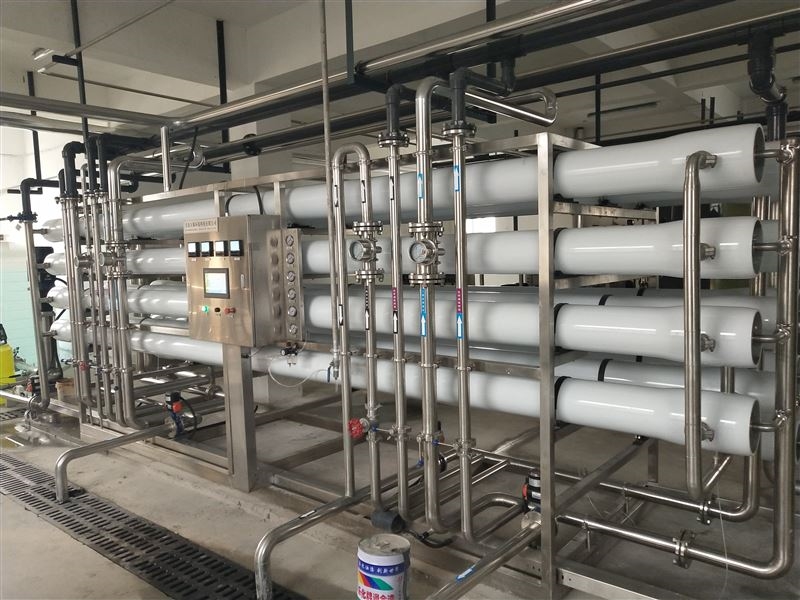
Single stage reverse osmosis equipment and two-stage reverse osmosis equipment are both used for water treatment, mainly for removing impurities, dissolved salts, microorganisms, etc. from water to obtain high-quality pure water. Their main differences are as follows:
1、 Working principle
-Single stage: Using a reverse osmosis membrane module, solutes (such as ions, organic compounds, etc.) in water are separated from solvents (water) by pressure difference. Under the action of the high-pressure pump, the raw water passes through the reverse osmosis membrane, and a portion of the water passes through the membrane to become pure water, while another portion of the water containing higher concentrations of impurities is discharged.

-Double stage: On the basis of single-stage reverse osmosis, a second reverse osmosis membrane component has been added. After the first stage of reverse osmosis treatment, the water enters the second stage of reverse osmosis membrane for further treatment. This can further improve the purity of water and reduce the content of dissolved salts and other impurities in the water.
2、 Produced water quality
-Single level: The quality of the produced water can generally reach a conductivity of around 10-20 μ S/cm, which can meet the requirements of general industrial water and some domestic water.
-Dual level: The water quality of the produced water is higher, and the conductivity can usually be reduced to 1-5 μ S/cm, or even lower, which can meet the water demand of industries with very high water quality requirements such as electronics, medicine, and laboratories.
3、 Equipment cost
-Single level: The device structure is relatively simple and the cost is low. It mainly consists of high-pressure pumps, reverse osmosis membrane components, control systems, etc., suitable for users with limited budgets and not particularly high water quality requirements.
-Double stage: Due to the addition of a second stage reverse osmosis membrane component, the equipment structure is more complex and the cost is higher. But it can provide higher quality pure water, suitable for occasions with strict requirements for water quality.
4、 Operating costs
-Single level: The operating cost is relatively low, mainly consuming electricity and the cost of replacing reverse osmosis membranes. Due to the presence of only one reverse osmosis membrane component, the frequency of membrane replacement is relatively low.
-Dual stage: The operating cost is relatively high because there are two reverse osmosis membrane components that require more electricity to maintain operation, and the frequency of membrane replacement may also increase, leading to an increase in maintenance costs.
5、 Applicable scenarios
-Single level: Suitable for general industrial water, domestic water, food and beverage industries, and other occasions where water quality requirements are not particularly high. For example, cooling water treatment in factories, preliminary purification of drinking water, etc.
-Dual level: Suitable for industries with high water quality requirements such as electronics, pharmaceuticals, laboratories, and semiconductor manufacturing. These industries require high-purity water to ensure product quality and experimental accuracy.
6、 Maintenance and upkeep
-Single level: Maintenance is relatively simple, mainly by regularly checking the status of high-pressure pumps and reverse osmosis membranes, and replacing filter elements and membrane components in a timely manner. It is generally recommended to conduct a comprehensive inspection and maintenance every 3-6 months.
-Dual level: Maintenance is more complex and requires simultaneous attention to the operational status of two reverse osmosis membrane components. Due to the complexity of the system, more frequent inspections and maintenance may be required to ensure the stable operation of the equipment.
7、 Summary of advantages and disadvantages
1. Single level:
-Advantages: Low cost, simple structure, easy operation, and low operating cost.
-Disadvantage: The water quality of the produced water is relatively low, which cannot meet the requirements of very high water quality situations.
2. Double level:
-Advantages: The quality of the produced water is high, which can meet the demand for high-purity water.
-Disadvantages: High equipment cost, high operating cost, and complex maintenance.
The choice between single-stage or two-stage reverse osmosis equipment depends on specific water requirements, budget, and application scenarios. If the water quality requirements are not high, single-stage reverse osmosis equipment is an economical choice; If high-purity water is needed, a two-stage reverse osmosis equipment is a better choice.