-
E-mail
info@phase2china.com.cn
-
Phone
13601073564
-
Address
Room 308, Building 2, Qingyuan Xili, Haidian District, Beijing
Phistus Measurement Instrument (Beijing) Co., Ltd
Measuring material rigidity and laying the foundation for quality - imported Rockwell hardness tester
Date: 2025-11-14Read: 0
In the fields of metal material production, heat treatment processing, and mechanical manufacturing, hardness is a key mechanical performance indicator for measuring the material's ability to resist local plastic deformation (such as indentation). It is directly related to the wear resistance, strength, and service life of the material. From a bearing gear to a heavy-duty machine tool, whether the hardness of its core components meets the standard is the cornerstone that determines the quality and reliability of the entire equipment. As a hardness testing method with a long history, mature technology, and robust results, the Rockwell hardness tester has become a judge for evaluating material properties in laboratories and workshops due to its simple operation, high efficiency, and wide applicability.
The hardness of materials is closely related to their heat treatment process and microstructure. Through hardness testing, it is possible to quickly determine:
1. Heat treatment effect: whether the quenching and tempering processes are appropriate.
2. Material consistency: Whether the performance of materials from different batches is stable.
3. Product wear resistance: the durability of parts such as molds and gears.
The Rockwell hardness test method involves pressing a specific specification of indenter (diamond cone or hard alloy ball) into the surface of the specimen in two steps, and calculating the Rockwell hardness value (such as HRC, HRB, etc.) by measuring the increment of indentation depth.
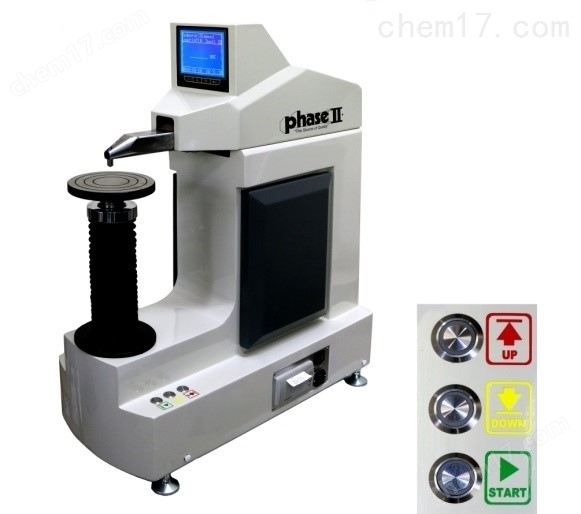
The outstanding advantages of imported Rockwell hardness tester:
1. Direct and intuitive, reliable results: The Rockwell hardness value is directly calculated based on the indentation depth, without the need to measure the diagonal length of the indentation through a microscope after measurement like Vickers or Brinell hardness. This direct measurement method reduces secondary measurement errors, resulting in more intuitive and reliable results with good repeatability and reproducibility.
2. Easy to operate, high efficiency: The testing process is simple and fast - placing the sample, applying initial test force, applying main test force, holding for a specific time, removing the main test force, and reading the hardness value. The entire process can be completed in just over ten seconds, which is very suitable for fast and large-scale testing on the production line, ensuring the efficiency of quality control.
3. Diverse scales and wide applications: By combining different indenters and test force combinations, Rockwell hardness testers have formed various scales (such as HRA, HRB, HRC, HRN, HRT, etc.), which can cover almost all common metal materials from extremely soft aluminum alloys and copper alloys to extremely hard quenched steel, hard alloys, etc., with an extremely wide range of applications.
4. Durable and Stable: Traditional desktop Rockwell hardness testers have a sturdy structure, high mechanical stability, low maintenance costs, and long service life. With the development of technology, digital Rockwell hardness testers have become more equipped with functions such as automatic loading, digital display, and data output, further improving the accuracy and convenience of testing.
Hardness is the inherent "backbone" of a material and a hardness indicator of product quality. The Rockwell hardness tester has established a position in the field of quality testing due to its enduring reliability, high efficiency, and wide applicability. It is not only a scientific instrument for material research and process development in the laboratory, but also a practical tool for incoming material inspection, process monitoring, and finished product factory inspection in the workshop. Choosing a Rockwell hardness tester lays a solid foundation for the quality of your products.