-
E-mail
info-china@noldus.com
-
Phone
18501168738
-
Address
507, Building 6, No.33 Guangshun North Street, Chaoyang District, Beijing
Nordas (Beijing) Information Technology Co., Ltd
Research on Social Interaction of Disabled People in Sports Activities
Date: 2025-11-18Read: 0
The significance of exercise goes far beyond just strengthening the body. For people with disabilities, it is an important bridge to social integration, enhancing self-confidence, and finding a sense of belonging.
For a long time, research on social interaction in sports has mainly focused on able-bodied athletes or high-level competitive sports. In the field of leisure sports, which is more friendly to people with disabilities and has lower participation barriers, what is their social world like? How do they get along with their teammates and coaches? How do these interactions affect their experience and persistence in sports?
Based on this exploration, this study conducted a groundbreaking research that analyzed qualitative interviews, group interviews, and behavioral observations through a mixed method research designSocial interaction experience of disabled youth in leisure sports projects (Orr et al., 2021).
The Importance of Sports Activities for People with Disabilities
The United Nations Convention on the Rights of Persons with Disabilities emphasizes that,persons with disabilitiesThe right to enjoy the highest attainable standard of health without discrimination based on disability. Among them, health not only includes diseases, but also physical functions, advocating for allpersons with disabilitiesTheir families are able to live with dignity, equal rights and opportunities, and fully realize their potential.
However,persons with disabilitiesDue to limitations in physical function, they often occupy a marginalized position in social life and face numerous challenges. Sports activities, as a special form of social activity, arepersons with disabilitiesProvides an important platform for showcasing oneself, enhancing self-confidence, and promoting social interaction. By participating in sports activities,persons with disabilitiesNot only can it improve physical fitness, but it can also enhance the ability to interact with others, thus better integrating into society. Therefore,persons with disabilitiesSports, as an important component of social sports, not only helps to improve their physical health, but also has a profound impact on their mental health and social adaptability.
Using mixed research methods to fill research gaps
Although there have been studies paying attention to itpersons with disabilitiesMultiple aspects of sports, but targetingpersons with disabilitiesThe research on social interaction experience in leisure sports projects is still relatively scarce. Especially for the special group of new adults (18-25 years old), they face unique challenges and opportunities in the process of transitioning from teenagers to adults. Therefore, this study aims to fill this research gap and explore in depth through a mixed qualitative and quantitative approachThe social interaction experience of disabled youth in leisure sports projects mainly answers two questions:
During the training period,How do disabled youth interact in social environments?
What is their leisure sports experience when transitioning from youth programs to adult programs?
Deep integration of quantitative observation and qualitative insight
This study adopts a mixed method research design, combining qualitative interviews and quantitative behavioral observation, to comprehensively and deeply understand the social interaction experience of people with disabilities in leisure sports projects.
Recruit a total of 8 peopleDisabled athletes aged 18-25 participated in the study, including 2 females and 6 males. Seven athletes participated in three leisure events: curling (n=1), basketball (n=1), and softball (n=5). For swimmers, no video observation was conducted, only two interviews were conducted. The types of disabilities self-reported by athletes include autism spectrum disorder (n=1), cerebral palsy (n=1), hearing impairment (n=1), visual impairment (n=1), or mild intellectual disability (n=5).
Quantitative behavior observation and coding
In a single training session for each project, use Nordas'Multi video recording software (Media Recorder)Full video recording was conducted to record the interactive behavior of participants during the training course for video observation, and Nodas'Behavior Observation Record Analysis System (The Observer XT)Encode and analyze the video.
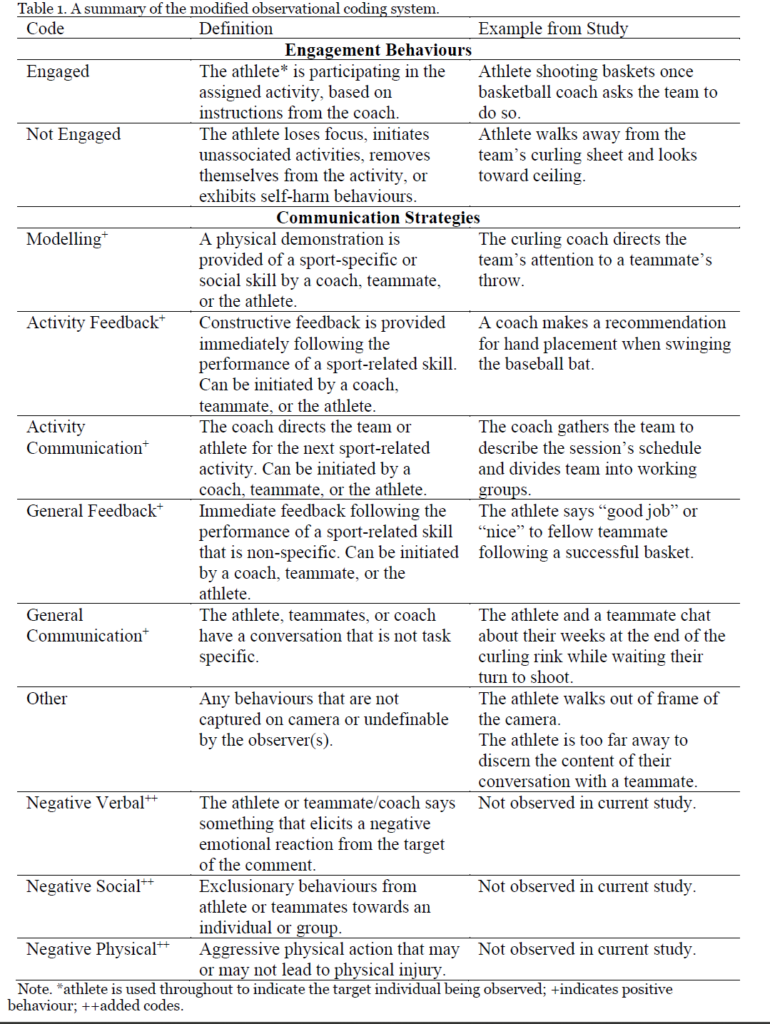
Based on the existing coach athlete observation coding system, it has been modified to include 11 specific behavior codes in two categories: participation and communication strategy (Table 1). The category of participation is defined by the athlete's attention and physical involvement in the activity, while the category of communication strategy is defined by the verbal and nonverbal communication between the athlete, teammates, and coach.
Qualitative interviews
The study conducted individual qualitative interviews and group interviews with participants. The interview covers participants' social experiences in leisure sports, their transition to adult sports, and the people who influence their sports experience, such as parents, coaches, and peers. During the interview, the researcher conducted in-depth questioning based on the participants' answers to obtain richer information.
Social Reality in Sports Stadiums
(1) Behavioral observation results
The results of behavioral observation analysis showed that in terms of participation, 56.9% of participants maintained focus during the tasks assigned by the coach. The participation rate of participants is mainly influenced by behaviors initiated by themselves (84.1%), coaches (8.7%), and teammates (7.3%). Athletes devote 56.9% of their time to tasks assigned by coaches. However, what drives them to invest is mainly their own behavior (84.1%), rather than the interaction with the coach (8.7%) or teammates (7.3%). In terms of communication strategies, communication behaviors are mainly initiated by coaches (60.7%), followed by participants themselves (24.6%) and teammates (14.8%). The most common types of communication are activity communication (38.5%, such as giving instructions) and general communication (34.8%, such as chatting), followed by overall feedback (10.3%), activity feedback (10.1%), and demonstration (6.3%).
This result may indicate that in the training environment, social interaction is mainly driven by the coach and is dominated by task instructions and general socialization. The interaction frequency between athletes and teammates is low and the depth is limited.
Taking curling and basketball as examples, Adam, a participant in curling, was mainly influenced by the coach's activity feedback and general communication during the observation period, and exhibited more focused behavior. And Chase, a participant in basketball, is more influenced by general communication initiated by himself, maintaining focus while interacting less with teammates.
(2) Qualitative interview results
The influence of parents
The interview results show that the parents arepersons with disabilitiesPlayed an important role in sports participation. They not only enroll their children in sports programs, but also frequently accompany them to training and competitions, providing necessary support and encouragement. For example, Chase's mother not only enrolled him in basketball programs, but also provided continuous support and guidance during the training process.
The Challenge of Peer Interaction
Despite peer interactionpersons with disabilitiesThe sports experience has a significant impact, but interview results show that participants face certain difficulties in describing the influence of peers on their sports experience. Some participants expressed a preference for interacting with coaches rather than teammates. For example, Adam stated in an interview that he usually participates in activities alone and interacts less with teammates.
The experience of transitioning to adult sports programs
For participants transitioning from youth to adult sports, this process is full of challenges. Some participants reported encountering numerous difficulties during the transition process, such as a lack of suitable sports programs and a lack of peer support. For example, Hadi mentioned in an interview that he had difficulty finding suitable sports programs after graduating from high school, which led to a disruption in his participation in sports.
Analysis of Social Interaction Sequence
Through lagged sequence analysis, it was found that there is a significant time series relationship between participants' participation and communication strategies. For example, in curling, Adam is more likely to stay focused after receiving feedback on the coach's activities; In basketball, Chase is more likely to maintain focus after initiating general communication. These findings suggest that communication strategies between coaches and participants have a significant impact on their engagement.
Redefine social interaction in sports
The core finding of this study is that there is limited interaction between teammates, which may challenge the traditional assumption that 'sports inevitably bring active peer relationships'. However, this does not mean that companions are not important.
Researchers suggest that for athletes with impaired social or cognitive skills, the passive presence of peers itself may have profound implications. It creates a shared physical and social space. The research results show that although peers play a certain role in the sports participation of people with disabilities, their interactions are often passive. This may be due to barriers in social skills or cognitive abilities that individuals with disabilities face when interacting with peers. Therefore, coaches should pay more attention to promoting active interaction among peers when designing and implementing sports projects, and enhance support and interaction among peers through structured peer relationships and mentorship systems.
Meanwhile, parents and coaches arepersons with disabilitiesPlayed a crucial role in sports participation. They not only provide opportunities for people with disabilities to participate in sports, but also provide continuous support and encouragement during training and competitions. Therefore, future sports programs should pay more attention to cooperation with parents and coaches, working together topersons with disabilitiesCreate a better environment for sports participation.
For people with disabilities transitioning from youth to adult sports, this process is full of challenges. Therefore, sports programs should provide more comprehensive and personalized support to helppersons with disabilitiesSmooth transition to adult sports programs. This includes providing services suitable for adultsSports programs for disabled individuals, strengthening peer support, providing career guidance and psychological support, etc.
Exploring the feasibility of social interaction through video observation
This study investigates throughVideo observation methodDetailed records and analysis were conducted on the interactive behavior of participants during the training course. This method not only provides rich behavioral data, but also offers a new perspective for understanding the social interactions of people with disabilities in sports events.It compensates for the subjective bias that may arise from interviews and directly displays the entire process of the event.At the same time, it can capture micro interactions to reveal brief, subtle, but potentially important sequences of behavior.
Future research can continue to use and optimize this observation method, combined with retrospective video interviews (allowing athletes to recall their feelings while watching videos), to gain a deeper understanding of the motivations behind behavior and further explore the application of observation methods in other contextspersons with disabilitiesThe application in sports projects, forpersons with disabilitiesCreate a better environment for sports participation, promote their social integration and mental health.
References
Orr, K., Tamminen, K. A., Evans, M. B., & Arbour-Nicitopoulos, K. P. (2021). Social influences in recreational sport programs for emerging adults with a disability: A preliminary examination using a mixed methods approach. European Journal of Adapted Physical Activity, 14(1).
Please follow our official account for more details