Welcome Customer !

Membership

Help

Nordas (Beijing) Information Technology Co., Ltd
Custom manufacturer

Main Products:

instrumentb2b>Article

Nordas (Beijing) Information Technology Co., Ltd

  • E-mail

    info-china@noldus.com

  • Phone

    18501168738

  • Address

    507, Building 6, No.33 Guangshun North Street, Chaoyang District, Beijing

Contact Now
Do you feel like drinking milk tea when you're under a lot of pressure? Probiotics may help you get rid of "sweet food dependence"
Date: 2025-11-18Read: 0

In daily life, the persistent presence of psychological and environmental stressors can trigger changes in motivational behavior, emotions, and feelings, which may lead to stress-related illnesses in individuals. Appetite changes are a typical behavioral response to stress, manifested as a decrease or increase in food intake. Increasing sweet food intake or craving for sugar is a common stress related reaction, which is a risk factor leading to eating disorders, metabolic syndrome, diabetes and obesity. However, there is currently no safe and effective method to treat the craving for sugar caused by stress.

Lactobacillus salivarius (LS) and Lactobacillus gasseri (LG), both strains have been reported to be beneficial to humans, including stress response, energy balance, and intestinal comfort. In this study, two strains of bacteria were analyzed for their effects on mice exposed toChronic mildpressure(CMS)The impact of food and sucrose intake before and during the period.

Materials and Methods

During the entire experiment, 2-month-old male mice were used. After adaptation, mice were randomly assigned to either the treatment group or the control group. The treatment group received a probiotic mixture (LS+LG) daily for 27 days, which was administered via gastric lavage using a mouse gavage tube. The control group received gastric lavage with 0.9% NaCl solution. After 10 days, the mice were individually placed in observation cages. The details of the observation cages are described in the following text. After adapting to the observation cage for one week, the mice received the CMS model, which included intermittent sound and light exposure. Automatic monitoring of feeding behavior, manual measurement of water intake, and free access to food, water, and 2% sucrose solution. Mice undergo several behavioral tests at different times to analyze motor, anxiety, and depression like behaviors, including open field, elevated cross maze, O-maze, tail suspension test, forced swimming test, etc., and use EV and other software to automatically measure parameters such as movement distance and time spent (experimental design shown in Figure 1).

Observation cage and feeding behavior analysis

Observation cage through NodasRodent home behavior observation box (PhenoTyper)Combined with food and beverage intake monitors and automatic door controllers, it is used to monitor food intake, water and sucrose intake, physical activity, and similar anxiety behaviors. PhenoTyper is a configurable instrument observation system, which includes an infrared sensitive camera, 3 sets of infrared LED lights, and aAnimal Movement Trajectory Tracking System (EthoVision XT)In this experiment, PhenoTyper also added a gray shelter to the controlled audio stimulation system.

Figure 1. Experimental design. Abbreviation: D, experimental day; FST, Forced swimming experiment; TST, Tail suspension test

result

food intake

Compared to the baseline levels of the control group or probiotic group, exposure to CMS did not significantly alter total food intake and eating patterns. Compared with the control group, mice treated with probiotics showed a slight decrease in daily total food intake before and during CMS, but this difference did not reach a significant level (Figure 2a). Whether before or during CMS, the eating pattern was significantly affected by treatment, with an increase in food intake but a decrease in frequency of eating in the lactobacillus treated group (Figure 2b, c).

Figure 2. Effects of LS+LG on food intake and feeding patterns in mice before and during CMS. Daily food intake (a), food intake (b), and frequency of eating (c)

Sucrose intake

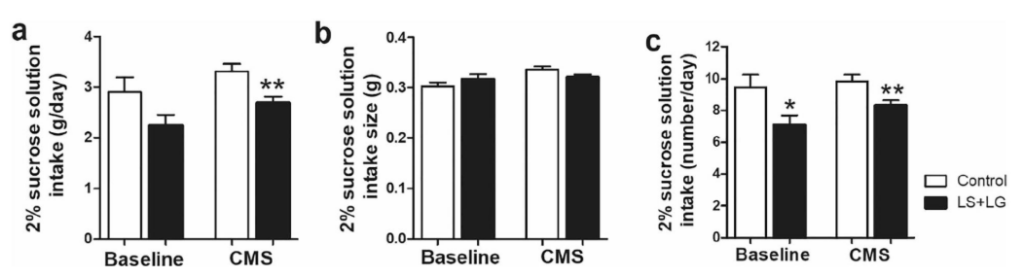
After exposure to CMS, the total daily intake of sucrose solution in both groups of mice showed an increasing trend, but did not reach a significant level. However, a significant increase in sucrose intake during CMS was observed in the control group, while it was not observed in mice treated with probiotics. In both the control group and the LS+LG group, there was a non significant increase in sucrose intake during the CMS period.

It is worth noting that in the probiotic treatment group, the total daily intake of sucrose was significantly lower than that in the control group. During the CMS period (Figure 3a), this strong trend was also observed in the baseline period. The decrease in total sucrose consumption in the probiotic group was mainly due to the significant reduction in sucrose intake observed before and after stress exposure (Figure 3c). Probiotic treatment had no significant effect on sucrose intake, although some trends were observed before and after CMS (Figure 3b).

Figure 3. The effect of LS+LG on the intake of 2% sucrose and its pattern in mice before and during CMS. Daily sucrose intake (a), size of each intake (b), and frequency of intake (c)

The relationship between water intake and food and sucrose intake

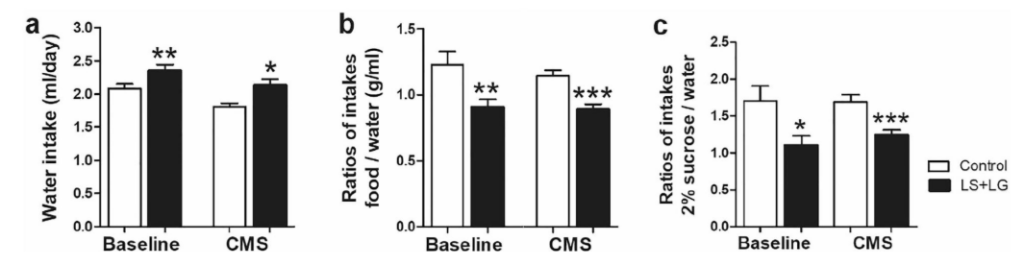
In the control group, there was a slight decrease in water intake during exposure to CMS, but there was no significant change in the probiotic group. However, compared with the control group, mice treated with probiotics showed an increase in water intake before and after CMS (Figure 4a).

In the probiotic treatment group of mice, the ratio of food and 2% sucrose intake to water intake decreased before and after CMS (Figure 4b, c). There was no difference in these ratios between the baseline period and the CMS period between the two groups.

Figure 4. The effect of LS+LG on the water intake of mice before and during CMS, and its relationship with food and 2% sucrose intake. Daily sucrose intake (a), size of each intake (b), and frequency of intake (c)

Anxiety like behavior

The anxiety like behavior and motor activity of mice were evaluated in open field, elevated O-maze, and phenotype. At D11, the motor activity of both groups of mice decreased compared to D0, but there was no significant difference between the groups before and after treatment (Figure 5a). Due to the anxiety like behavior manifested as a reduction in the duration of stay at the center of the field in the open field test, the time ratio between the center and the periphery was compared. It was found that there was no significant difference in the ratio between the groups at D0 or D11. However, at D11, a decrease in the ratio was observed in the control group, but not in the probiotic treatment group (Figure 5b).

Figure 5. Open field test of mice before (D0) and after 10 days (D11) in LS+LG or 0.9% NaCl solution as a control. Total walking distance (a) and center to periphery time ratio (b)

On day D20, 2 days after the start of the CMS protocol, an O-maze experiment was conducted to evaluate the anxiety of rodents caused by their natural fear of height and open space. There was no significant difference observed in exercise activity and time spent in the open or closed arms of the O-maze between the probiotic treatment group and the control group (Figure 6).

During the CMS period, there was no significant difference in the total movement distance of mice in each group observed in the cage. The increase in time spent in the shelter can be considered as an increase in stress-induced anxiety, and there is no significant difference.

Figure 6. O-maze test during CMS in mice receiving LS+LG or 0.9% NaCl solution as control. The distance traveled in the open arm (a) and closed arm (b) of the O-maze, as well as the time spent in the open arm (c) and closed arm (d)

depression-like behavior

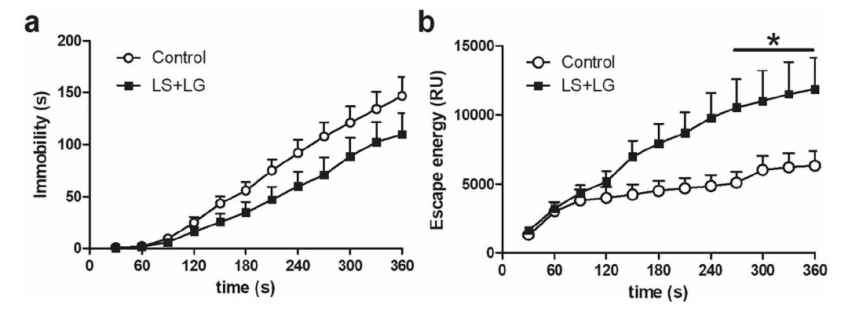
During CMS, depressive like behavior was evaluated through tail suspension test (TST) and forced swimming test (FST). Compared with the control group, the mouse group receiving the lactobacillus mixture showed a reduced tendency towards inactivity in TST, with a total inactivity time reduced by 25%, but this difference did not reach a significant level (Figure 7a). However, the LS+LG group showed a significant increase in escape energy (Figure 7b).

Figure 7. Tail suspension test during CMS in mice receiving LS+LG or 0.9% NaCl solution as control. The immobility time (a) and escape energy (b) in TST

summary

In summary, this study indicates that the mixture of two strains LS and LG can significantly reduce sugar consumption in mice, particularly during the CMS period. This discovery has practical significance as it, along with other beneficial effects including increased water intake, reduced meal frequency, and mild antidepressant effects, suggests that the current LS and LG strain mixture appears to be a potential candidate for human stress management, particularly for combating stress-induced sugar cravings.

References

Nicol, Marion, et al. “Lactobacillus salivarius and Lactobacillus gasseri supplementation reduces stress‐induced sugar craving in mice.” European Eating Disorders Review 32.6 (2024): 1041-1054.

For more details, please follow our official account