-
E-mail
sales@nanjingkrs.com
-
Phone
15715193902
-
Address
A1015, No. 108 Keyuan Road, Jiangning District, Nanjing City
Nanjing Korisheng Equipment Technology Co., Ltd
Principle and core structure analysis of short-range distillation equipment
Date: 2025-09-23Read: 2
Short distance distillation (also known as molecular distillation) is an efficient liquid-liquid separation technology that operates under high vacuum.It is different from traditional distillation that relies on the principle of boiling point difference separation, but uses the difference in the average free path of molecular motion of different substances to achieve separation, which is particularly suitable for processing high boiling point, thermosensitive, and easily oxidizable materials.
1、 Core working principle: molecular free path and high vacuum
The working principle of short-range distillation is based on a core physical concept - the average free path of molecules, which is the average distance traveled by a gas molecule between two adjacent collisions.
The separation process mainly includes four key steps:
1. Diffusion of molecules from the main liquid phase to the evaporation surface: The diffusion rate in the liquid phase is the main factor controlling the distillation rate of molecules, so reducing the thickness of the liquid layer and strengthening the flow of the liquid layer are crucial.
2. Free evaporation of molecules on the surface of the liquid layer: The evaporation rate increases with temperature, but it is necessary to choose an economically reasonable distillation temperature based on the thermal stability of the material.
3. Molecules fly from the evaporation surface to the condensation surface: In a high vacuum environment, the distance between the evaporation surface and the condensation surface is designed to be less than or equal to the average free path of the separated material molecules. This allows vapor molecules vaporized from the evaporation surface to reach the condensation surface directly without colliding with other molecules.
4. Molecules condense on the condensation surface: As long as there is sufficient temperature difference between the hot and cold surfaces (usually 70-100 ℃), and the condensation surface is reasonably smooth, the condensation process can be completed instantly.
Due to the difference in average free path between light and heavy molecules, light molecules can reach the condensation surface and be captured, while heavy molecules cannot reach due to their shorter free path, thus achieving precise separation of substances. This process is irreversible, without the bubbling, boiling, and gas-liquid equilibrium phenomena of traditional distillation.
2、 Main structural components
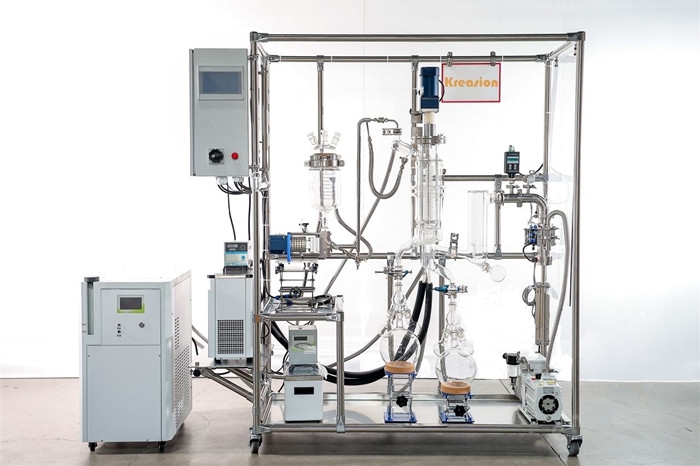
A complete short-range distillation equipment is a complex system, which mainly consists of the following parts:
1. Short range distiller: This is the core of the entire equipment. It is a vertical cylindrical body with a heating jacket, containing all key moving components inside. The material is added from the top and evenly distributed on the heating surface through the material liquid distributor on the rotor. It is then scraped into a very thin, turbulent liquid film by the scraper and pushed downwards in a spiral shape. The built-in condenser is located at the center of the evaporator and is used to directly condense and capture light molecules.
2. Heating system: responsible for providing energy for evaporation, usually using electric heaters or hot oil circulation systems to ensure uniform heating.
3. Vacuum extraction system: used to create and maintain a high vacuum environment required for distillation, which is a prerequisite for achieving molecular free path separation.
4. Cooling system: used to condense steam and convert it into liquid.
5. Collection system: used to collect separated light and heavy components.
6. Degassing system, feeding system, and control system: These auxiliary systems ensure the continuity, stability, and automation control of the process.
3、 Types of evaporators
There are three main types of molecular evaporators, which differ in their film-forming methods and efficiency:
1. Falling film type: relying on gravity to make the material form a film and flow down. The structure is simple, but the formed liquid film is thick and inefficient, which is rarely used at present.
2. Scraping type: The material is scraped into a thin and turbulent liquid film by a rotating scraper. It has high separation efficiency and relatively simple structure, and is currently the most mainstream type in laboratory and industrial production.
3. Centrifugal: The material is sent to the center of a high-speed rotating turntable and forms a film by centrifugal force. It can form an extremely thin and uniform liquid film, with good evaporation and separation efficiency, shorter material heating time, but its structure is complex, manufacturing and operation are difficult, and the cost is also the highest.
4、 Technical features and advantages
Short range distillation technology has the following significant advantages due to its unique principle and structure:
1. Low operating temperature: far below the atmospheric boiling point of the material, greatly reducing the risk of thermal decomposition of thermosensitive substances.
2. Short heating time: The material flows rapidly through the heating surface in the form of an extremely thin liquid film, with a heating time of only a few seconds to tens of seconds.
3. High separation efficiency: It can separate substances that are difficult to separate by conventional distillation, and the product purity is high.
4. Non polluting physical process: The entire process is physically separated, non-toxic and harmless, which can effectively protect the original quality of the product.
Short range distillation equipment has achieved mild and efficient separation of materials through its special high vacuum environment and precise structural design, and has become a crucial tool in fields such as fine chemicals, petroleum, food, and medicine.