-
E-mail
18101268918@126.com
-
Phone
18101269698
-
Address
B910, Building 8, No. 97 Changping Road, Shahe Town, Changping District, Beijing (Changping Demonstration Park)
Kechuang Xingguang (Beijing) Technology Co., Ltd
Understanding Sodium Ion Analyzer in One Article: Science Popularization from Principle to Daily Application
Date: 2025-12-13Read: 4
In many fields such as environmental monitoring, industrial production, and scientific research experiments, sodium ion concentration is a key indicator, and sodium ion analyzers, as professional equipment for accurately measuring this indicator, are playing a role. Now, let's delve into its mysteries.
1、 Working principle: Accurate detection based on electrochemical or optical properties
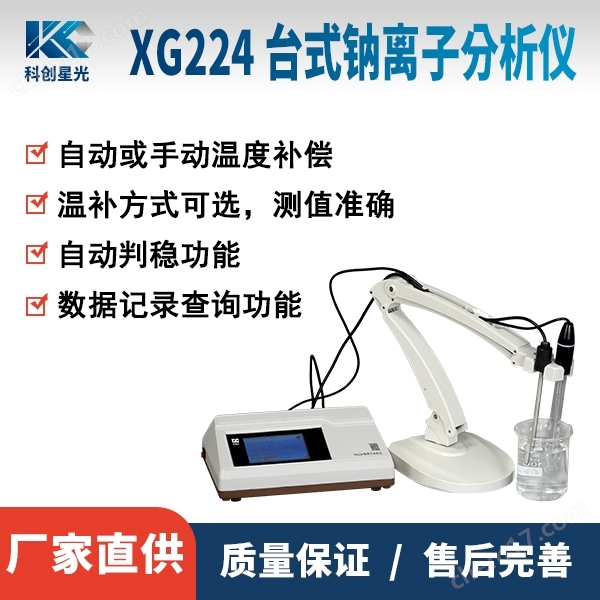
1. Electrode method (potential analysis): This is a common method.Sodium ion analyzerInternally, there is an indicator electrode that selectively responds to sodium ions, usually a glass electrode, with a special membrane material that can undergo specific exchange reactions with sodium ions in solution, generating a potential difference. When the indicator electrode and the reference electrode (providing a stable potential reference) are immersed together in the sample to be tested, the electromotive force between the two electrodes changes with the concentration of sodium ions. According to the Nernst equation, by measuring the potential value, the activity of sodium ions can be converted, and then combined with known solution conditions, the concentration value can be obtained. The entire process is like a microscopic "charge game", accurately locking in the trace of sodium ions.
2. Flame photometry: Utilizing the characteristic of sodium element being excited by heat in a flame, it emits light of a specific wavelength (around 589nm, yellow light). The instrument first atomizes the sample and introduces it into a high-temperature flame, causing sodium atoms to transition to a high-energy state, and then releases characteristic light when returning to the ground state. The detector captures the intensity of this light and compares it with a pre drawn standard curve. Because the intensity of light is directly proportional to the concentration of sodium ions, it can quickly determine the sodium content in the sample. This method is intuitive and highly sensitive, especially suitable for detecting low concentrations of sodium ions.
3. Ion chromatography: Using the principle of high-performance liquid chromatography, a specially designed ion exchange resin is used as the stationary phase to fill the chromatographic column. When the sample flows through the chromatographic column with the mobile phase, different ions are separated due to differences in affinity with the resin. The sodium ions flowing out are further suppressed by a suppressor to reduce background conductivity, and then the signal is measured by a conductivity detector. Based on retention time and peak area quantification, multiple cations, including sodium ions, can be simultaneously measured at once, which has significant advantages in complex water quality analysis and other fields.
2、 Core Structure: Precise Component Collaboration, Creating High Performance
1. Sample injection system: responsible for precise collection and delivery of samples. There is a manual syringe for injection, suitable for small and intermittent testing; The automatic sampler is programmable and can continuously process large quantities of samples. It is equipped with a cleaning device to avoid cross contamination and ensure the purity and accuracy of each injected sample.
2. Detection module: If using electrode method, the key lies in the electrode. The indicator electrode needs to be activated and calibrated regularly to ensure sensitivity to sodium ions; The reference electrode electrolyte should be replenished in a timely manner to maintain a stable potential. In a flame photometer, the design of the combustion head affects the stability of the flame, while the fine processing of the nozzle ensures uniform atomization of the sample; Optical detectors such as photomultiplier tubes determine the accuracy of light signal capture, while cooling systems prevent overheating noise interference. The core of an ion chromatograph is the efficiency of the chromatographic column. A packing material with uniform particle size and appropriate pore size facilitates ion separation, and a suppressor effectively eliminates the interference of ions, thereby improving detection accuracy.
3. Data processing and display unit: Modern sodium ion analyzers are often equipped with intelligent microcomputers, which receive raw signals from detection components. After a series of complex operations such as amplification, filtering, and analog-to-digital conversion, they are instantly converted into intuitive sodium ion concentration readings and displayed on the screen. It can also store historical data, generate trend charts, and facilitate users to trace and query. Some models even support networking, remote monitoring of device status, and sharing of data resources.
3、 Daily application scenarios: multi-point flowering, empowering various industries
1. Water quality monitoring: Water plants rely on it to control the softening effect of water sources in real time, preventing excessive hardness; Wastewater treatment plants use it to track residual sodium ions in desalination processes and optimize the quality of recycled water; In the study of river and lake ecology, monitoring the process of eutrophication in water bodies, warning of the risk of blue-green algae outbreaks, and safeguarding water resource security.
2. Food and beverage industry: The production process strictly tests the sodium content in raw materials (such as salt and dairy products) and finished products (sports drinks, baby food) to meet health standards. This not only meets the needs of flavor blending, but also avoids the harm of excessive intake, helping enterprises create high-quality products.
3. In the field of biomedicine: precise regulation of sodium ion levels during the preparation of cell culture media and physiological saline injections, simulating the human body environment, supporting drug research and development, and vaccine production; Clinical laboratories use this to diagnose hypertension, kidney disease, etc., evaluate patients' electrolyte balance, and provide support for precision medicine.
With the continuous advancement of technology, sodium ion analyzers are moving towards miniaturization, portability, and intelligence. In the future, they will surely expand more cutting-edge application scenarios and continue to contribute to the improvement of human quality of life.