-
E-mail
lina-he@zolix.com.cn
-
Phone
13810146393
-
Address
Feihong Road, Nanhu Avenue, Liangxi District, Wuxi City, Jiangsu Province
Jiangsu Shuangli Hepu Technology Co., Ltd
How can hyperspectral imaging equipment safeguard every grain of food as the 'technological sentinel' of food security?
Date: 2025-12-24Read: 1
The Importance of Grain Quality Inspection
Hyperspectral imaging technology (HSI), as a cutting-edge detection method that integrates spectral analysis and spatial imaging, has built a comprehensive and high-precision analysis system in the field of grain quality detection, demonstrating irreplaceable application value. This technology achieves integrated detection of grain appearance and internal components by synchronously collecting spectral features and spatial distribution information of samples. Spatial imaging data can accurately identify appearance quality indicators such as mold, imperfect grains, and variety purity, while spectral features can deeply analyze the content distribution and physical structural characteristics of core chemical components such as moisture, protein, and starch, achieving a comprehensive quality evaluation that balances both surface and core.

Compared with traditional detection methods that rely on chemical reagents, have long detection cycles, and have destructive limitations, HSI technology has the core advantages of "fast, objective, non-contact, and non-destructive" to achieve efficient screening of large quantities of samples. It not only avoids the risk of secondary pollution caused by chemical testing, but also greatly improves detection efficiency and result accuracy, fully meeting the development needs of modern food safety control and quality refinement management. With the continuous advancement of computer vision, machine learning, and deep learning technologies, the application of HSI in grain quality inspection will become more intelligent, providing precision for agricultural production, food processing, and grain storageAccurate and efficient quality control measures can help promote the development of China's grain industry towards high quality and intelligence.
2. Application of Hyperspectral Imaging Technology in Grain Physical and Chemical Quality Inspection
An et al. (2024) developed a green and non-destructive method for evaluating the vitality of single corn seeds by combining hyperspectral imaging technology with data fusion strategies.
The study used catalase (CAT) activity and malondialdehyde (MDA) content as key biochemical indicators, and constructed seed samples with different aging gradients based on artificial aging experiments. Partial least squares regression (PLSR) model was used to predict CAT and MDA content, and the model performance was optimized by combining low and medium layer data fusion strategies (prediction set RPDs were 2.11 and 2.93, respectively). Further proposed a dual threshold discrimination strategy, which achieved efficient classification of seed vitality with an accuracy of 92.9% by setting a joint threshold of CAT activity (threshold 317 μ mol · min ⁻¹ · g ⁻¹) and MDA content (threshold 22 nmol · g ⁻¹).
This method provides an interpretable quantitative basis for seed vitality assessment through the correlation between biochemical indicators and spectral characteristics. Compared with traditional germination tests and single spectral models, it is efficient, environmentally friendly, and high-precision, providing new ideas for agricultural seed quality management. The research process is shown in Figure 7.
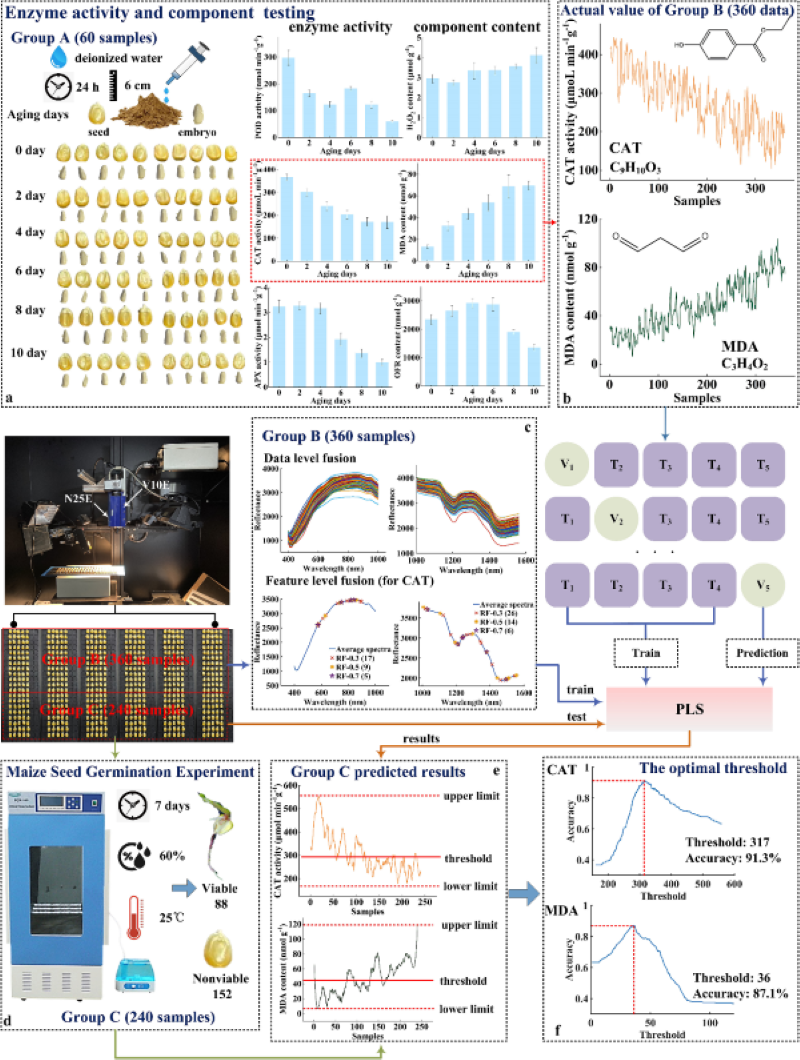
Figure 8 Research flowchart
3. Recommendation of Shuangli Hepu Hyperspectral Related Products (Suitable for Grain Quality Testing Scenarios)
As a national level high-tech enterprise, Jiangsu Shuangli Hepu focuses on the research and development of hyperspectral imaging technology. Its products can cover the entire process of grain "field monitoring storage detection variety screening". The core recommendations are as follows:
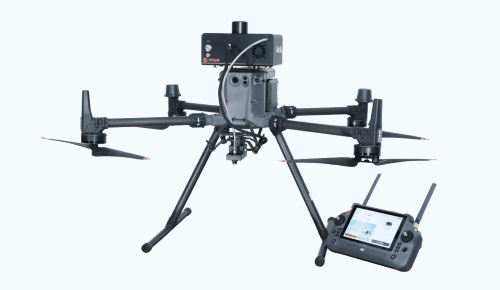
Unmanned Aerial Laser Radar Hyperspectral Imaging System (Model: GaiaSky mini VLidar)
Core parameters

indicator |
Parameter Details |
Hyperspectral module |
Spectral range of 400-1000nm, spectral resolution of 3.5nm, spectral channel count of 128/224 (standard), spatial resolution of 0.014-0.023m (100m height) |
Lidar module |
Three echo design, laser point frequency * high 1.92 million points/second, can obtain three-dimensional point cloud data of ground objects |
Accessibility |
16/25mm lens optional, 2600w pixel RGB camera, GPS attitude accuracy 0.008 ° (1 σ), real-time data calibration and inversion output |
environmental adaptability |
Temperature measurement range: -20 ℃ -+150 ℃,+100 ℃ -550 ℃, laser radar active detection (not affected by light, can operate 24/7) |
Adapt to grain quality testing scenarios
Large scale field monitoring:Suitable for early warning of growth period quality of field crops such as corn and rice (such as water distribution and chlorophyll content), combined with three-dimensional point cloud of LiDAR, it can correlate crop plant type and grain quality (such as spike height and starch content);
Pre storage field screening:Quickly scan farmland, preliminarily determine grain moisture and fatty acid content through hyperspectral data, screen high-quality areas for priority purchase, and reduce the risk of storage mold
Unmanned Aerial Sunlight Induced Chlorophyll Fluorescence System (Model: GaiaSky SP SIF)
indicator |
Parameter Details |
Spectral module |
Spectral range 650-800nm (chlorophyll fluorescence key band), spectral sampling interval 0.17nm, signal-to-noise ratio (SNR) 1000:1, 18 bit A/D conversion |
Calibration function |
Double cosine calibrator (real-time acquisition of sunlight and target brightness), pre factory absolute radiation calibration (unit: μ W · cm ⁻² · sr ⁻¹ · nm ⁻¹) |
Accessibility |
35mm/50mm fixed focus lens (bare fiber mode optional), GPS positioning (recording latitude and longitude of the acquisition area), Raspberry Pi operating system, SD card storage |
detection efficiency |
Multiple spectra can be collected in one flight, supporting both drone and ground dual-use |
Adapt to grain quality testing scenarios
Health monitoring during grain growth period:Reflecting crop photosynthetic efficiency through chlorophyll fluorescence (690nm/760nm peak), warning of stress such as drought, pests and diseases (stress can lead to an increase in fatty acids and a decrease in protein), and ensuring the final grain quality;
Variety screening assistance:Compare the fluorescence characteristics of different grain varieties, correlate the later protein content detection results, and quickly screen high-quality varieties
4. Summary
Hyperspectral technology has moved from "laboratory research" to "application in the grain industry", enabling comprehensive non-destructive testing of moisture, nutrient composition, and seed vitality; The unmanned aerial hyperspectral system (including LiDAR and fluorescence detection) of Shuangli Hepu provides hardware support for the "large-scale and field oriented" application of this technology, especially suitable for the practical needs of grain "field monitoring variety screening storage warning", and helps China's grain industry upgrade to "high-precision and intelligent".