During the use of your instrument
You will definitely encounter many doubts about usage and maintenance
We are here to assist you
Assist in using your instrument
All in FAQs
How to read the glass transition temperature when measuring glass transition with TMA?
TMAIt is a measurement method that can quantitatively detect the expansion and contraction behavior of substances, and can be used to measure the coefficient of thermal expansion (CTE), softening temperature, and glass transition temperature. Regarding TMA measurement and analysis of glass transition methods, ISO, ASTM, andJISVarious testing standards have been established. When applicable, it is recommended to follow the corresponding standard specifications for analysis.Generally speaking, the expansion rate (volume) of polymer materials will change near the glass transition temperature. withGlass transitionThe expansion rate of the high elastic state region after transformation will increase compared to the expansion rate of the glassy state region before transformation. TMA utilizes this property to measure the glass transition temperature of polymers. As a reference, Figure 1 shows the methods used in various experimental standards 1-6). In all test standards, the point where the tangent line extending from the straight line below the glass transition temperature to the high temperature side intersects with the tangent line extending from the straight line above the glass transition temperature to the low temperature side is defined as the glass transition temperature Tg.
Figure 1 Method for reading glass transition temperature1-6)
Vitrification is a relaxation phenomenon that does not occur instantaneously at a specific temperature. There must be a certain temperature range (transition zone) between the state before vitrification (glassy state) and the state after vitrification (highly elastic state). In general, Tg is represented by a temperature, but this is only based on the definition of Tg that occurs in the transition region and is used as a representative temperature for identification. Figure 2 shows the actual glass transition starting temperature Tig and ending temperature Teg in the glass transition results measured by TMA. The actual starting and ending temperatures of vitrification are the temperatures at which the TMA curve begins to deviate from the tangent in the transition region.image2Actual starting temperature for vitrificationTigAnd termination temperatureTegWhen using TMA for glass transition measurement, the influence of thermal history or residual strain may be observed. Taking the measurement results of printed circuit board (glass fiber reinforced epoxy resin) as an example, as shown in Figure 3. This is the result of the second heating of the same sample after the first heating. In the first heating result, vitrification occurred around 130-150 ℃, and the expansion rate changed before and after the transformation, but shrinkage behavior was observed in the transformation zone. This shrinkage is caused by residual strain during material forming, and the molecular chains of residual strain undergo shrinkage as they attempt to transform into a more stable form in the transition region. Due to the temperature being raised above Tg during the first heating, residual stress was released (eliminated). Therefore, no shrinkage phenomenon was observed during the second heating, and the expansion rate showed discontinuous changes with vitrification as the boundary. As in this example, if the influence of residual strain is observed during the heating process, the temperature can be raised above Tg to eliminate residual strain during the first heating, followed by a second heating. Therefore, the method of reading Tg using the measurement results of the second heating is widely used.
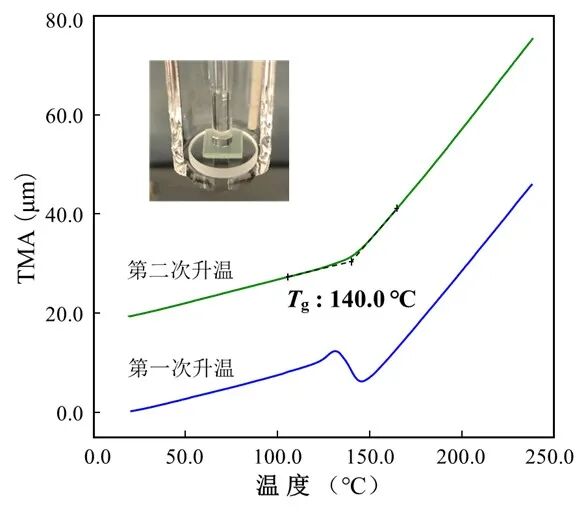
Figure 3 TMA measurement results of printed circuit board
1) ISO 11359-2, Plastics - Thermomechanical Analysis (TMA) Part 2: Determination of Coefficient of Linear Thermal Expansion and Glass Transition Temperature,International Organization for Standardization(2021)2) ASTM E1545-22, Standard Test Method for Assignment of the Glass Transition Temperature by Thermomechanical Analysis,ASTM International(2022)3) ASTM E1824-24, Standard Test Method for Assignment of a Glass Transition Temperature Using Thermomechanical Analysis: Tension Method, ASTM International(2024)4) JIS C 6481, Test methods of copper-clad laminates for printed wiring boards, Japanese Standards Association(1996)5) IPC-TM-650 2.4.24.3, Glass Transition Temperature of Organic Films - TMA Method, Association Connecting Electronics Industries(1995)IPC-TM-650 2.4.24.5, Glass Transition Temperature and Thermal Expansion of Materials Used In High Density Interconnection (HDI) and Microvias -TMA Method, Association Connecting Electronics Industries(1998)

