-
E-mail
liufeng@hignal.com
-
Phone
18066728578
-
Address
No. 211 Fute North Road, China (Shanghai) Pilot Free Trade Zone
Higona (Shanghai) Technology Co., Ltd
Safety Guardian in RTO Waste Gas Treatment: FTA Combustible Gas Analyzer
Date: 2025-11-28Read: 1
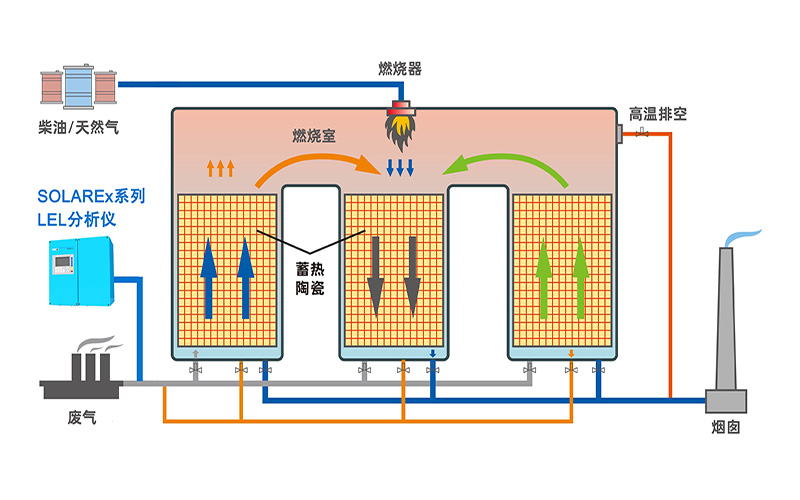
In the field of industrial waste gas treatment, thermal storage incinerators (RTOs) have become one of the mainstream technologies for treating volatile organic compounds (VOCs) due to their stable performance. RTO is capable of treating almost all exhaust gases containing organic compounds, especially adept at dealing with complex working conditions such as high air volume, low concentration, and frequent fluctuations in concentration and composition. Its purification efficiency of over 95% has made it widely used in industries such as petrochemicals, coal chemicals, pharmaceuticals, and coatings.

However, the core principle of RTO is to decompose organic matter through high-temperature thermodynamic combustion, which itself carries safety risks. If the concentration of combustible gases in the exhaust gas entering RTO is too high, exceeding the lower explosive limit, it is highly likely to cause serious safety accidents such as flash explosions. Therefore, real-time and accurate flammability monitoring of the exhaust gas before entering RTO has become the lifeline to ensure the safe and stable operation of the entire system. At this critical stage, the Flame Temperature Analyzer (FTA) stands out with its unique advantages and becomes an important "sentinel" to safeguard RTO safety.
Why do traditional instruments face challenges in RTO injection monitoring?
The components of exhaust gas treated by RTO are often complex and varied, and may contain multiple organic compounds (such as alkanes, alkenes, aromatic hydrocarbons, ketones, alcohols) and even some inorganic compounds (such as hydrogen and carbon monoxide) simultaneously. This cocktail style gas sample places high demands on monitoring instruments:
Catalytic principle alarm (CAT): susceptible to poisoning by substances such as sulfur, phosphorus, halogens, etc., leading to catalyst deactivation, inaccurate measurement, and difficult calibration in complex component backgrounds.
Infrared analyzer (IR): It has weak detection ability for molecules without infrared activity or symmetrical structure (such as hydrogen and nitrogen), and the measurement results are greatly affected by background gas interference.
Flame ionization detector (FID): Although sensitive to the vast majority of organic compounds, it has no response or extremely weak response to inorganic combustibles (such as H ₂, CO), and cannot fully reflect the overall flammability risk.
Faced with these challenges, FTA analyzer provides a solution that is closer to real combustion conditions.

FTA analyzer: a tool tailored for RTO safety monitoring
The core principle of a flame temperature analyzer (FTA) is to directly measure the temperature rise generated by the combustion of a sample gas under specific conditions. This feature makes it demonstrate in RTO safety monitoringVery goodAdvantages:
1. Wide detection range: FTA can respond to almost all combustible gases, whether they are organic compounds such as methane, benzene derivatives, alcohols and ketones, or inorganic substances such as hydrogen, carbon monoxide, hydrogen sulfide, etc. This ensures that the overall combustibility of the exhaust gas can be accurately captured regardless of changes in its composition.
2. Second level response speed: The measurement process of FTA is direct and fast, with extremely short response time. In the race against time safety control, this can buy valuable operational time for the process system, enabling timely measures such as dilution, cut-off, or bypass to nip risks in the bud.
3. Direct measurement, reflecting the actual working conditions: FTA directly measures the heat released by sample combustion (manifested as temperature rise), which is highly consistent with the actual combustion behavior in the RTO furnace. The measurement result of% LEL (lower explosive limit percentage) is closer to the actual combustion risk, providing a reliable basis for safety control.
Reliable guarantee for high demand industries
In industries with high safety production standards such as petroleum, chemical, and pharmaceutical, any minor negligence can have incalculable consequences. The FTA combustible gas analyzer not only provides high-precision concentration data, but also has long-term stability, which can adapt to harsh industrial environments and operate continuously and stably. It's likeTirelessThe security sentinel continuously provides accurate and reliable data for the control system. Once the% LEL concentration approaches the preset alarm value, it will immediately trigger an alarm and link with the executing agency to build a solid security firewall.
Conclusion
The widespread application of RTO technology has made important contributions to the defense of the blue sky, but its operational safety cannot be compromised. Choosing a monitoring instrument that can handle complex components, respond quickly, and truly reflect combustible risks is the core of ensuring the safe and efficient operation of RTO. The flame temperature analyzer (FTA), with its comprehensive detection capability, fast response characteristics, and direct and reliable measurement principle, well meets the stringent requirements of RTO injection safety monitoring and has become an important safety critical equipment in modern industrial waste gas treatment devices.