-
E-mail
hzfsn@foxmail.com
-
Phone
13738015913
-
Address
4th Floor, Building 2, Science and Technology Innovation Industrial Park, No. 16 Changtai Street, Changkou Town, Fuyang District, Hangzhou City, Zhejiang Province
Hangzhou Fansuoneng Ultrasonic Technology Co., Ltd
Ultrasonic spraying flux
Date: 2025-12-12Read: 49
1. Introduction
Ultrasonic spraying flux is a processing technology that uses high-frequency ultrasonic vibration to break liquid flux into extremely fine and uniform mist droplets, and then sprays them onto PCB boards (printed circuit boards) through a current carrying gas. At present, commonly used fluxes for spraying operations through ultrasonic equipment include non cleaning liquid fluxes, water-soluble liquid fluxes, and low solid content rosin type liquid fluxes.
2、 Characteristics
The main methods of coating flux on PCB board are foaming method and spray method (pressure spray). Compared with these two methods, ultrasonic spraying flux has the following advantages and outstanding performance:
1. Ultra high precision and controllability: The equipment is equipped with FUNSONIC ultrasonic spraying automation control system, and the display screen desktop operating system is convenient, fast, and easy to use. It integrates control of ultrasonic atomization, ultrasonic dispersion, injection pump, and guide gas, including the function of one click generation of template trajectory. You can program the painting path like a printer to accurately spray specific areas that need to be soldered, avoiding areas that do not want to be contaminated with flux.
2. Uniformity: There are dozens of FUNSONIC ultrasonic nozzles available, with different frequencies ranging from 20 to 180kHz and nozzle options, to meet the requirements of various working conditions and coatings. Therefore, the formed flux film will be thin and uniform, avoiding excessive or insufficient local deposition and ensuring the quality of subsequent soldering.
3. Cost saving: Atomized deposition flux process, no scattering or splashing, material utilization rate of 99%.
4. Non destructive spraying: The gentle low-speed spray will not blow or overturn the tiny packaging components on the PCB board.
5. Environmental Protection and Cleanliness: The excessive spraying amount is minimal, reducing pollution on the inner walls of the equipment and the surrounding environment, and making maintenance simpler.
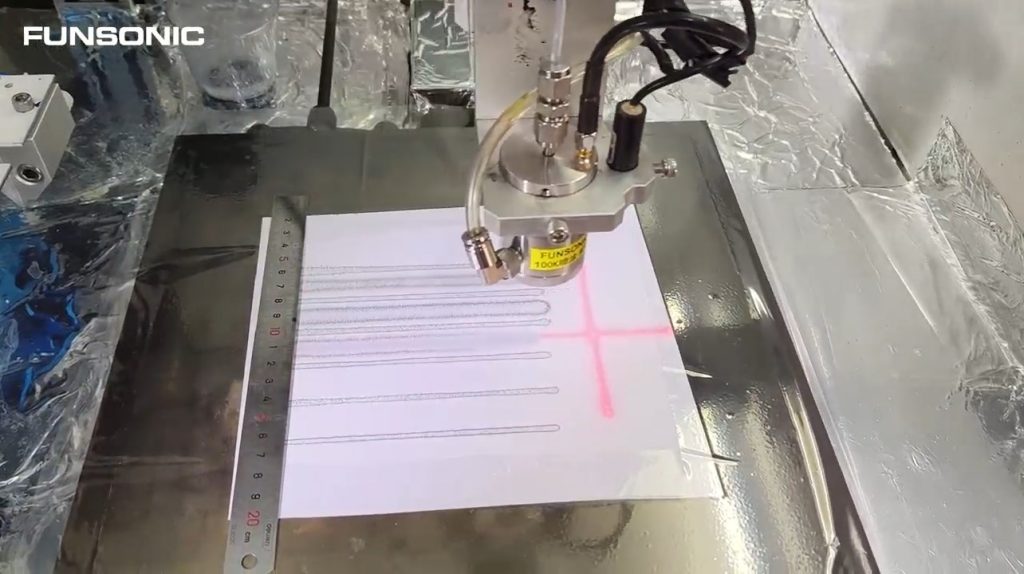
Application scenarios of ultrasonic spray soldering flux:
selective solderingThis is a classic application of ultrasonic spraying. On a production line, controllable spraying speed will not damage or interfere with components, while also achieving a high surface filling rate in this application.
High performance wave soldering: For PCB with high component density, shielding cover or large components, traditional foaming and spray cannot evenly cover all pads. With its excellent through-hole penetration, ultrasonic spraying technology can achieve larger top filling.
flip-chip bondingThe solder pad is at the bottom and requires precise flux application. Ultrasonic spraying can spray a very thin and uniform flux layer to prevent excessive flux residue and avoid poor bottom filling. Strictly controlling the thickness of the flux can also prevent chip floating soldering, avoid downtime, and prevent poor chip connections.
Ultrasonic spraying flux represents a more precise, economical, and environmentally friendly coating technology. With the development of electronic products towards miniaturization and high density, as well as the increasing demand for welding quality and cost control, ultrasonic spraying technology is becoming a standard process in electronic manufacturing.