-
E-mail
sales@morotchem.com
-
Phone
19884159221
-
Address
Ivy Health Industry Park, Yuhang District, Hangzhou City, Zhejiang Province
Hangzhou Borealis Chemical Technology Co., Ltd
Modular construction of microreactor array for high-throughput amplification and process digital twin of acetophenone alpha bromination
Date: 2025-11-18Read: 3
With the increasing popularity of microreactor technology in synthetic organic chemistry, its many advantages are gradually becoming prominent, such as faster mixing speed, more efficient heat transfer, and low liquid holdup for hazardous intermediates, which can provide better yield and selectivity. This makes microreactors exhibit significant advantages in handling highly active intermediates, easily thermally runaway reactions, and high-temperature nanoparticle synthesis. However, despite the significant advantages of continuous flow chemistry over traditional batch reactor processes, most organic chemists still prefer to use traditional laboratory equipment in their daily experiments. Therefore, this study aims to transform the common organic reaction - the alpha bromination of acetophenone - from the traditional batch reactor process to a continuous flow process. This transformation not only helps to expand the knowledge system of continuous flow based organic reactions, but also provides a high-yield or high-purity synthesis method for laboratory and small-scale industrial applications, especially in situations where expensive substrates are used or high product purity and yield are required.


Overview of experimental plan
This study conducted experiments using a commercial microreactor platform and designed two stock solutions containing ketone substrates and bromine reagents. 1,4-dioxane was selected as the solvent to avoid the evaporation of toxic and corrosive bromine vapors. The influence range of three test parameters (temperature, molar ratio of bromine to substrate, and reaction time) on substrate conversion rate was determined through univariate parameter screening experiments. An optimization experiment with 60 data points was designed using the standard D-algorithm. Assuming the cubic response of all parameters, the experiment was automatically prepared and conducted using the FlowScreen instrument of FutureChemistry. All samples were analyzed using GC, and the data was processed and the reaction model was fitted using FlowFit software. To suppress self catalytic behavior, 0.5 equivalents of hydrobromic acid (acetic acid solution) were added to stock solution A, achieving reproducible experimental results. Meanwhile, a quenching method was designed using 2-methoxypropene as a quencher to achieve good reaction time control.
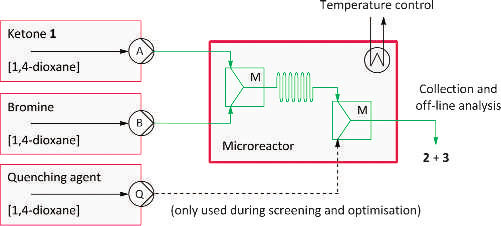
The research focuses on the important role of the alpha bromination reaction of acetophenone in organic chemistry, which can provide a convenient pathway for the synthesis of mono - α - substituted ketones and various heterocyclic compounds. This study successfully transformed the reaction from a known batch process to a continuous flow process, and achieved a yield of 99% through D-optimization and subsequent amplification verification. The specific research content includes:
1) Design the microreactor system, including two reaction solutions of ketone substrate and bromine reagent, and select appropriate solvents;
2) A univariate parameter screening experiment was conducted to determine the parameter ranges for temperature, molar ratio of bromine to substrate, and reaction time;
3) Multivariate analysis and optimization experiments, using D-algorithm to design optimization experiments and determine reaction conditions;
4) Inhibiting self catalytic behavior and designing quenching methods to improve the repeatability and controllability of the reaction;
5) Prepare large-scale synthesis, verify reaction conditions in a large-scale microreactor system, and synthesize the target compound.
1. Determination of reaction conditions
Through D-The experimental design and data analysis were optimized, and the reaction conditions for the alpha bromination of acetophenone were determined to be a temperature of 20 ° C, a molar ratio of bromine to substrate of 1.5:1, and a reaction time of 60 seconds. Under these conditions, the reaction selectivity was goodNo by-products were detected, and the yield of monobrominated products reached 99%, with a space-time yield of 0.26 kg/m ³/s, which is comparable to the 0.24 kg/m ³/s of the intermittent kettle process in the literature. This meets the requirements of high yield and high purity for laboratory and small-scale industrial applications.
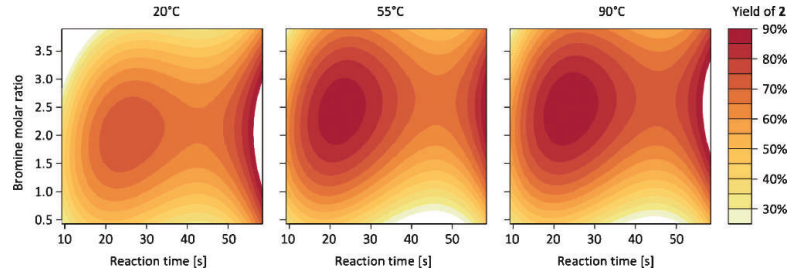
Optimize the experimental reaction model
2. Inhibition of autocatalytic behavior
Research has found that the alpha bromination reaction of acetophenone has self catalytic properties, meaning that the hydrobromic acid generated from the reaction accelerates the reaction process. By adding 0.5 equivalents of hydrobromic acid (acetic acid solution) to reaction solution A, catalytic conditions were introduced from the beginning of the reaction, effectively eliminating self catalytic behavior and significantly improving the reproducibility of experimental results, providing a guarantee for optimizing the smooth progress of the experiment and obtaining accurate results.
3. Effectiveness of quenching method
We designed and validated a quenching method using 2-methoxypropene as a quencher, which can effectively consume excess bromine without affecting the main reaction results. This method meets the requirements of fast quenching reaction rate, no interference with the main reaction, and no impact on analysis, achieving precise control of reaction time. It provides a reliable means for accurately measuring reaction conversion rate and product yield, and helps to further study reaction kinetics and optimize reaction conditions.
4. Feasibility of scale synthesis preparation
The optimized reaction conditions were validated in a large-scale microreactor system, and 1.07g of monobromo product was successfully synthesized with a reaction selectivity exceeding 98%. This proves that the continuous flow process can be smoothly scaled up from small-scale laboratory to preparation scale, achieving effective conversion from optimization to actual production, laying the foundation for industrial applications, and also demonstrating the practical application potential and advantages of microreactor technology in synthetic chemistry.
5. Advantages of continuous flow process
Compared with traditional batch reactor processes, continuous flow microreactor technology exhibits significant advantages in the alpha bromination reaction of acetophenone. Its continuous flow reaction mode not only improves the safety of the reaction, but also makes the treatment of toxic and corrosive bromine safer and more reliable; It has also achieved automation and precise control of the reaction process, reduced human operational errors, and improved the repeatability and stability of experimental results; At the same time, it significantly reduces reaction time, improves reaction efficiency, reduces production costs and resource waste, providing strong support for the improvement of space-time yield, and is more in line with the requirements of modern chemical synthesis for high efficiency, safety, environmental protection, and economy.
6. Potential for process amplification
Research has shown that by further increasing the concentration of reactants or developing more efficient catalysts, it is possible to achieve more enhanced processes, further improve space-time yield and production efficiency, reduce production costs, expand the application potential of this continuous flow process in larger scale industrial production, and provide more competitive production technologies for fields such as fine chemicals and drug synthesis.
Published in Journal of Flow Chemistry
作者: René Becker, Sebastiaan (Bas) A.M.W. van den Broek, Pieter J. Nieuwland,Kaspar Koch and Floris P.J.T. Rutjes