-
E-mail
sales@amittari.com
-
Phone
13059102297
-
Address
Room 302, Building A, No. 9 Hailong Road, Zhongnan Street, Liwan District, Guangzhou City
Guangzhou Anmiao Instrument Co., Ltd
Analysis of the Four Functions of Leeb Hardness Tester
Date: 2025-11-18Read: 2
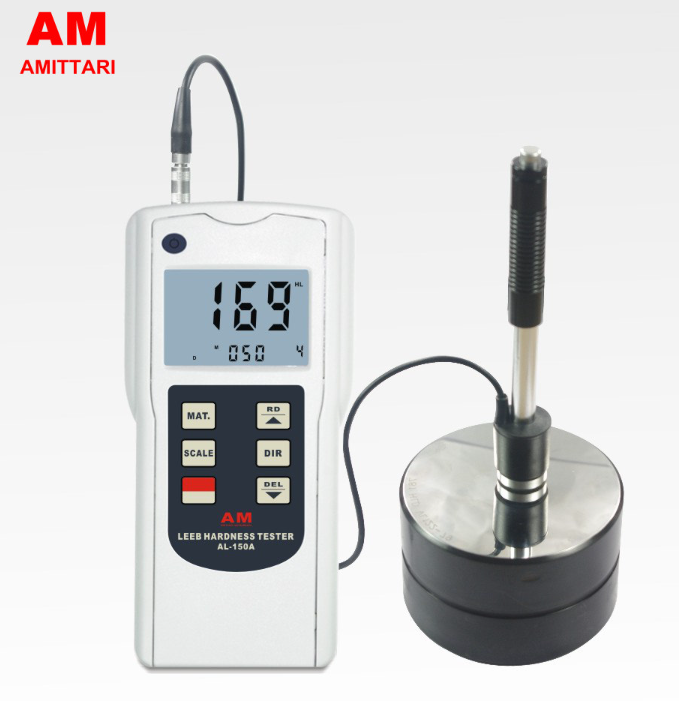
Leeb hardness tester is a multifunctional portable hardness testing instrument, mainly used for:
1. Multi scenario applicability: Suitable for failure analysis of installed mechanical or long-term assembly components, mold cavities, heavy workpieces, pressure vessels, steam turbine generators and other equipment, as well as hardness testing of workpieces, bearings and other parts with limited experimental space.
2. Material differentiation and rapid inspection: It can be used for material differentiation in metal material warehouses, as well as rapid inspection of multiple measuring parts of large workpieces, meeting the need for formal original records of test results.
3. Multi hardness unit conversion: Supports free switching of six hardness units (HL, HRC, HRB, HB, HV, HS) to meet the hardness testing needs of different materials and standards.
4. Data storage and transmission: It can store 50 sets of measurement values and test status (including material, test direction, hardness, and other information), and is equipped with an RS-232 interface for easy communication with computers, enabling data export and analysis.
The Leeb hardness tester is based on the principle of electromagnetic induction, and calculates the hardness value by measuring the impact velocity and rebound velocity of the impact body on the surface of the specimen. The specific steps are as follows:
1. Impact process: An impactor with a certain mass impacts the surface of the specimen under the test force, and the impact velocity (VA) and rebound velocity (VB) at a distance of 1mm from the specimen surface are measured.
2. Electromagnetic induction: Using the principle of electromagnetism, a voltage proportional to the speed is induced to convert the speed signal into an electrical signal.
3. Hardness calculation: Calculate the hardness value using the Leeb hardness formula, where HL is the Leeb hardness value, VB is the rebound velocity, and VA is the impact velocity.
4. Unit conversion: According to user needs, convert the Leeb hardness value to other hardness units (such as HRC, HB, etc.) to achieve multi standard compatibility.