-
E-mail
1115468868@qq.com
-
Phone
13622644996
-
Address
Building B1, No. 6 Yanhai Road, Yongtou Community, Chang'an Town
Guangdong Laibotong Testing Equipment Co., Ltd
Selection of drop testing machine: essential differences in applicable scenarios between zero height and conventional models
Date: 2025-12-18Read: 1
Drop testerAs the core equipment for packaging and product reliability testing, its selection directly affects the simulation effectiveness of test results on actual transportation scenarios. Although the zero height drop testing machine and the conventional drop testing machine belong to the same drop testing equipment, there are essential differences in their testing principles and applicable scenarios - the former focuses on verifying impact protection performance, while the latter focuses on evaluating the "gravity impact" tolerance. Only by clarifying the applicable boundaries of the two can accurate reliability testing be provided for different types of products such as electronic components and precision instruments. Starting from the scenario requirements, we will break down the core differences between the two.
The core application scenario of the zero height drop testing machine is the precise simulation of "micro height, strong impact", targeting precision products that are easily damaged by small impacts. Its' zero height 'does not mean that the height is zero, but rather that the sample is freely dropped within a very short distance of 10-50mm through pneumatic or electromagnetic release mechanisms, and an impact is formed by the instantaneous reaction force of the rigid tabletop. This type of scenario is concentrated in the fields of electronic manufacturing and precision instruments: for example, micro components such as mobile phone chips and camera modules often face impact risks such as tray tipping and manual transmission errors during assembly or transportation on the production line. Zero height drop testing can accurately verify their solder joint strength and packaging integrity; For ultrasound probes, diagnostic reagent cards, etc. in medical equipment, small impacts may cause internal structural displacement or reagent failure. Testing with this equipment can ensure the stability of the product in daily operation. The focus of its testing is on the product's tolerance to "low-energy, high acceleration" impacts, with impact acceleration typically reaching 1000-5000m/s ².
The conventional drop testing machine takes "full height, gravity impact" as the core simulation object, and is suitable for transportation protection testing of packaging and finished products. The drop height can be adjusted from 300mm to over 2000mm, and the sample can be freely released after being raised to the set height by the lifting mechanism, simulating possible scenarios such as falling and rolling of the product during storage, handling, and logistics transportation. Applicable scenarios cover multiple fields such as consumer goods and industrial products. In the food and beverage industry, packaging such as bottled water and canned goods need to pass a drop test at a height of 1.2-1.5m to verify the protective ability of cardboard boxes and cushioning materials on the bottle body; Finished products such as washing machines and refrigerators in the home appliance industry need to undergo a drop test at a height of 800-1000mm on corners, edges, and surfaces before leaving the factory to ensure that the outer shell and internal structure are not damaged in transportation accidents; In the field of logistics packaging, corrugated cardboard boxes can determine their maximum load-bearing capacity and stacking layers through drop tests at different heights. The core of this type of testing is to evaluate the cushioning effect of the packaging system on "high-energy, moderate acceleration" impacts, with impact acceleration generally ranging from 100-1000m/s ².
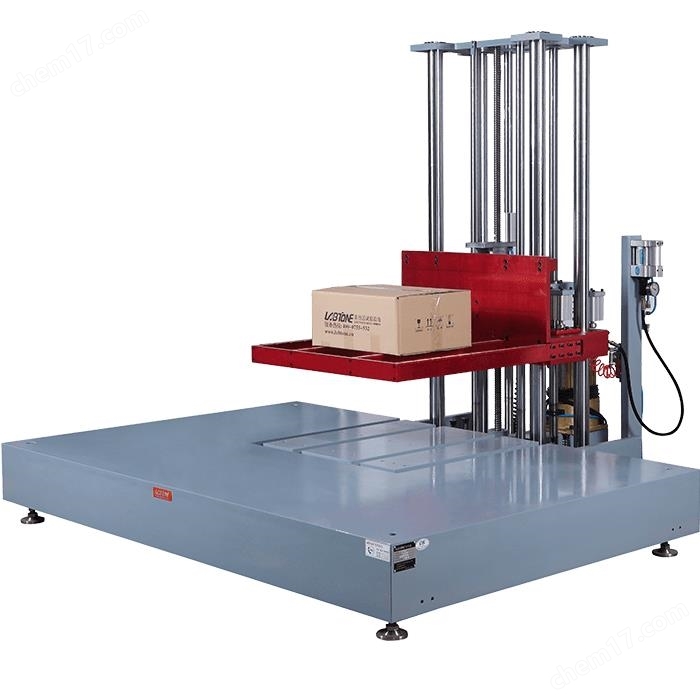
The essential difference between the two in terms of applicable scenarios is also reflected in the differences in testing purposes and product lifecycle stages. The zero height drop testing machine is mainly used in the later stage of product development and mass production quality control. The testing purpose is to discover the weak points of the product's own structure, such as component welding defects, material brittleness problems, etc., which belongs to the "product reliability testing"; Conventional drop testing machines are mostly used in the packaging design verification and finished product factory inspection stages. The purpose of the test is to evaluate the protective performance of the packaging and product combination, and determine whether the packaging can protect the product from safely reaching the terminal, which belongs to the "packaging protection effectiveness test". For example, for the same laptop, a zero height drop machine is used to test the connection strength between the motherboard and the screen during development, while a conventional drop machine is used to test the protective effect of the entire machine packaging when dropped from a height of 1 meter before leaving the factory.
In addition, the shape of the test samples also determines the model selection: the zero height drop machine is suitable for single components, small components, and other "unpackaged or simple packaged" samples, with a sample weight usually ranging from 0.1-5kg; the conventional drop machine is suitable for finished products or components with complete packaging, with a sample weight ranging from 1kg to over 100kg, and some industrial models can test ton level heavy objects.
The selection of zero height and conventional drop testing machines is essentially a dual match of "impact energy and testing purpose". Enterprises need to accurately select models based on product characteristics, testing stages, and actual application scenarios - focusing on the structural strength of the product itself to choose zero height models, and verifying packaging protection performance to choose conventional models. If you need to build a comprehensive reliability testing system, you can contact a professional team for scenario analysis and customized solutions to ensure that the test results truly serve the improvement of product quality.