-
E-mail
1115468868@qq.com
-
Phone
13622644996
-
Address
Building B1, No. 6 Yanhai Road, Yongtou Community, Chang'an Town
Guangdong Laibotong Testing Equipment Co., Ltd
Economic vibration testing machine: a cost-effective vibration measurement solution, suitable for the basic testing needs of small and medium-sized enterprises
Date: 2025-10-17Read: 0
In small and medium-sized electronic factories, component processing plants, research laboratories, and other scenarios, product anti vibration performance testing is an important part of quality control. However, traditional vibration equipment has high costs and complex operations, making it difficult to meet the core requirements of small and medium-sized enterprises for "low cost, easy operation, and practicality".Economic vibration testing machineBecoming the preferred vibration testing option for small and medium-sized users, providing an economical and reliable solution for basic anti vibration testing.
The highlight of the vibration testing machine is its high cost-effectiveness and core functionality. While controlling costs, the equipment retains the core function of vibration testing: using a simple mechanical transmission or small electromagnetic drive structure, the vibration frequency covers 1-50Hz, and the amplitude is adjustable from 0.1-3mm, which can meet the basic anti vibration testing needs of common products such as electronic components and small parts, such as detecting the vibration resistance of mobile phone casings and the stability of small motor components. Its testing accuracy meets basic industrial standards, with an amplitude deviation of less than ± 8% and a frequency control accuracy of ± 1Hz. It can provide users with reliable qualitative and semi quantitative testing data, and the equipment procurement cost is only 1/3-1/2 of the model, greatly reducing the investment threshold for small and medium-sized enterprise testing equipment. For example, in small electronic component factories, simulating logistics transportation vibrations through vibration testing machines can quickly screen out products with insufficient anti vibration performance, avoid after-sales quality problems, and bring significant quality assurance effects with small investment.
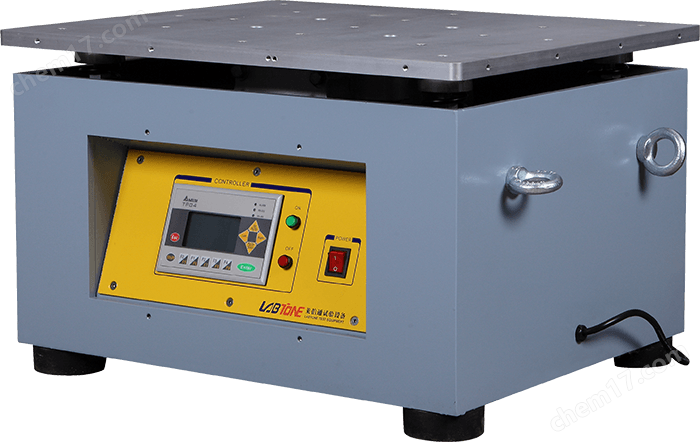
Secondly, simple operation and convenient maintenance lower the threshold for use. The device adopts a "one click" operation interface, retaining only core buttons such as frequency adjustment, amplitude setting, and timed start, paired with clear LED indicator lights and digital display screens. No professional training is required, and ordinary employees can master basic operations in 10 minutes; The body structure is simplified, and the core components adopt standardized design, such as universal motors and easily replaceable transmission belts. The maintenance cost is low in the later stage. When common faults occur, users can quickly restore use by replacing simple accessories, reducing downtime losses. For scenarios where laboratory space is limited, the equipment is designed to be compact and can be directly placed on a regular laboratory bench without the need to occupy a large area of space, further reducing usage costs.
In terms of practicality and adaptability, the detailed design of the economical vibration testing machine meets the basic requirements. The workbench is equipped with universal screw hole positions, which can fix small samples of different sizes with conventional fixtures without the need for customized special fixtures; Support scheduled testing function, which can meet the needs of short-term rapid screening and basic durability testing; Some models are equipped with a simple data recording function, which can export test parameters through an external USB drive for easy traceability of basic data. At the same time, although the equipment is designed economically, it still retains core safety protections: motor overheating protection, overload shutdown function, to prevent equipment damage due to improper operation and ensure basic safety of use.
From daily quality inspection for small and medium-sized enterprises to sample testing in research laboratories, and to low-cost R&D assistance for startups, economical vibration testing machines are economical, practical, easy to operate, and easy to maintain. Choosing a vibration testing machine is not a "compromise choice", but a "rational selection" based on actual needs for small and medium-sized users - achieving basic anti vibration testing at controllable costs, building the first line of defense for product quality, and helping small and medium-sized enterprises steadily develop in competition.