-
E-mail
info@phenom-china.com
-
Phone
18516656178
-
Address
Room T5705, Shanghai Hongqiao Libao Plaza, No. 88 Shenbin Road, Hongqiao Town, Minhang District, Shanghai
Funa Scientific Instruments (Shanghai) Co., Ltd
The Metamaterials Behind the Nobel Prize: The Rise of MOFs
Date: 2025-10-11Read: 2
The Royal Academy of Sciences in Sweden has decided to award the 2025 Nobel Prize in Chemistry to Susumu Kitagawa, Richard Robson, and Omar M. Yaghi, in recognition of their pioneering contributions in the field of metal organic frameworks (MOFs) research and development.
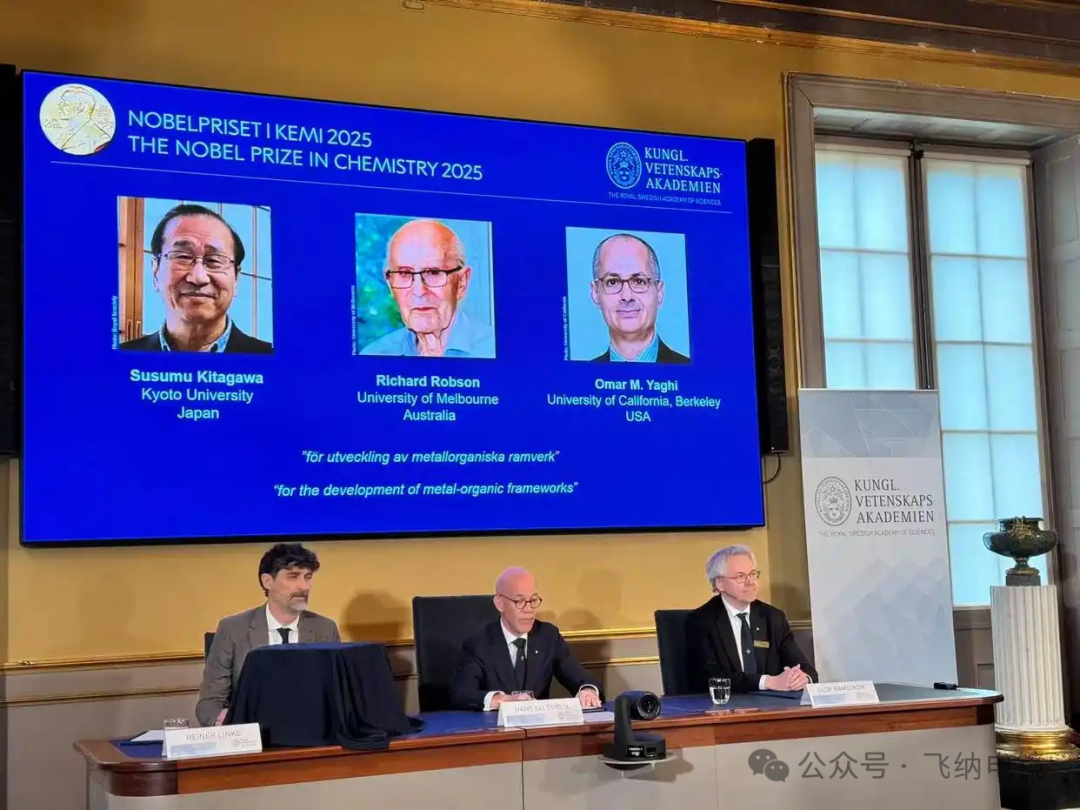
Metal Organic Frameworks (MOFs) are a type of porous material formed by self-assembly of metal ions or metal clusters with organic ligands. MOFs have shown extensive application prospects in multiple fields due to their excellent properties such as porosity, adjustability, and unique stability.
Feina electron microscopy has a wide range of applications in the characterization of MOFs materials. Using Feina electron microscopy for scanning electron microscopy morphology and composition characterization, researchers in related fields have published high-quality journals one by one. Let's take a look together!
PART 01Negative electrode material for sodium ion batteries based on MOFs materials
University of Electronic Science and technologyProfessor Chen Junsong's research group
Publish article:
Bilateral Interfaces in In2Se3‐CoIn2‐CoSe2 Heterostructures for High-Rate Reversible Sodium Storage(In2Se3-CoIn2-CoSe2 Dual interfaces in heterojunctions for high rate reversible sodium storage
Published Journal:ACS Nano
DOI: 10.1021/acsnano。 1c03056
Feina Electron Microscope Model:Phenom Pharos desktop field emission scanning electron microscope

The core content of this article is to achieve high rate reversible sodium storage by constructing InSe CoIn CoSe heterojunction. Researchers prepared InSe CoIn CoSe heterojunctions with dual interfaces by growing cobalt based MOFs (ZIF-67) on the surface of indium based MOFs (MIL-68) and then in-situ gas-phase selenization. This structure not only improves the conductivity and sodium ion diffusion rate of the material, but also enhances the structural stability, thereby significantly improving the performance of sodium ion batteries. The morphology and structural changes of InSe/CoSe-450 samples were observed in detail through characterization using a Phenom Pharos field emission scanning electron microscope. This MOF based heterojunction material exhibits excellent performance in sodium ion batteries, providing new ideas for the design of high-performance negative electrode materials for sodium ion batteries.
PART 02MOFs thin film electronic materials
Fujian Institute of Material Structure, Chinese Academy of Sciences——Professor Cao Rong's research group
Publish article:
Integration of metal-organic frameworks into an electrochemical dielectric thin film for electronic applications( Integrating metal organic framework materials into electrochemical dielectric thin films for the field of electronic materials
Published Journal:Nature Communications
DOI: 10.1038/ncomms11830
Feina Electron Microscope Model:Phenom Pro High Resolution Professional Edition Scanning Electron Microscope
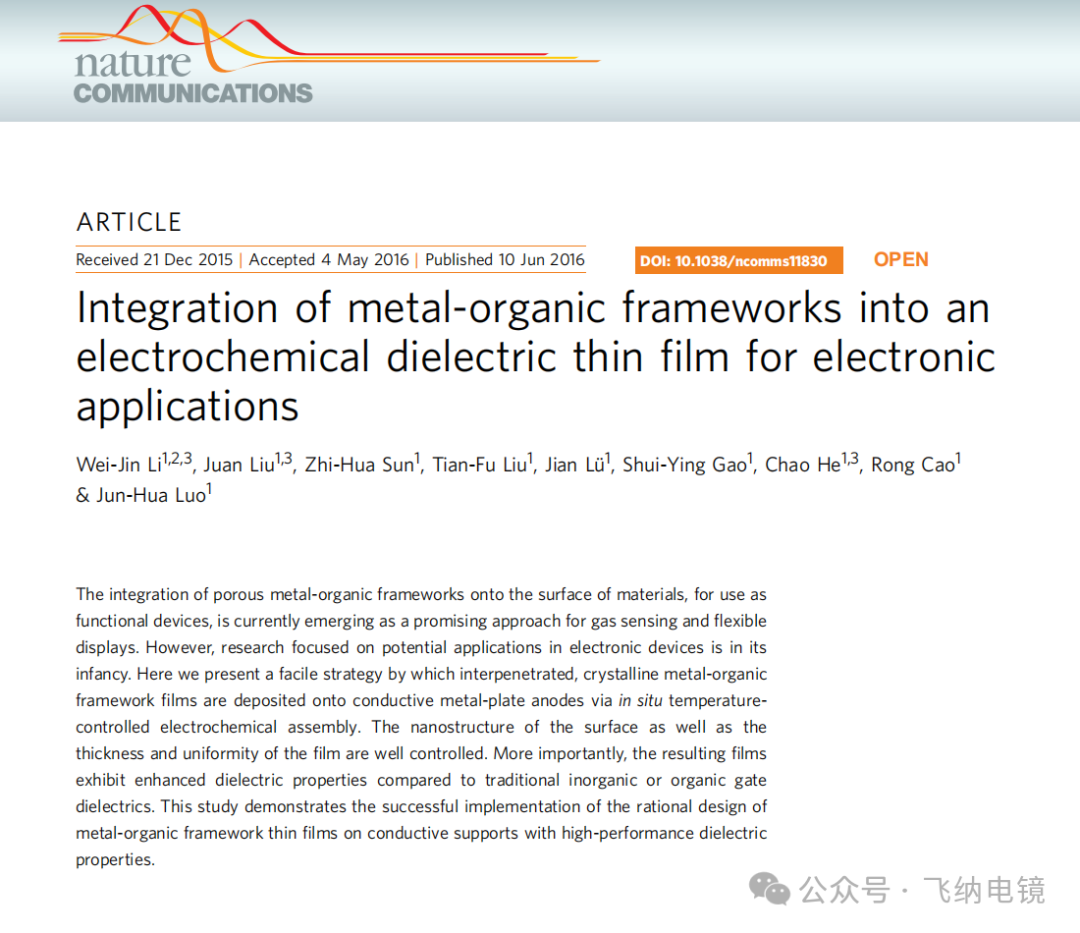
The core content of this article is the integration of porous metal organic frameworks (MOFs) onto the surface of conductive metal plate anodes, and the deposition of interpenetrating and crystalline MOFs thin films through in-situ temperature controlled electrochemical assembly methods. This film not only has good dielectric properties, but its surface morphology, thickness, and uniformity can be precisely controlled by controlling reaction conditions such as temperature, time, and voltage. The research results indicate that the dielectric constant of this MOF film is much higher than that of traditional inorganic or organic gate dielectric materials, providing new possibilities for the application of MOFs in electronic devices. Researchers used a Phenom G2 scanning electron microscope to observe the surface morphology and microstructure of MOF films, and achieved precise control of film thickness and surface morphology by adjusting reaction conditions.
PART 03Flexible electrode based on MOFs materials
Fudan University——Professor Mei Yongfeng's research group
Publish article:
Atomic Layer Deposition Inducing Integration of Co,N Codoped Carbon Sphere on 3D Foam with Hierarchically Porous Structures for Flexible Hydrogen Producing Device( Atomic layer deposition induces Co/N co doped carbon spheres to form hierarchical porous structure on three-dimensional foam and its application in flexible hydrogen production device)
Published Journal:Advanced Functional Materials
DOI: 10.1002/adfm.201906365
Feina Electron Microscope Model:Phenom ProX Electron Microscope Energy Spectrometer Integrated Machine

The core content of this article is to induce the growth of Zeolitic Imidazolate Framework-67 (ZIF-67) layer on three-dimensional carbon foam (CF) through atomic layer deposition (ALD) technology, then transform it into Co, N co doped carbon spheres (Co – N – CSs) through pyrolysis process, and apply it to flexible hydrogen production electrodes. This composite structure not only has a high specific surface area and multi-level pore structure, but also exhibits excellent electrochemical performance and flexibility, making it suitable for hydrogen production reactions in acidic and alkaline electrolytes. Through characterization using Phenom ProX scanning electron microscopy, researchers observed in detail the morphological changes from CF to ALD-ZIF-67-CF and then to Co-N-CS-CF. These observations provide important support for understanding the growth mechanism of ZIF-67 on CF and the structural changes during pyrolysis. This composite structure based on MOFs not only exhibits excellent electrochemical performance in acidic and alkaline electrolytes, but also has significant flexibility, providing new ideas for the design of flexible hydrogen production electrodes.
PART 04Biomimetic materials based on MOFs materials
Sichuan University——Professor Wang Yuzhong's research group
Publish article:
Constructing hierarchically hydrophilic/superhydrophobic ZIF-8 pattern on soy protein towards a biomimetic efficient water harvesting material( Constructing hierarchical hydrophilic/superhydrophobic ZIF-8 patterns on soy protein to prepare biomimetic efficient water harvesting materials
Published Journal:Chemical Engineering Journal
doi.org/10.1016/j.cej.2019.03.152.
Feina Electron Microscope Model:
Phenom ProX Electron Microscope Energy Spectrometer Integrated Machine
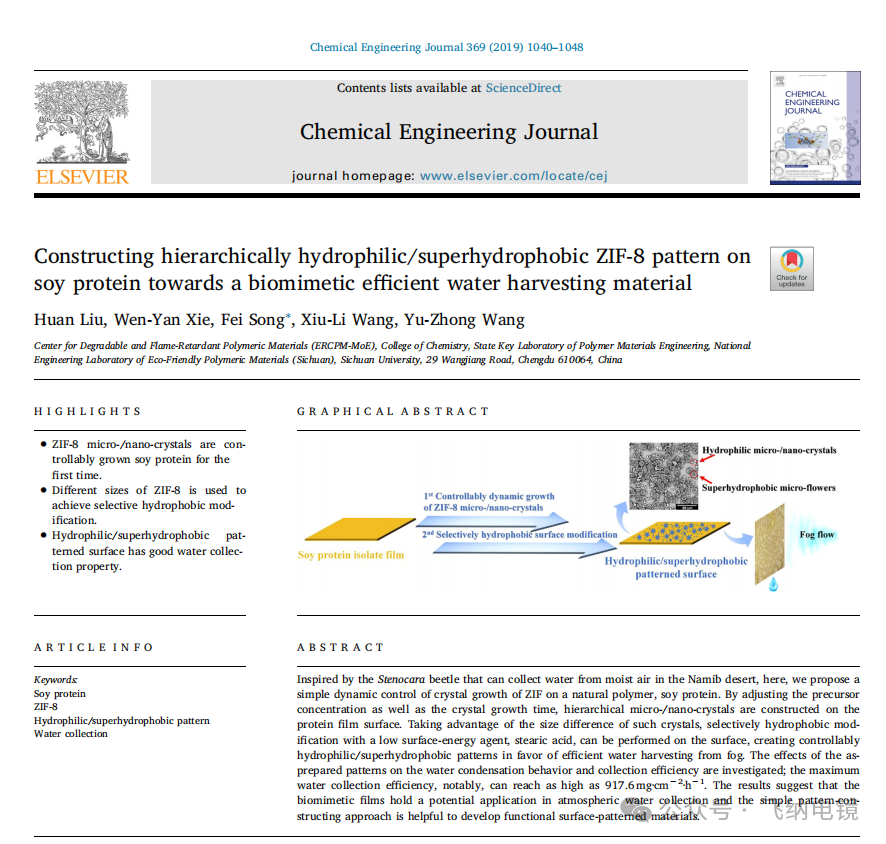
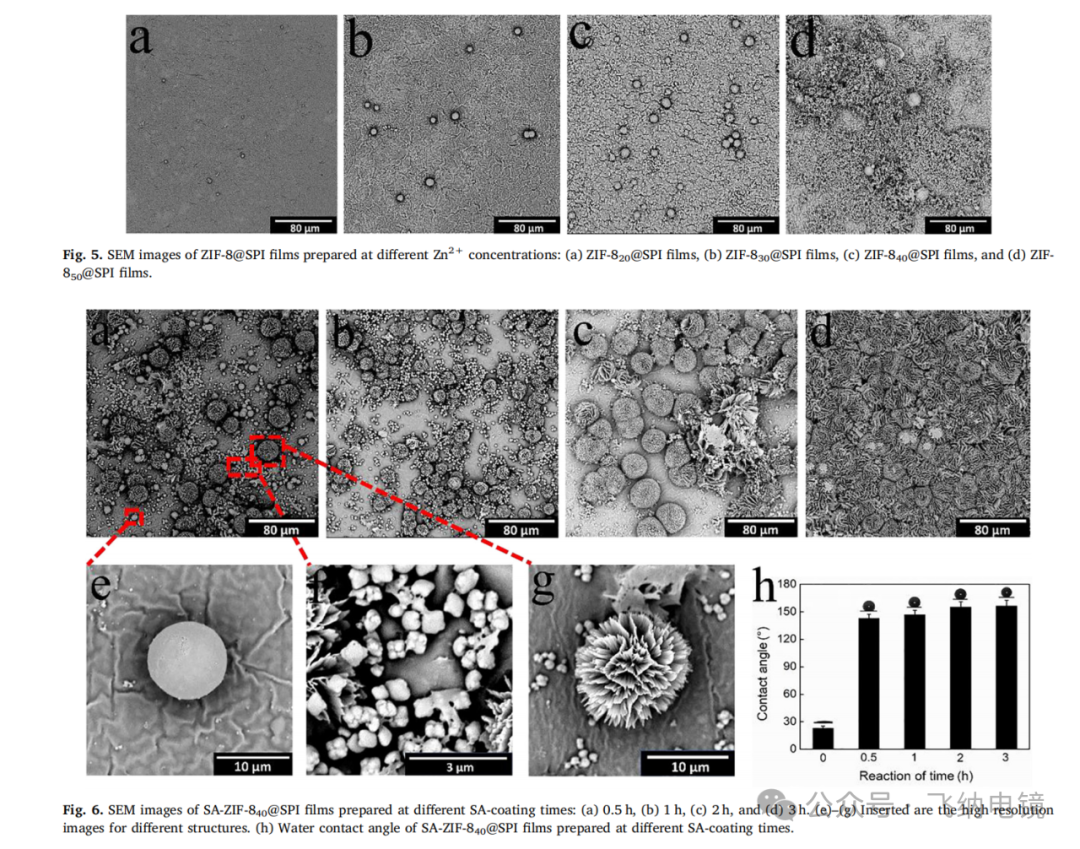
The article was inspired by the Stenocara beetle in the Namibian desert, which is capable of collecting moisture from moist air to sustain life. The structure of the beetle's back is composed of hydrophilic protrusions distributed on a superhydrophobic background, which allows water molecules to condense into droplets in the hydrophilic area and roll down under the action of gravity. Based on this natural phenomenon, researchers have designed a similar hydrophilic/superhydrophobic patterned surface for collecting moisture from mist. The researchers used a Phenom ProX scanning electron microscope to observe the growth process and morphological changes of ZIF-8 crystals on the surface of soy protein (SPI) films. At low magnification, larger micrometer sized crystals can be observed, which are uniformly distributed on the surface of the film. At high magnification, smaller nanoscale crystals can be observed, which are distributed on the surface of micrometer sized crystals and thin films, forming a hierarchical structure.
PART 05Water treatment membrane based on MOFs materials
California State University——Fangyuan Tian's research group
Publish article:
Electrodeposition of Ag/ZIF-8-Modified Membrane for Water Remediation(Ag/ZIF-8 Preparation of Modified Membrane by Electrodeposition and Its Application in Water Treatment
Published Journal:Langmuir
DOI: 10.1021/acs.langmuir.2c02947
Feina Electron Microscope Model:
Phenom ProX Electron Microscope Energy Spectrometer Integrated Machine


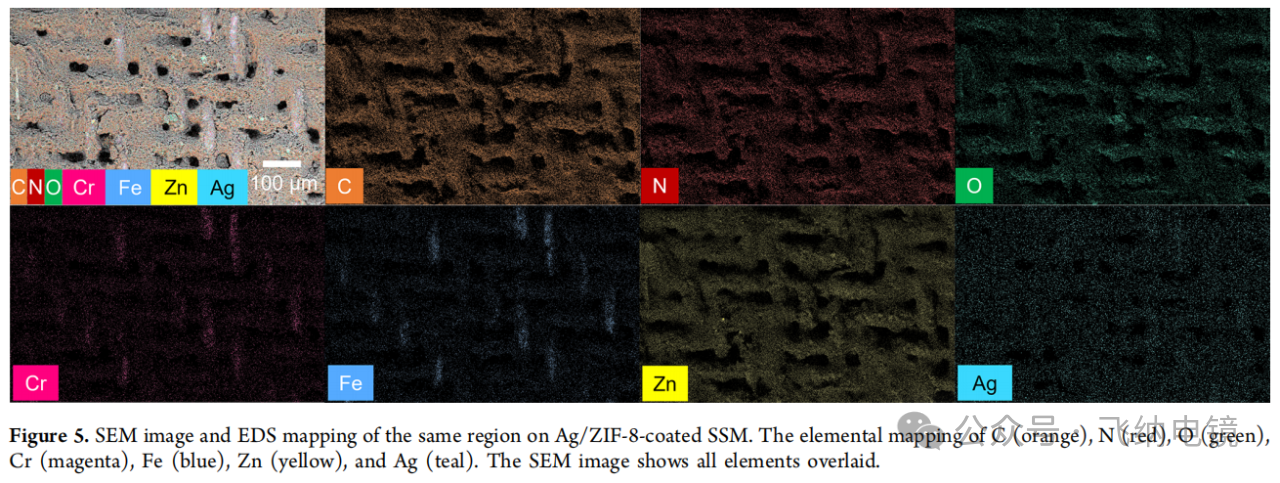
The core content of this article is the preparation of modified films based on ZIF-8 and Ag/ZIF-8 on stainless steel mesh by electrodeposition method, and their application in water treatment. ZIF-8 is a MOF material with high specific surface area and adjustable pore size, widely used in gas and liquid separation. By doping silver nanoparticles (Ag NPs) into ZIF-8, researchers have prepared Ag/ZIF-8 membranes with antibacterial properties for removing organic dyes (such as Rhodamine B) from water and inhibiting bacterial growth. The morphology and structure of ZIF-8 and Ag/ZIF-8 modified membranes were observed in detail through characterization using a Phenom ProX G6 scanning electron microscope. These observations provide important support for understanding the application of ZIF-8 and Ag/ZIF-8 in water treatment. This MOF based modified membrane not only effectively removes organic dyes from water, but also has significant antibacterial properties, providing a new solution for the field of water treatment.
So, the Feina electron microscope is not only useful, but can also produce high-quality articles. Different models of Feina electron microscopes have excellent performance in various fields. Come and choose the scanning electron microscope that suits your research.