-
E-mail
1471815660@QQ.COM
-
Phone
18925778253
-
Address
No. 29, Houjie Section, Port Avenue, Houjie Town, Dongguan City, Guangdong Province
Dongguan Baopin Precision Instrument Co., Ltd
Working principle and application fields of small sheet extruder
Date: 2025-11-16Read: 2
Small sheet extruder is a widely used equipment in the plastic processing industry, mainly used to manufacture thin plastic products. With the continuous development of the plastic industry, the application range of sheet materials is becoming increasingly wide, from packaging, electronics, construction to daily products, the demand for sheet materials continues to grow. Due to its compact structure, easy operation, and strong adaptability, it has become an ideal choice for small and medium-sized enterprises and laboratories to produce plastic sheets.
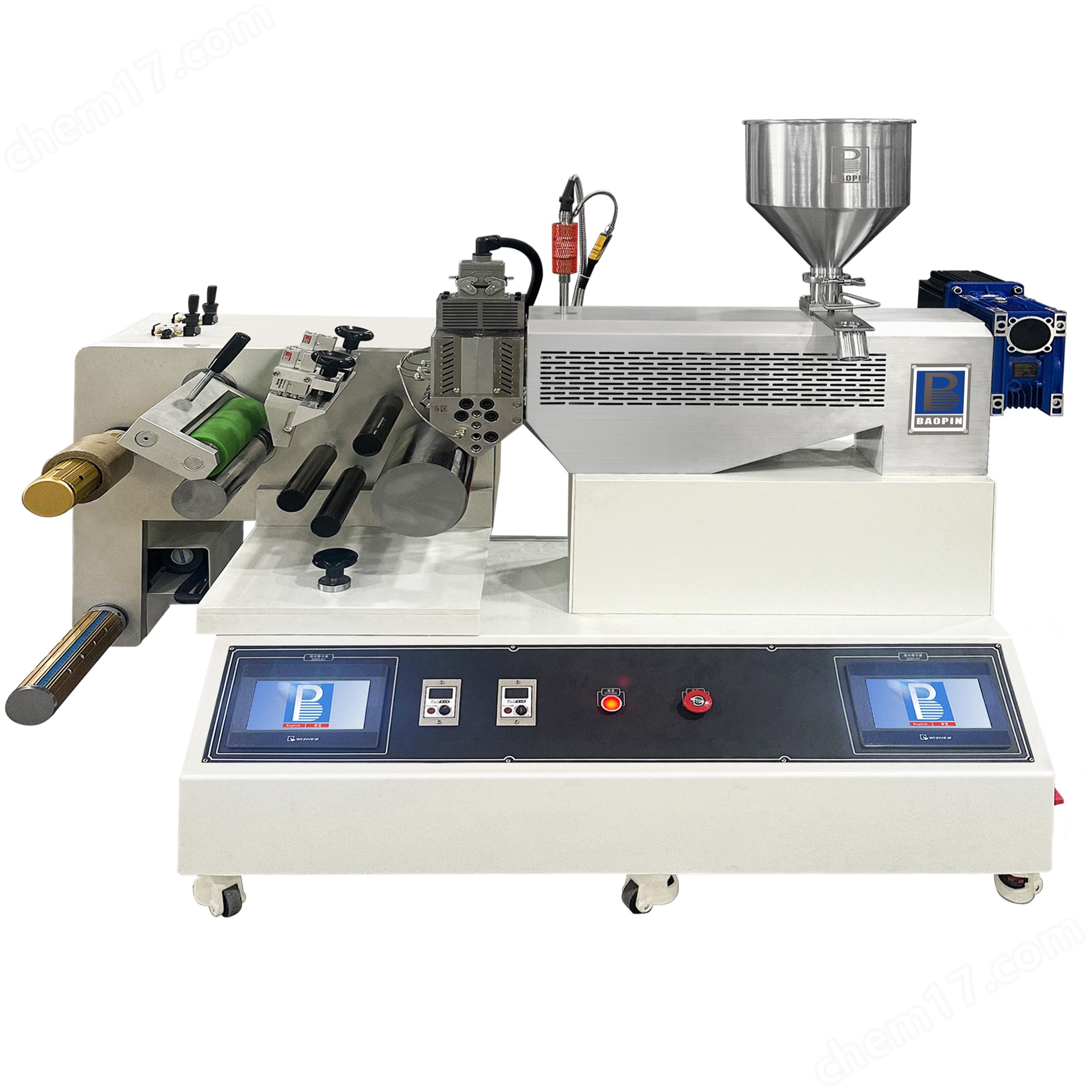
Small sheet extruderWorking principle:
1. Feeding of plastic raw materials: Plastic particles or powder like raw materials enter the extruder barrel through the feeding port. Usually, raw materials are transported to the heating zone through the rotation of a screw.
2. Heating and plasticization: In the feeding area, there is a heating electric heating tube inside the material barrel, which heats the plastic raw materials to the plasticization temperature through heat. As the temperature of plastic raw materials continues to rise, they gradually become soft and form a molten state with good fluidity.
3. Extrusion molding: After plasticization, the molten plastic moves axially along the barrel under the action of the screw, and is finally extruded into a sheet by the die head of the extruder. According to the design of the mold, the plastic melt will form continuous thin sheets.
4. Cooling and shaping: The extruded plastic sheet is cooled by a cooling device (such as a water tank or air cooling) to quickly solidify and maintain a certain shape. The cooled sheet is usually cut or wound into rolls to complete the production process.
5. Rolling or cutting: According to different production needs, the sheet can be rolled into a roll shape by a winding device, or cut into sheets of a certain size by a cutting machine.
Application fields:
1. Packaging industry: Plastic films and sheets have been widely used in the packaging industry, including food packaging, electronic product packaging, etc. Can produce thin sheets of different thicknesses for the manufacturing of various packaging materials.
2. Construction industry: Plastic sheets can be used to manufacture building decoration materials, such as wall panels, floor films, curtains, etc. Capable of producing high-quality sheets suitable for these purposes.
3. Electronics industry: Protective casings and screen protectors for electronic components can also be manufactured through sheet extruders, which have good physical properties and beautiful surface effects.
4. Daily products: can produce thin sheets, used to manufacture various plastic products in daily life, such as tableware, stationery, household items, etc.
5. Medical industry: In the medical industry, films and sheets are widely used in the production of medical packaging, disposable products, catheters, etc.
6. Environmentally friendly materials: Environmentally friendly plastic sheets can also be manufactured through sheet extruders for the production of biodegradable plastic films, green packaging materials, etc.
When choosing a small sheet extruder, the following key factors need to be considered:
1. Production requirements: Firstly, it is necessary to clarify the specifications of the sheets to be produced, including width, thickness, etc., in order to select the appropriate equipment model. Different models of extruders can meet the production needs of different scales and specifications.
2. Production efficiency: Select suitable equipment power and capacity based on actual production volume and cycle. If the production volume is large, it is necessary to choose equipment with higher power and production capacity.
3. Equipment stability: The stability of equipment directly affects the smooth progress of the production process. Choosing brands and models with high stability can reduce failure rates and maintenance costs.
4. Control system: Generally equipped with a numerical control system, it has functions such as temperature control, speed control, thickness control, etc. Choosing an easy-to-use and comprehensive control system can help improve production efficiency and product quality.