-
E-mail
1142790045@qq.com
-
Phone
13861112485
-
Address
No. 98 Yangang Road, Jincheng Town Industrial Park, Jintan City
Changzhou Xiangtian Experimental Instrument Factory
From startup to shutdown: Complete operation guide for single measurement of digital constant temperature water bath oscillator
Date: 2025-10-16Read: 58
Digital constant temperature water bath oscillatorIt is a core equipment that integrates temperature control and oscillation functions in fields such as biological experiments and chemical synthesis. It can provide precise temperature environment and uniform oscillation mixing for samples (such as cell suspensions and enzyme reaction systems). Mastering the complete operation process from startup to shutdown is the foundation for ensuring the reliability of single measurement data. The following is a detailed step-by-step guide:
Step 1: Preparation before startup
Firstly, confirm the placement environment of the equipment - it should be placed on a stable and ventilated table, away from heat sources (such as ovens) and flammable materials. The recommended ambient temperature is 10-30 ℃ (to avoid abnormal temperatures affecting temperature control accuracy). Check the water level in the water bath: The water level should be below the heating tube (usually 5-10cm from the edge of the bath) and below the bottom of the oscillating tray (to prevent overflow). It is recommended to use deionized water or distilled water (to avoid scale deposition affecting heating efficiency). Place the test sample (such as a test tube or conical flask) into a specialized fixture or spring grid, ensuring it is firmly fixed (to avoid tipping over during oscillation), and the sample volume should not exceed 2/3 of the total container volume (to prevent oscillation overflow).
Step 2: Startup and Basic Parameter Settings
Connect the power supply (220V/50Hz), turn on the power switch on the back of the device, and enter the main interface after the digital display screen lights up. Firstly, set the "target temperature": adjust it to the desired temperature for the experiment (such as culturing cells at 37 ℃ or conducting enzyme reactions at 25 ℃) using the "△/▽" keys. Some models support preset common temperatures (one click call). Next, set the "oscillation parameters": including oscillation frequency (usually 50-300rpm, low speed is suitable for fragile samples such as protoplasts, high speed is suitable for uniformly mixed solutions), oscillation mode (reciprocating/swirling, reciprocating is suitable for liquid mixing, swirling is suitable for uniformity in the test tube), and oscillation time (if timed operation is required, set the "00:00-99:59" format; if continuous oscillation is required, no setting is needed). After completing the parameter settings, press the "confirm" button to save.
Step 3: Start up operation and process monitoring
After confirming that the parameters are correct, press the "heating" and "oscillation" start buttons simultaneously (some models have independent buttons), and the device will start working. At this time, the digital display screen displays the current temperature (such as "28.5 ℃ → target 37 ℃") and oscillation frequency (such as "150rpm") in real time. During the initial start-up period (about 5-10 minutes), the temperature may not reach the set value, which is a normal phenomenon - observe whether the temperature rise curve is stable (if the fluctuation is>± 1 ℃, it may be due to uneven water temperature in the water bath, and manually shake the water in the bath to promote circulation). Regular observation is required during operation (recommended every 10-15 minutes): confirm that the sample is not overflowing, the fixture is not loose, and whether there are alarm prompts on the digital display screen (such as "over temperature" or "water shortage"). If a "water shortage alarm" occurs, immediately stop the machine and replenish distilled water to the safe water level.
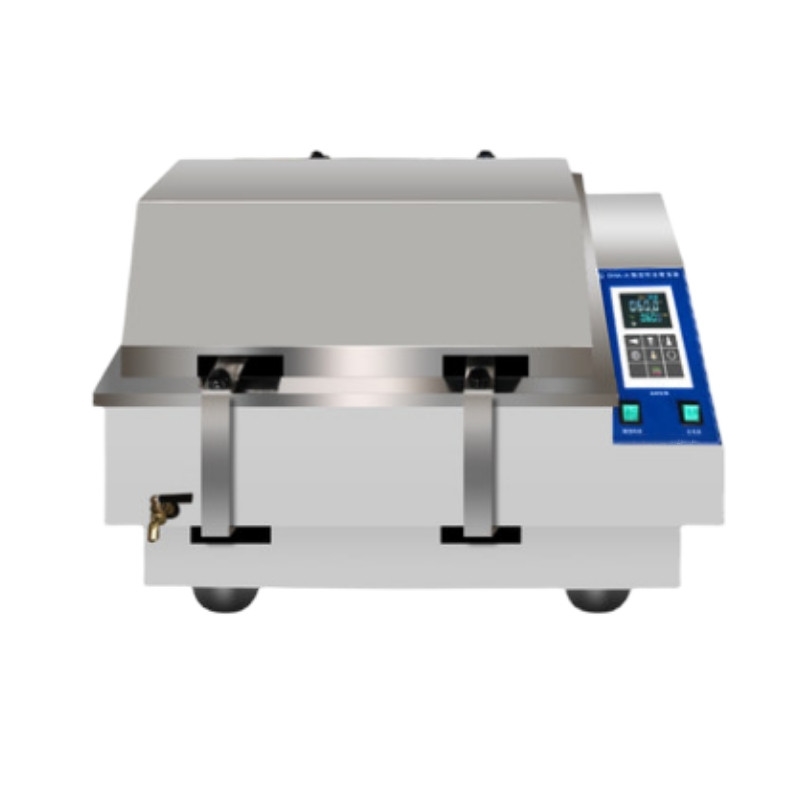
Step 4: Shutdown and Closing Operations
When the required time for the experiment is reached (such as sampling after 30 minutes of constant temperature oscillation), first press the "stop" button (or simultaneously turn off the "heating" and "oscillation" buttons), and wait for the equipment to gradually cool down (it is recommended to cool naturally for 5-10 minutes to avoid sudden arrest and component damage). Turn off the power switch and unplug the power plug (if not used for a long time). Finally, take out the sample (note high temperature burns, it is recommended to wear insulated gloves), pour out the water from the water bath (clean if reused), wipe the tank body and tray with a soft cloth (to avoid residual water stains that corrode metal parts), and return the fixture to its original position. If further use is required, the device can be kept powered on and in standby mode (saving time for reheating).
Attention: If parameters need to be adjusted during the experiment (such as increasing temperature or changing oscillation frequency), pause the operation first (press the "stop" button), modify the parameters, and restart; If the equipment has not been used for a long time (>24 hours), it is necessary to check whether the heating tube and oscillating motor are normal before the next start-up (which can be tested by short-term no-load operation).