- Phone
-
Address
Room 316, Chengda Creative Park, Building 76, No. 402 Guilin Road, Xuhui District, Shanghai
Buqi Laboratory Equipment Trading (Shanghai) Co., Ltd
Application: A silk fibroin drug delivery platform based on naproxen
Date: 2025-09-19Read: 2

Büchi Labortechnik AG
A silk fibroin drug delivery platform based on naproxen
Spray drying application
”
1
Introduction
This article introduces the development and evaluation of a controllable drug delivery platform based on silk fibroin (SF) using naproxen (sodium diclofenac) as a model drug.SF matrix was prepared by tape casting and spray drying, and its drug release curve was analyzed. Using solvents and glycerol to induce the conformational transition of SF from random curling to beta folding, thereby forming a crystalline network that regulates drug release. Fourier transform infrared spectroscopy (FTIR) and scanning electron microscopy (SEM) imaging were used to confirm structural changes and particle morphology. In vitro dissolution experiments showed that compared with the control group containing only gelatin, the SF based system significantly prolonged drug release time. These findings support the potential of SF as a biocompatible and adjustable material for oral drug delivery applications.
Silk fibroin (SF) is a natural polymer mainly extracted from silkworm cocoons and widely used in textiles, sutures, biomedical scaffolds, and other fields. Its structure is composed of hydrophobic and hydrophilic peptide sequences, forming a β - folded crystalline region that endows it with water insolubility and mechanical strength. The biocompatibility, biodegradability, and minimal inflammatory response of this protein enable its application in wound healing, tissue engineering, and cell culture. Silk fibroin is also processed into films, hydrogels and microspheres for drug delivery, and its secondary structure has been proved to affect the release kinetics. Multiple studies have demonstrated the multifunctionality of silk fibroin in encapsulating small and large molecule drugs, highlighting its potential as a controlled release carrier. It has been confirmed that when silk fibroin is mixed with gelatin by spray drying or solvent treatment, the conformational transformation of silk fibroin from random curling to β - folding can be used to generate porous matrix. The crystallization of silk fibroin in these mixtures enables the development of drug delivery systems with sustained release capabilities. Further research will be conducted on silk fibroin based matrices and particles to evaluate their suitability for delivering various drug categories, particularly for targeted delivery of large molecule drugs. It has been confirmed that,The conformational transition of silk fibroin (SF) mixed with gelatin from random crimping to β - folding by spray drying or solvent induction can be used to generate porous matrixThe development of silk fibroin crystals in a mixture containing silk fibroin can create a drug delivery system, achieving controlled release of drugs. Further research will be conducted on silk fibroin containing matrices and particles to explore their feasibility for delivering different types of drugs, particularly for targeted delivery of macromolecular drugs.
Research shows thatThe conformational transition of SF from random crimp to β - fold in the blend of silk fibroin (SF) and gelatin can be used to construct porous matrix through spray drying or solvent induction.The SF containing blend developed by inducing SF crystallization can form a drug delivery system that can control the drug release rate. Further research will be conducted on SF containing matrices and particles to explore the feasibility of delivering different types of drugs, especially large molecule drugs for targeted delivery.
A silk fibroin drug loading platform was constructed using naproxen as a model drug, and controlled drug release was achieved through structural regulation.
SF's excellent biocompatibility, degradability, and mechanical strength make it an ideal material for biomedical and pharmaceutical applications.
Crystallized SF matrix can achieve sustained drug release, and future research will focus on the development of macromolecular drugs and targeted delivery systems.
Prepare silk fibroin (SF) particles, with sodium naproxen and SF ratios of 1:1, 1.5:1, 2:1, and 3:1, respectively.
2
Equipment
Instrument: BUCHI small spray dryer B-290

Import temperature: 135-200 ° C
Pump flow rate: 6-7mL/min
Atomizing air flow rate: 600L/H (0.75bar)
3
Experimental Procedure
Table 1: Treatment conditions for low conductivity (<10 μ S/cm) silk fibroin protein.Measure and record the UV absorbance of each component at 280 nanometers (blank: quartz cuvette filled with deionized water). All components are placed in a 60 ℃ oven for 24 hours, or until all liquids evaporate, and then the residual net mass of each component after drying is measured. Use Fourier transform infrared spectrometer (FTIR) and Nicolet 380 Avatar OMNI sampler device. A KBr tablet containing approximately 0.7% (by mass) of spray dried powder was prepared using a Carver tablet press at a pressure of 18000 lbs. Thin films for comparison were obtained by casting silk fibroin solution onto the surface of a polystyrene weighing vessel and analyzed by Fourier transform infrared spectroscopy (FTIR).
Types of silk |
Degumming solution |
Dissolving solution |
Silkworm Cocoon - Silkworm |
0.25% Na2CO3 |
9.0 M LiBr |
0.25% Na2SO4 |
Ca(NO3)24H2O: MeOH (75 : 25)w/w |
|
5A grade raw silk - silkworm |
0.25% Na2CO3 |
Ca(NO3)24H2O: MeOH (75 : 25)w/w |
0.25% C12H25O4SNa |
CaCl2:EtOH:H2O(1:2:8) mole ratio |
|
Silk fibroin powder |
no need |
CaCl2:EtOH:H2O(1:2:8) mole ratio |
Table 2: FT-IR analysis of partially hydrolyzed sorbitan in a mixture with gelatin.
AmideDimension(cm)-1) |
AmideⅡ(cm-1) |
|
Pure SF Films | ||
2 kDa SF |
1620 |
- |
14 kDa SF |
1624 |
1520 |
100 kDa SF |
1625 |
1519 |
SF/gelatin blends | ||
2 kDa SF (1.8%) |
1636 |
1542 |
12 kDa SF (0.9%) |
1632 |
1540 |
100 kDa SF(1.4%) |
1625 |
1538 |
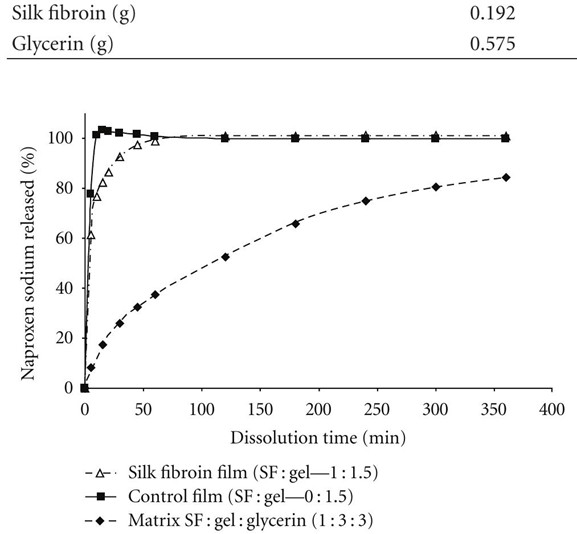
▲Figure 2: Dissolution curves of naproxen in calcium sulfate containing matrix (@) and films without calcium sulfate matrix (A) and films without calcium sulfate( ®) Comparison situation(For more detailed information, please refer to the original reference)

▲Figure 3: Scanning electron microscope image of spray dried particles. SF solution containing spray drying particles (a), spray drying particle solution (b) with SF and NS mixing ratio of 2:1, spray drying particle solution with additional 5% ethanol (c), and spray drying particle solution (d) with SF and NS mixing ratio of 2:1 and additional 5% ethanol.

▲Figure 4: Fourier transform infrared spectrum of SF/gelatin/glycerol matrix
4
References
Design and characterization of a Silk-Fibroin-Based Drug Delivery Platform Using Naproxen as a Model Drug
Tatyana Dyakonov, Chue Hue Yang, Derek Bush, Saujanya Gosangari, ShingaiMajuru, and Aqeel Fatmi
(PDF) Design and Characterization of a Silk-Fibroin-Based Drug Delivery Platform Using Naproxen as a Model Drug