-
E-mail
market@ensoultech.com
-
Phone
13810615661
-
Address
Room 603, Block B, Langqin International Building, No. 168 Guang'anmen Outer Street, Xicheng District, Beijing
Beijing Yingsheng Hengtai Technology Co., Ltd
Changes in Freshness of Slaughtered Yellow Feathered Broiler under Refrigeration Conditions
Date: 2025-12-24Read: 50
At present, research on the freshness of chicken meat mainly focuses on using visualization systems or establishing predictive models to evaluate the shelf life of chicken meat. However, there are many types of yellow feathered broiler chickens, and further research is needed to determine whether these methods are suitable for evaluating the freshness of yellow feathered broiler chickens, how to grade the freshness of chicken meat, how to determine the post slaughter time of chicken breast meat, and predict the shelf life of chicken breast meat. Therefore, in this study, "Wen's Food Group Co., Ltd." measured the freshness indicators of chicken meat (pH value, color, total bacterial count, TVB-N content, malondialdehyde (MDA) content, sensory evaluation) and K value, studied the changes in meat quality indicators and shelf life of slaughtered yellow feathered broiler chickens, and established a method based on meat quality indicators to reflect chicken freshness and predict broiler slaughter time, providing theoretical basis and data support for the judgment of chicken shelf life.
Meat freshness tester:Model MFT-2 Yingsheng Hengtai
Analysis of Test Results
The K value is the ratio of the sum of hypoxanthine nucleoside (HxR) and hypoxanthine (Hx) content produced by the degradation of adenosine triphosphate (ATP) in the body to the total amount of ATP and its decomposition products. Therefore, K value is an important indicator reflecting shelf life. The fresher the meat product, the smaller the K value, and vice versa.

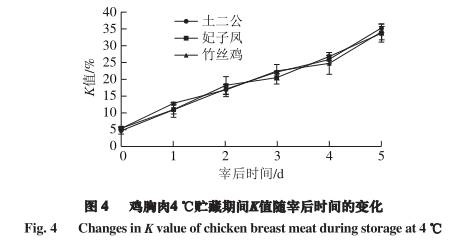
As shown in Figure 4, the K value of Feizifeng chicken breast meat increases with the prolongation of storage time. This is because after broiler chickens are slaughtered, oxygen supply stops and the body needs to consume ATP to provide energy. During the entire storage process, ATP is broken down in the muscles, and IMP is slowly degraded into Hx, resulting in a slow increase in the K value of chicken breast meat after slaughter. On the day after slaughter, the K value of Feizifeng chicken breast meat was less than 5; On the first day after slaughter, the K value ranges from 5% to 15%; After 2 days of slaughter, the K value is 15% to 20%; 3 days after slaughter, with a K value of 20% to 25%; After 4 days of slaughter, the K value is 25% to 30%; After 5 days of slaughter, the K value is greater than 30%. The K value of chicken breast meat varies regularly within a certain range with the extension of storage time. Therefore, K value can be used to classify chicken breast meat into first grade, second grade, third grade, fourth grade, fifth grade fresh meat and spoiled meat according to freshness, corresponding to the day of slaughter (<5%) and 1 (5%~15%), 2 (15%~20%), 3 (20%~25%), 4 (25%~30%), and 5 days (>30%) after slaughter, respectively. The K value can reflect the freshness of slaughtered chicken breast and predict the slaughter time of broiler chickens.
As a scientific and objective freshness evaluation method, freshness K-value detection can accurately reflect the quality changes of meat products during storage, provide reliable quality references for consumers, and effectively ensure food safety. Meanwhile, by establishing unified and standardized evaluation standards, this method can not only guide the storage and transportation of meat products, enhance market competitiveness, but also promote standardized production in the meat product industry, providing important basis for scientific research and regulation.
The MFT-2 Meat Freshness Tester is a brand new highly automated meat freshness K value detection system independently developed by our company. It uses electrophoresis separation technology, and the decomposition metabolites of adenosine triphosphate ATP show obvious fluorescence grading after UV irradiation. This grading is quickly recognized and analyzed by specialized image analysis methods to accurately calculate the K value representing the freshness of the sample, thereby accurately evaluating the freshness of meat, fish, poultry, and other products. MFT-2 adopts an integrated whole machine design, which automatically controls each step of the experimental process through software, quickly completes the entire experimental process, and automatically saves chart analysis results. This product can be effectively used for quality and quality testing of various meat raw materials in food processing enterprises, restaurants, supermarkets, restaurants, and other food processing industries.

Last Article: New automated meat freshness rapid detection system