-
E-mail
sales@eco-tech.com.cn
-
Phone
18210150760
-
Address
101B, Unit 1, Building 6, Courtyard 3, Gaolizhang Road, Haidian District, Beijing
Beijing Yiketai Ecological Technology Co., Ltd
The 'elemental code' of a seed: How does FireFly LIBS see through the quality of germplasm?
Date: 2025-12-17Read: 0
YiketaiFireFly LIBSThe rapid elemental analysis and imaging system, with its ability to detect multiple elements simultaneously without sample preprocessing and in situ imaging, is becoming a potential analytical tool in germplasm resource research. Its useLIBSThe technology effectively solves the problems of long time consumption and strong destructiveness in traditional chemical analysis, and can directly scan plant leaves, seeds, and even soil quickly, achieving nitrogen analysis(N)Phosphorus(P)Potassium(K)Real time monitoring of key nutrients and heavy metals. This system can obtain spatial distribution information of the sample surface(Mapping)By using machine learning algorithms to analyze the differences in elemental characteristics between different varieties, it can assist in crop variety identification, origin tracing, and genetic background analysis. In the field of stress research and quality assessment, this technology is widely used to explore the physiological response of plants to heavy metal pollution or drought stress, such as by monitoring silicon in leaves(Si)Or calcium(Ca)The accumulation mode is used to evaluate the tolerance of crops to abiotic stress.

Seed vitality testing
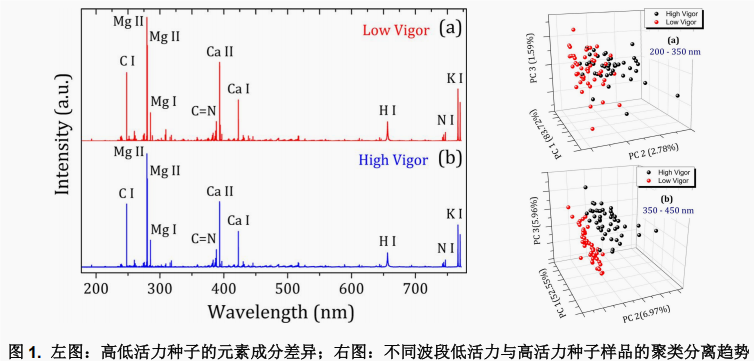
As a soybean exporting country, Brazil's research team has teamed up with an Italian team to use laser-induced breakdown spectroscopy(LIBS)Technology, combined with multivariate analysis and machine learning algorithms, explores the feasibility of quickly and efficiently distinguishing low vitality and high vitality soybean seed batches. Research has found that the main elements of two types of seeds(CTheMgTheCaTheNTheK)There are differences in the intensity of emission peaks, among which the high vitality seeds haveCa ITheCTheC=NTheMg I/IIThe peak intensity is lower than that of low vitality seeds. The results show thatLIBSTechnology combined with principal component analysis(PCA)And support vector machine(SVM)Waiting for machine learning algorithms to efficiently distinguish between low vitality and high vitality soybean seed batches——350-450 nmThe spectral band is the distinguishing region, and calcium element is the core distinguishing factor;SVMThe classification accuracy of the algorithm can reach98.9%Among them, the second timeSVMAnd three timesSVMImplement in high vitality and low vitality seed recognition separately100%accuracy
Seed variety identification

The technical team of Zhejiang University《PLANT SCIENCES》Title:“Fast identification of soybean seed varieties using laser-induced breakdown spectroscopy combined with convolutional neural network”Research article on laser-induced breakdown spectroscopy(LIBS)By combining deep learning technology, rapid identification of soybean seed varieties has been achieved, with single seed detection taking only a short amount of time30Seconds; Among them, the input is the "spectral matrix"2D-PCSA-ResNetmodel performance,Prediction accuracy reaches91.75%The correspondence between the significance map and the peak positions of elements in the study indicates that carbon in soybeans(C)Silicon(Si)Magnesium(Mg)Calcium(Ca)Sodium(Na)The content and proportion of elements are the key to distinguishing differences in varieties; This method provides a new paradigm for the identification of agricultural product varieties and has broad practical application prospects.
Rice quality inspection

Huazhong Agricultural University and Changchun Institute of Optics, Fine Mechanics and Physics focus on micro hyperspectral imaging, Raman spectroscopy, and laser-induced breakdown spectroscopy(LIBS)The applicability of the three technologies in the detection of rice amylopectin and protein content was studied. The impact of rice, brown rice, milled rice and Rice noodles samples on the modeling results of spectral detection was analyzed, and the characteristic variables related to the target components such as amylopectin and protein were screened, aiming to provide a reference for the optimization of nondestructive detection technology for rice quality. The experimental results showed that among the three spectral techniques,LIBSPerformance in the detection of amylopectin and protein content in rice(R² Da0.81)Raman spectroscopy is second, and the imaging effect of microscopic hyperspectral is relatively poor. In addition,LIBSThe selected feature variables have a high degree of matching with the elemental composition of the target component, while the feature variables of Raman spectroscopy are greatly affected by molecular structure and experimental conditions. This study provides a technical comparison basis for non-destructive testing of rice quality,LIBSRaman spectroscopy can be used as a preferred technique, and the detection scheme needs to be further optimized based on the sample type.
Nutrient element and pesticide testing
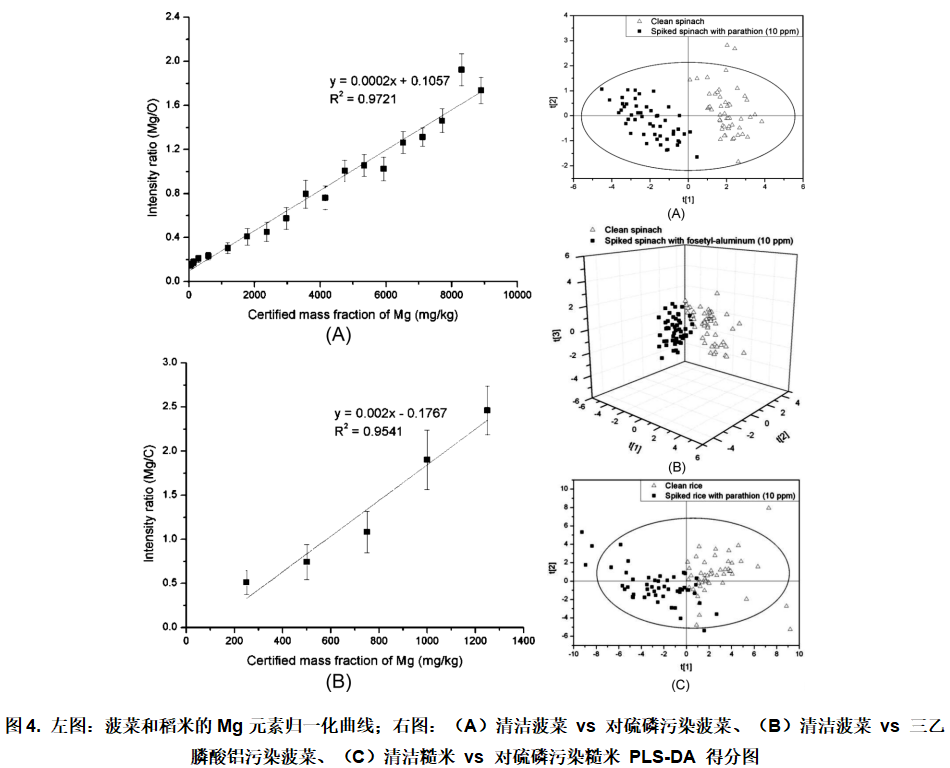
US and South Korean research teams utilizeLIBSTechnology for Key Nutrients in Spinach and Rice(MgTheCaTheNaTheK)Conduct rapid quantitative analysis; At the same time, by combining chemometric methods, rapid differentiation between pesticide contaminated and uncontaminated agricultural products (spinach, rice) has been achieved, effectively solving the problem of traditional methods being difficult to identify pesticide contamination. Although the elements contained in pesticides overlap with the elements of agricultural products themselves, it is impossible to identify pollution through single element detectionPLS-DAMethods can be utilizedLIBSThe distribution characteristics of multi-element emission lines in spectra enable efficient differentiation between contaminated and uncontaminated samples. Among them, the misclassification rate of clean spinach is0,10 ppmThe misclassification rate of spinach contaminated with pesticides is only2%And this method is applicable to aluminum triethylphosphonate pollution, fully verifying the practicality of this technology.
FireFly LIBSPublished literature content
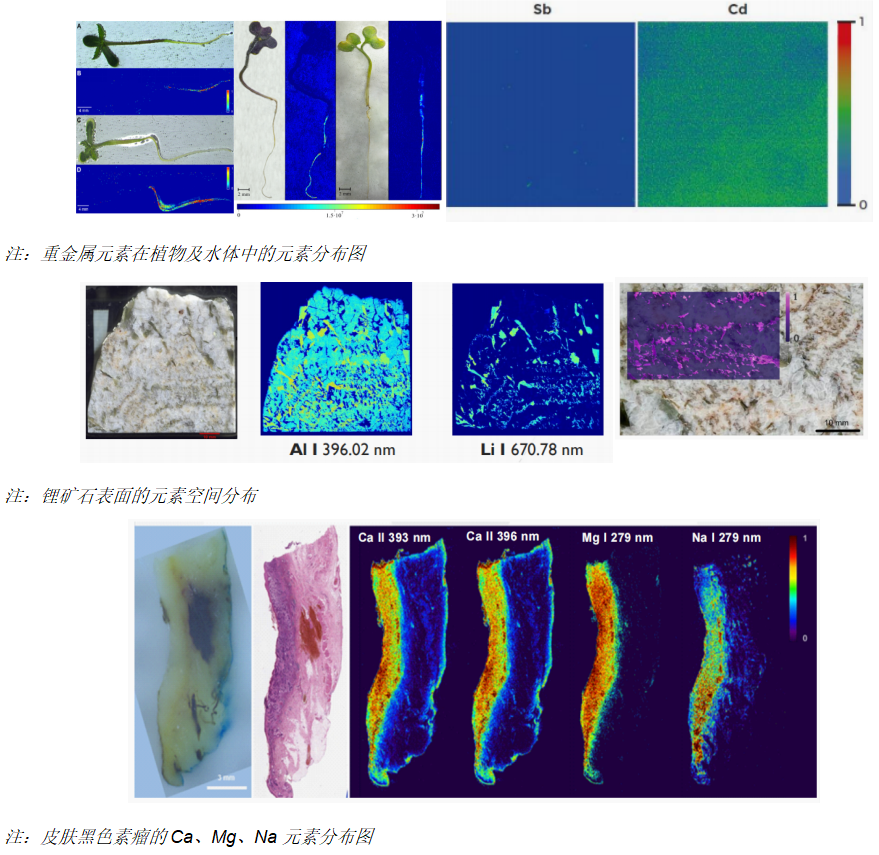
Beijing Yiketai focuses on the research and development of agricultural research equipment and technology promotion. It provides a complete set of instruments and equipment for domestic research institutions, including seed vitality detection, quality assessment, nutrient analysis, and online sorting. It provides efficient technical support for germplasm resource innovation, variety breeding, and industrialization research, including:
²PhenoTronGermplasm Resource Testing System
²SeedSortSeed hyperspectral imaging online analysis platform
²PhenoTronCompound intelligenceLEDLight source cultivation and spectral imaging analysis system
²Thermo-RGBSeed morphology and dynamic thermal imaging fusion analysis system
²High throughput seed respiration and vitality measurement system
²GrainsenseGrain Composition Analysis System
²seedXX-ray imaging analyzer
²Phenotron-apRapid measurement of seed germination rateAPP
1. Kim G, Kwak J, Choi J, et al. Detection of nutrient elements and contamination by pesticides in spinach and rice samples using laser-induced breakdown spectroscopy (LIBS)[J]. Journal of agricultural and food chemistry, 2012, 60(3): 718-724.
2. Larios G S, Nicolodelli G, Senesi G S, et al. Laser-induced breakdown spectroscopy as a powerful tool for distinguishing high-and low-vigor soybean seed lots[J]. Food Analytical Methods, 2020, 13(9): 1691-1698.
3. Li X, He Z, Liu F, et al. Fast identification of soybean seed varieties using laser-induced breakdown spectroscopy combined with convolutional neural network[J]. Frontiers in plant science, 2021, 12: 714557.
4. Guo J, Jiang S, Lu B, et al. Exploring the potential of microscopic hyperspectral, Raman, and LIBS for nondestructive quality assessment of diverse rice samples[J]. Plant Methods, 2025, 21(1): 25.