-
E-mail
sales@eco-tech.com.cn
-
Phone
18210150760
-
Address
101B, Unit 1, Building 6, Courtyard 3, Gaolizhang Road, Haidian District, Beijing
Beijing Yiketai Ecological Technology Co., Ltd
Application of Chlorophyll Fluorescence Imaging Technology in Tissue Culture (Callus)
Date: 2025-12-17Read: 0
In the field of plant tissue culture and stress resistance research, precise analysis of photosynthetic system functions and rapid assessment of stress response are key to breaking through technological bottlenecks. Chlorophyll fluorescence signal as a physiological state of plant photosynthesisThe 'ideal probe' can reflect the activity and structural integrity of the photosynthetic system in real time, providing core data support for researchers. Yiketai chlorophyll fluorescence imaging technology, with its advantages of non-destructive detection, high spatial resolution, and multi parameter synchronous analysis, has been deeply applied in scenarios such as callus culture, tissue culture seedling stress assessment, and stress mechanism exploration. The following will demonstrate three typical research cases in detailFluorCamThe application and value of chlorophyll fluorescence imaging technology in tissue culture (callus) related research.
case1:Efficient induction and cultivation system of callus tissue in winter
Duandong is an important medicinal plant, and introducing it into laboratory culture through in vitro cultivation can provide valuable insights for future cultivationThe inexhaustible medicinal plant resources lay the foundation. The aim of this article is to establish an efficient induction and cultivation system for the callus tissue of Platycodon grandiflorus, and systematically analyze its growth kinetics, morphological structure, photosynthetic activity, and biochemical characteristics. Research has found that in the presence of3 mg/L IAAand2 mg/L BAPofMSUnder dark conditions, solid culture medium can successfully induce and maintain vigorous growth of callus tissue. This callus tissue has the potential for organogenesis and somatic embryogenesis, and is suitable as a biotechnological source for the production of medicinal metabolites. The research results show that the photosynthetic activity of callus tissue is relatively lowFv/Fm(Photosynthetic systemIIquantum efficiency)Basically lower than0.1However, after being cultured under light, the callus tissue formed buds, and its photosynthetic efficiency was significantly improved, indicating that its cells still retained some of the assembly and function of the photosynthetic device.

case2:lowCO2Horizontal interference with photosynthetic function and accumulation of reactive oxygen speciesTissue cultured seedlingsharmful
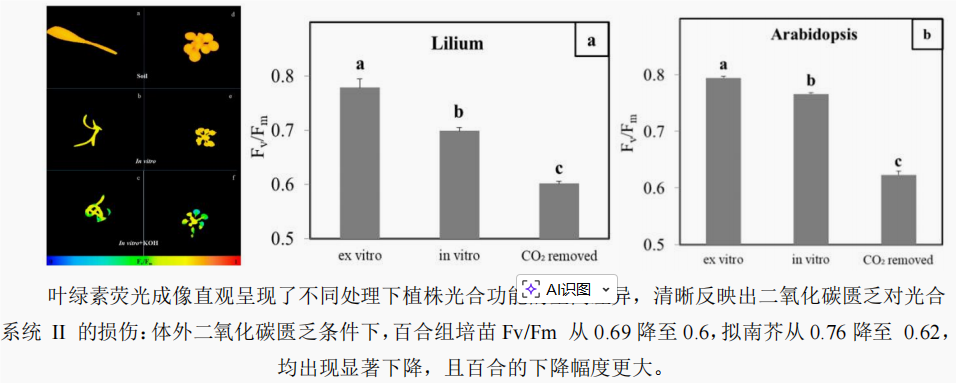
This study takesOrganizational cultivationLily scales (regenerated adventitious bulbs) and Arabidopsis seedlings were used as materials, and concentrated in a culture containerKOHSolution removes carbon dioxide and explores its effects on tissue culture seedlings. The results show thatlowCO2Under the levelLily regeneration bulbandArabidopsis seedling growthWeaken, addSucrose can only partially restore growth.ROSa large amount ofaccumulate.Fv/Fmrespectively from0.69、0.76 drop to0.60、0.62ButIn vitro seedlings growing in soilBoth of themFv/Fmrespectively0.77、0.79This indicates that low carbon dioxide concentration can interfere with photosynthetic function and trigger tissue culture stress, and the poor growth of tissue culture seedlings is partly due to a significant decrease in photosynthetic capacity.
case3:The effects of biotic and abiotic stress factors on tissue culture and development of European white wax tree
Biological stress(Mainly fungi, such asHymenoscyphus fraxineus)andNon biological threat(such asAccumulation of heavy metals and salinity in soil)It is an important factor affecting the population of European white wax tree speciesThis study utilized in vitro culture techniques (based on callus tissue and seedlings regenerated through indirect organ regeneration) to investigate the threat level of these biotic and abiotic stress factors to European white wax trees. The results show. HFraxinianHas pathogenic potential,14 Within a day, it can cause cell death in callus tissue, and the tissue cannot activate defense mechanisms; The concentration is0.027 mmol/LCadmium has high toxicity; Salinity can cause differences in oxidase activity between seedlings and callus tissues, indicating that these enzymes play a role in regulating the morphogenesis and development of tissue culture.
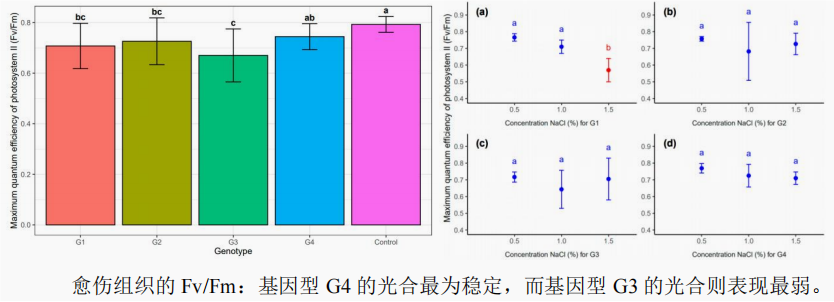
The effects of salinity on callus tissue and seedlings are mainly detected through two aspects: antioxidant enzyme activity and photosynthetic efficiency. among which,FluorCamThe results of chlorophyll fluorescence imaging technology showed that,Regardless of the concentration of sodium chloride, the callus tissueFv/FmThe value is always lower than that of the seedlings. This may be due to the difference in the maturity of photosynthetic devices between these two plant materials,The cellular tissue in seedling leaves canmoreefficientlandUtilize light energy and minimize the damage caused by its excess.This tooRevealed different developmental stages (or tissue types) of plants)The correlation between the maturity of the photosynthetic system and stress tolerance provides data support for further research on plant stress resistance mechanisms
References:
[1]Bojko, M., Kędra, M., Adamska, A., Jakubowska, Z., Tuleja, M., & Myśliwa-Kurdziel, B. (2024). Induction and characteristics of callus cultures of the medicinal plant Tussilago farfara L. Plants, 13(21), 3080.
[2]Askari, N., Aliniaeifard, S., & Visser, R. G. (2022). Low CO2 levels are detrimental for in vitro plantlets through disturbance of photosynthetic functionality and accumulation of reactive oxygen species. Horticulturae, 8(1), 44.
[3]Nawrot-Chorabik, K., Sułkowska, M., Osmenda, M., Mohytych, V., Surówka, E., & Latowski, D. (2022). The Impact of biotic and abiotic stress factors on development of European ash tissue cultures. Forests, 13(1), 59.
Yiketai Ecological Technology——Chlorophyll fluorescence technology expert
Yiketai is committed to providing chlorophyll fluorescence technology solutions for scientific research and application fields, including:
ØFluorCamChlorophyll fluorescence imaging technology
ØPlantScreenPhenotypic imaging technology,From FluorCam to PlantScreen Platform
ØFluorTron ®Photosynthetic phenotype imaging analysis technology, including chlorophyll fluorescence dynamic imaging, spectral imaging, multispectral imaging3DA comprehensive solution for imaging, plant photosynthetic phenotype, and photosynthetic physiology
ØFluorTron ®Multi functional chlorophyll fluorescence measurement technology, based on the dynamics of chlorophyll fluorescence(time-resolved)Chlorophyll fluorescence spectrum(spectral-resolved)Comprehensive analysis of chlorophyll fluorescence and simultaneous imaging analysis of reflected light
ØFluorTron ®intelligenceLEDOnline monitoring system for light source cultivation and chlorophyll fluorescence imaging
ØFluorTron-ROBOTChlorophyll fluorescence inspection robot