-
E-mail
sihdgj@qq.com
-
Phone
17091080008
-
Address
Jinyu Dacheng Era 1508, Fengtai District, Beijing
Beijing Sihuan Qihang Technology Co., Ltd
Laboratory Freeze Drying Machine Operation Guide: 4 Key Points to Build a Strong Defense Line for Sample Drying and Equipment Safety
Date: 2025-11-06Read: 0
The laboratory freeze dryer (freeze dryer), with its core advantage of "low-temperature vacuum sublimation drying", plays an irreplaceable role in preserving the activity of biological samples, ensuring the purity of chemical reagents, and improving the stability of drug development. It has become a "scientific research essential equipment" in fields such as molecular biology, pharmaceutical engineering, and material research and development. However, its precise refrigeration and vacuum systems require high operational standards, and even minor operational errors can lead to sample failure, data deviation, and even equipment malfunction. This article summarizes four core operational precautions to help researchers accurately control each step of the process, achieving a dual guarantee of sample drying effect and equipment lifespan.
1、 Pre cooling preparation: precise temperature control+component inspection to eliminate potential startup hazards
The pre cooling process before starting the freeze dryer directly determines the stability of the initial state of the sample, and requires a dual requirement of "temperature compliance" and "component integrity". It is recommended to reserve 30-60 minutes of pre cooling time according to the device model, with the core goal of stabilizing the temperature of the cold trap in the range of -40 ℃~-60 ℃ (some high-sensitivity sample adaptation devices need to be lowered to below -80 ℃), to avoid problems such as ice crystal melting and degradation of active ingredients due to cooling lag after sample filling. During the pre cooling period, three core checks need to be completed simultaneously: first, observe whether there are any leakage marks in the refrigerant circulation pipeline to ensure the efficient operation of the refrigeration system; Secondly, start the vacuum pump and run it without load for 3-5 minutes to check for any abnormal sounds, vibrations, or other conditions; The third is to check the fit of the sealing cover of the cold trap. The sealing of the gap can be tested by a tissue. If the temperature continues to not meet the standard or there is air leakage, the machine should be stopped immediately and after-sales maintenance should be contacted to avoid the fault expanding and affecting the core performance of the equipment.
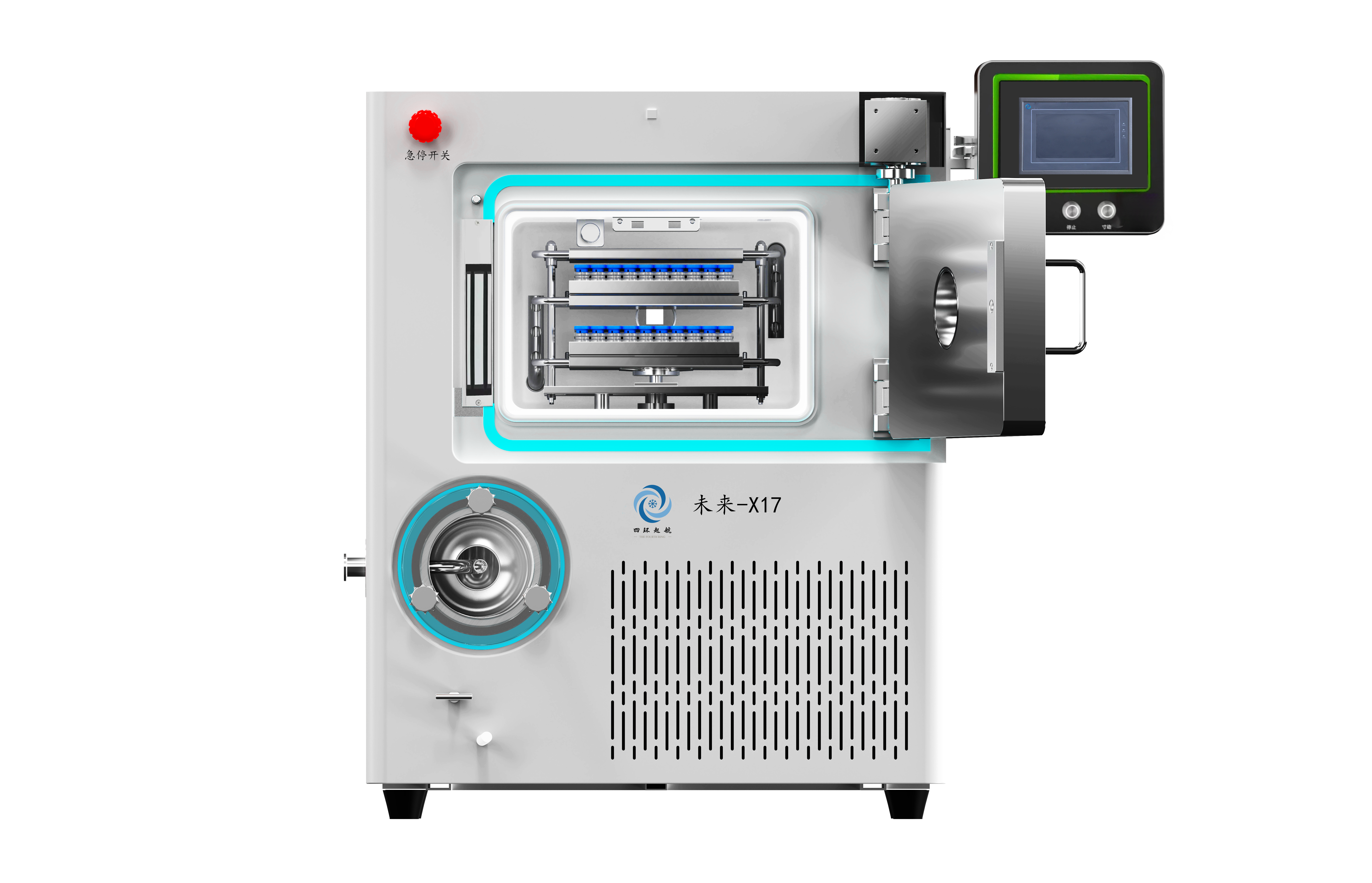
2、 Vacuum system maintenance: regular maintenance+real-time monitoring to ensure sublimation efficiency
As the "power core" of the freeze dryer, the status of the vacuum pump directly affects the rate of moisture sublimation and drying performance, and a dual management mechanism of "regular maintenance+each monitoring" needs to be established. In terms of daily maintenance, it is necessary to strictly follow the equipment manual for a deep maintenance every 300 hours: replace the dedicated vacuum pump oil in a timely manner (the oil level should always be kept between the scale lines, and if the oil quality is found to be cloudy or blackened, it should be replaced immediately to avoid impurities from damaging the pump body); Regularly clean the dust and sample residue on the intake filter screen to prevent blockage and affect the vacuum degree. During the experimental operation, a vacuum gauge should be continuously monitored after each start-up to ensure that the vacuum degree is stable below 5Pa (special tolerance samples can be relaxed to 10-50Pa). After the vacuum degree meets the standard, the sample can be filled to avoid drying due to insufficient vacuumin placeThere is a phenomenon of moisture regain.
3、 Sample filling specification: Quantitative control+uniform distribution to improve drying consistency
The scientificity of sample filling is the key to ensuring the uniformity of drying effect, and it is necessary to follow the two principles of "quantity control+distribution". Considering the airflow circulation characteristics of the drying chamber, the sample filling height in the tray should not exceed one-third of the tray depth, and stacking is strictly prohibited to prevent differences in drying speed caused by airflow obstruction of lower level samples; Granular samples shall be crushed in advance to the particle size ≤ 5mm, and evenly spread with tools to ensure that the sublimation surface area of each sample is consistent. If the filling specifications are ignored, it is easy to encounter problems such as "local excessive drying and clumping, local residual moisture", which not only affects the repeatability of experimental data, but also may cause difficulties in subsequent sampling due to sample adhesion, especially for highly sensitive samples such as biological agents and nanomaterials, which will directly lead to experimental failure.

4、 Cleaning and disinfection process: Handle immediately after use to avoid cross contamination and component corrosion
Laboratory freeze dryers often come into contact with microbial samples, drug intermediates, chemical reagents, etc. After use, cleaning and disinfection should be carried out "in a timely manner" to avoid cross contamination of subsequent samples with residual substances, reduce damage to equipment components caused by chemical corrosion, and extend the service life. When cleaning, turn off the power first and wait for the equipment to cool down to room temperature before disassembling removable parts such as trays and sealing gaskets. Use anhydrous ethanol or specialized cleaning agents to wipe the surface residual samples. For stubborn stains, use a soft brush to clean (avoid scratching the parts with hard scrapers); The sealing ring should be regularly wiped with silicone maintenance agent to prevent aging and hardening, which may affect the sealing performance; After cleaning, the components need to be dried and reassembled, and the interior of the equipment should be kept ventilated and dry to avoid bacterial growth or component corrosion in humid environments.
In summary, the stable operation of laboratory freeze dryers relies on the dual guarantee of "standardized operation+refined maintenance". It is suggested that the research team establish an equipment operation ledger to record in detail the pre cooling temperature, vacuum degree data, sample type, cleaning situation, and maintenance records of each experiment, and optimize operating parameters through data accumulation. Only by integrating every detail into daily operations can the performance advantages of the freeze dryer be fully utilized, providing solid support for the accuracy and reliability of scientific research experiments.