-
E-mail
31775247@qq.com
-
Phone
13911991473
-
Address
Room 403, Building 15, No. 109 Jinghai 3rd Road, Daxing District, Beijing, China
Beijing Qinye Zhiyuan Technology Co., Ltd
Recommended TC-DUST500 type light scattering laser dust analyzer
Date: 2025-08-26Read: 0
The light scattering laser dust analyzer is an air quality monitoring device designed based on the principle of laser scattering, mainly used for real-time detection of the concentration of suspended particles in the air. By shining a laser beam onto a dusty airflow, the beam generates scattered light. The higher the dust concentration, the greater the intensity of the scattered light generated. By measuring the intensity of the scattered light, the dust concentration can be calculated.
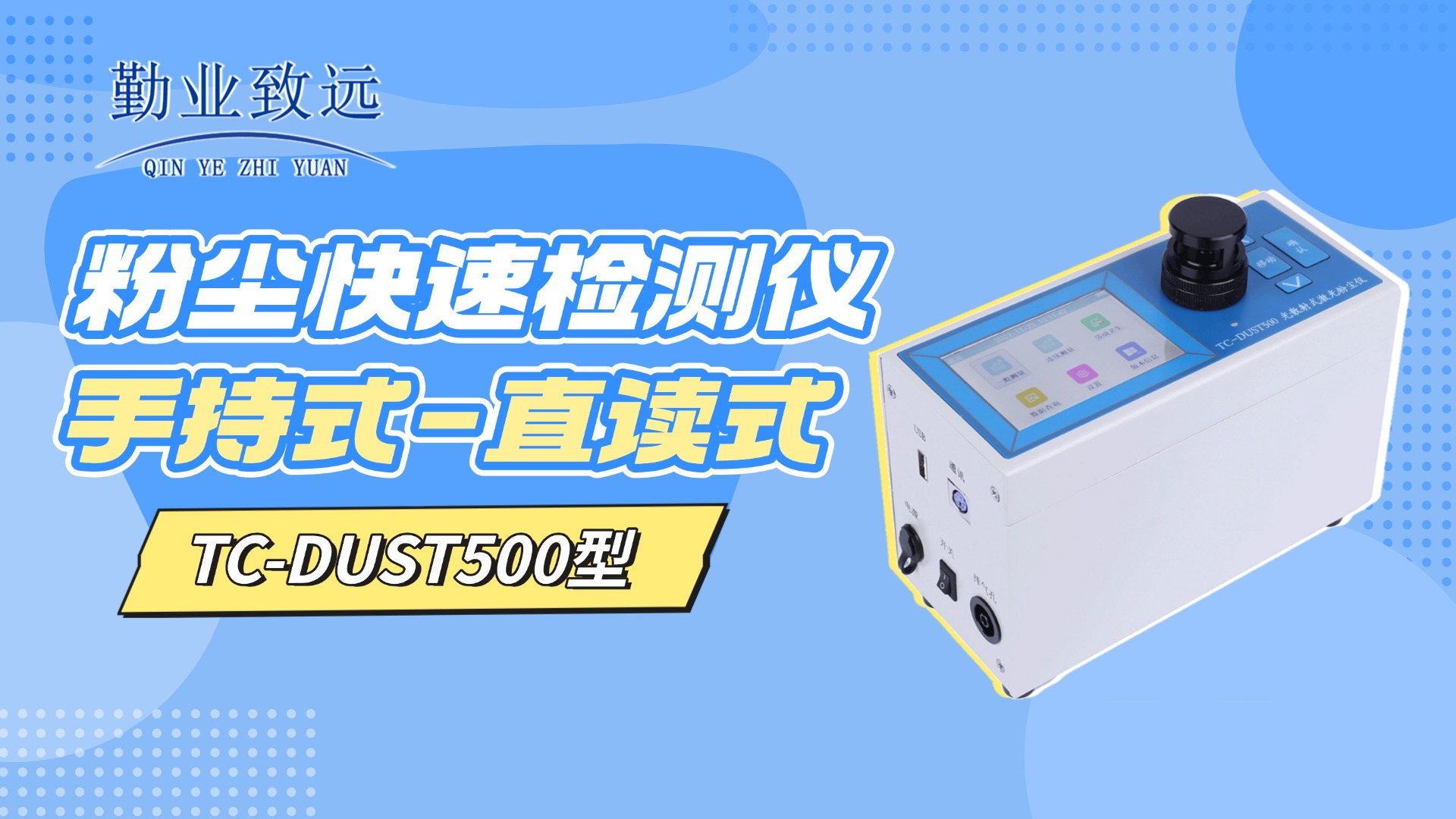
Fast detection: Results can usually be obtained within 1 minute, which can quickly reflect changes in dust concentration in the air.
High sensitivity: It can detect dust concentrations as low as 0.001mg/m ³ and accurately capture subtle changes in dust particles.
Good stability: with good repeatability, the error can be controlled within ± 2%, and the measurement accuracy is relatively high, generally ± 10%.
Easy to operate: Equipped with a touch screen, the interface is intuitive, the operation is simple, and it also has functions such as automatic zeroing and self-cleaning, reducing manual maintenance costs.
Application field
Industrial production: used for monitoring dust concentration at production sites of industrial and mining enterprises to ensure the occupational health of workers, such as mining, metallurgy, power plants, chemical industries, etc.
Environmental monitoring: applicable to the detection of atmospheric dust, PM10, PM2.5, PM1, TSP, and pollution source investigation by environmental protection departments.
Public places: Rapid testing of air quality can be conducted in schools, hospitals, shopping malls, and other public places to provide a healthy environment for the public.
Research field: In scientific research, filter performance testing, etc., it can be used for on-site testing to provide data support for related research.
1. Equipped with a sheath gas protection system and a 40mm filter membrane for detecting concentration, it can also collect dust samples.
2. Measurement of particle size: PM10, PM5, PM2.5, PM1, TSP, and total dust
PM10 particulate matter capture characteristics: Da50=10 μ m ± 0.5 μ m, σ g=1.5 ± 0.1.
PM2.5 particulate matter capture characteristics: Da50=2.5 μ m ± 0.2 μ m, σ g=1.2 ± 0.1.
Da50 is the aerodynamic diameter of particulate matter corresponding to a capture efficiency of 50%; σ g is the geometric standard deviation of capture efficiency.
Note 1: The correction particles are polystyrene particles with an average particle size of 0.6 μ m and a geometric standard deviation of σ ≤ 1.25;
Note 2: CPM is a method of expressing relative concentration by counting pulses per minute.
3. The LCD display directly reads the dust mass concentration (mg/m ³) and displays the data measurement curve.
4. Measurement sensitivity: For calibration particles, the instrument counts 1CPM=0.001mg/m3;
5. Repetitive error: ± 2%;
6. Relative measurement error: For calibrated particles, the relative measurement error is less than ± 10%;
7. Measurement range: 0.001-500 mg/m ³;
8. Equipped with the function of eliminating humidity interference (humidity correction), it can be used under conditions of high relative humidity (>50%) in the environment.
9. Equipped with a powerful suction pump, it can reduce the impact of air velocity on measurement results.
10. Measurement time: 1 minute, users can set it according to their requirements.
11. Continuous monitoring: general measurement, continuous monitoring, labor hygiene.