-
E-mail
titan_market@bjjitian.com
-
Phone
18910230180
-
Address
Jiuxianqiao East Road, Chaoyang District, Beijing
Beijing Jitian Instrument Co., Ltd
Working principle of single quadrupole gas chromatography-mass spectrometry (GC-MS)
Date: 2025-04-18Read: 0
Working principle of single quadrupole gas chromatography-mass spectrometry (GC-MS)
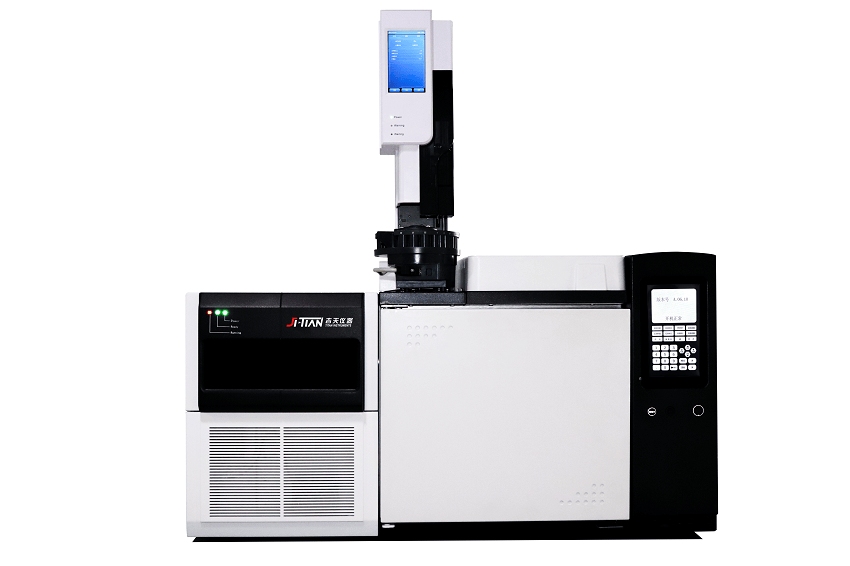 GC-MS 8700 single quadrupole gas chromatography-mass spectrometer
The single quadrupole gas chromatography-mass spectrometry (GC-MS) combines the separation ability of gas chromatography (GC) and the detection ability of mass spectrometry (MS) to achieve qualitative and quantitative analysis of complex samples through the following steps:
1. Gas chromatography separation
- Sample vaporization: Liquid or gaseous samples vaporize at the injection port and are carried into the chromatographic column by an inert carrier gas (such as helium).
- Column separation: Different components flow out of the column in chronological order due to differences in their distribution coefficients in the stationary and mobile phases, achieving physical separation.
2. Mass spectrometry detection
The separated components enter the mass spectrometer in sequence and undergo the following process:
① Ionization (ion source)
- Electron bombardment (EI): Component molecules are bombarded by high-energy electron beams, losing electrons to form positive ions (molecular ions or fragment ions).
② Quality screening (four level bar quality analyzer)
- Electric field screening: The four stage rod forms a dynamic electric field by applying direct current voltage (DC) and radio frequency voltage (RF), allowing only ions with a specific mass to charge ratio (m/z) to pass through stably, while the remaining ions are filtered out if they deviate from the orbit.
- Full scan/selective ion monitoring (SIM): Multiple ions can be detected through scanning voltage range (full scan), or target ions can be selectively monitored with fixed voltage (SIM).
③ Signal detection (detector)
- Electron multiplier: a screened ion impact detector that converts into an electrical signal and amplifies it to generate a mass spectrum.
3. Data analysis
- Mass spectrometry analysis: Determine the compound structure by comparing the characteristics of ion fragments with the standard spectral library.
- Chromatographic peak integration: Combining retention time and peak area to achieve quantitative analysis.
Core strengths
- High sensitivity: capable of detecting trace substances (ppm/ppb level).
- High selectivity: Accurately distinguish compounds by mass to charge ratio.
- Widely used in fields such as environmental monitoring, food safety, and drug analysis.