-
E-mail
titan_market@bjjitian.com
-
Phone
18910230180
-
Address
Jiuxianqiao East Road, Chaoyang District, Beijing
Beijing Jitian Instrument Co., Ltd
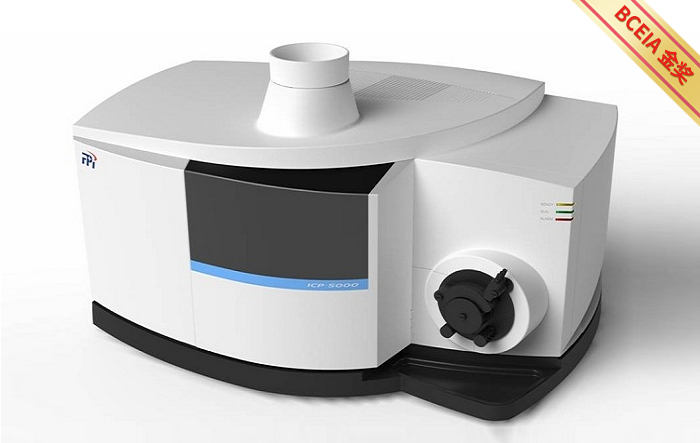
ICP-5000 inductively coupled plasma spectrometer for detecting water-soluble salts in soil
Date: 2025-06-26Read: 0
In the field of soil science research, soil salinization has always been one of the key factors restricting agricultural production. By accurately analyzing water-soluble salts in soil, scientific and detailed classification of saline soil can be carried out, providing important basis for the rational utilization of soil resources and the sustainable development of agricultural production.
It is worth noting that water-soluble potassium, sodium, calcium, and magnesium ions account for a large proportion in the composition of soil water-soluble salt bases. These ions are not only important components of soil nutrients, but also have a profound impact on the physical and chemical properties of soil such as acidity, alkalinity, and osmotic pressure. For example, excessive sodium ion content can lead to soil compaction and structural deterioration, affecting crop root growth and absorption of water and nutrients; Potassium ions are one of the essential macroelements for crop growth, playing an important role in improving crop stress resistance and quality.
So, how to accurately determine the content of these key ions in soil? At present, the analysis method for water-soluble salts in soil usually involves shaking extraction of soil and distilled water in a ratio of 1:5 to remove carbon dioxide.
In order to further improve the accuracy and reliability of the analysis, an inductively coupled plasma emission spectrometer (ICP-5000) from Beijing Jitian Instrument Co., Ltd. (hereinafter referred to as "Jitian Instrument") was used to conduct in-depth research on the optimal testing conditions for simultaneously determining water-soluble potassium, sodium, calcium, and magnesium elements in soil. Inductively coupled plasma emission spectrometer has the advantages of high sensitivity, good selectivity, and simultaneous determination of multiple elements, which can quickly and accurately analyze the elemental content in soil samples.
In the research process, the various parameters of the instrument were first optimized and adjusted. Secondly, strict detection limits, precision, and spiked recovery experiments were conducted to ensure the reliability of the analysis results.
The detection limit experiment showed that the method achieved extremely low detection limits for potassium, sodium, calcium, and magnesium, which can meet the analysis needs of trace elements in soil
The precision experiment results show that the relative standard deviation of multiple repeated measurements is small, indicating that the method has good repeatability and stability;
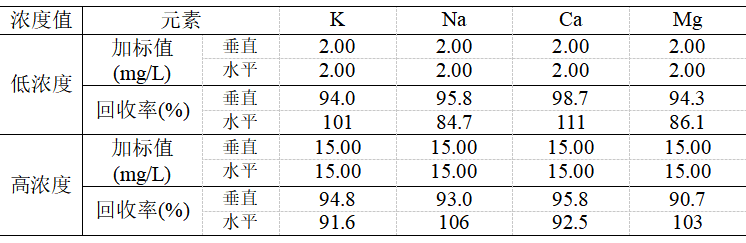
The spiked recovery rate experiment further verified the accuracy of the method, and the spiked recovery rates of the four elements were within a reasonable range.
Experimental Procedure
1.1 Instruments and reagents
Instrument:Inductively coupled plasma emission spectrometer (ICP-5000), reciprocating oscillator, centrifuge.
Reagent:Deionized water and nitric acid solution.
1.2 Experimental Methods
Accurately weigh 20g of air dried soil that has passed through a 2mm sieve using a balance, place it in a dry 200mL plastic bottle, accurately add 100mL of 5% nitric acid solution using a graduated cylinder, add a stopper, and shake on a shaker at 180r/min for 3 minutes. After the oscillation is completed, pour the extraction solution into a 100mL centrifuge tube and centrifuge at a centrifugation rate of 4000r/min for 10 minutes. Then, filter the upper clear liquid through a quantitative filter paper into a dry 100mL stoppered triangular flask. Measure potassium, sodium, calcium, and magnesium in the filtered solution separately.
2 Results and Discussion
2.1 Results of standard curve determination
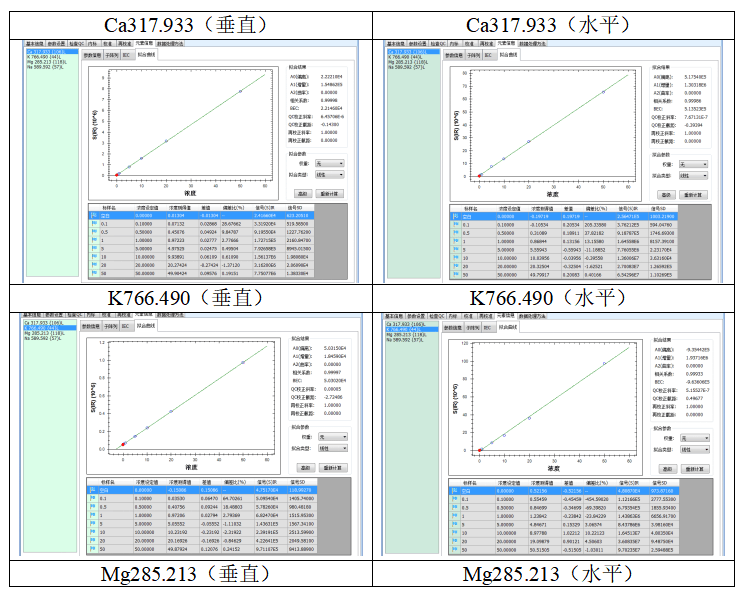
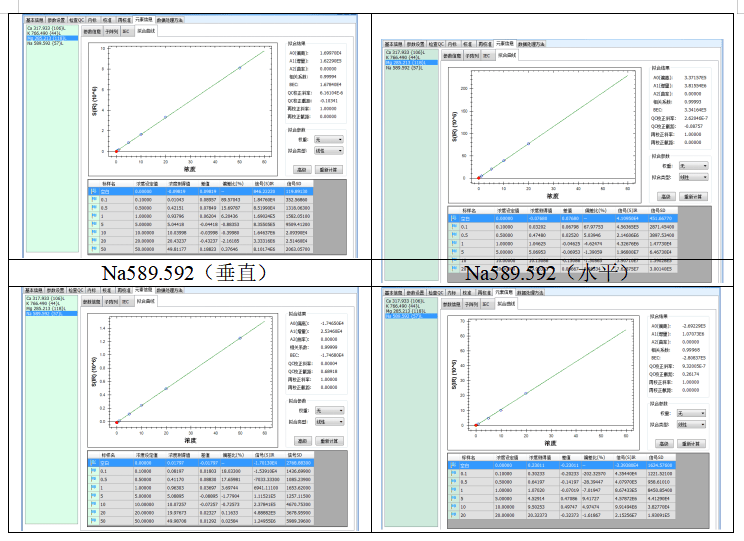
Inject the prepared standard curve solution into the instrument to determine the standard curve results of each element, as shown in Table 1.
Table 1 Determination results of standard curves for each element
2.3 Method detection limit
Take the results of 20 parallel determinations of blank solution, and calculate the detection limits of each element based on 3 times the standard deviation of blank solution, as shown in Table 2.
Table 2 Detection limits of four elements (unit: mg/L)

2.4 Precision Test
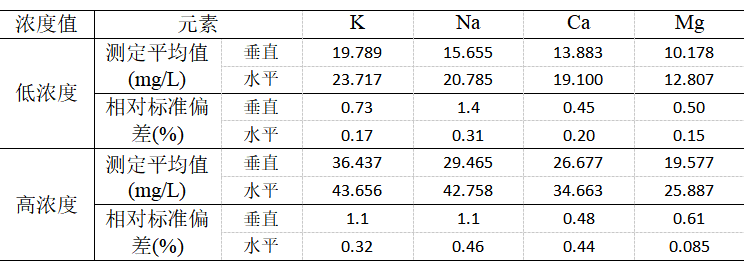
According to the working conditions of this method, 7 parallel measurements were conducted on the sample, and the relative standard deviation (RSD) was between 0.085% and 1.4%, indicating that the precision of this method is good and can meet the measurement requirements. The results are shown in Table 3.
Table 3 Precision tests for high and low concentrations of four elements
2.5 Recovery rate test
In order to confirm the reliability of the analysis results and understand the presence of interfering elements in the soil, this method is applied to conduct spiked recovery tests on the leaching solution. Add a certain amount of potassium, sodium, calcium, and magnesium standards to the extraction solution, and determine them according to the analytical method. The results are shown in Table 4.
Table 4 Recovery Test of Four Elements with High and Low Concentrations
empirical conclusion
The analysis method for water-soluble potassium, sodium, calcium, and magnesium in soil described in this article is determined using the inductively coupled plasma emission spectrometer ICP-5000 from Beijing Jitian Instrument Co., Ltd. The test substance is extracted using a 5% nitric acid solution, and the linear correlation number of this method is above 0.999; The quantitative repeatability ranges from 0.085% to 1.4%; The recovery rate of spiked samples is 84.7% -111%. After calculation, this method can meet the detection requirements.
Through in-depth analysis of water-soluble salts in soil, not only can the salinization status of soil be accurately grasped, but it can also provide strong support for rational land use planning and the development of scientific soil improvement plans. On this basis, reasonable planting and irrigation can be achieved to improve the efficiency and quality of agricultural production, thereby promoting the sustainable development of agriculture.
In the future, Jitian Instrument will continue to explore more advanced and efficient analytical methods and technological means, contributing more wisdom and strength to soil science research and agricultural production practice.