-
E-mail
titan_market@bjjitian.com
-
Phone
18910230180
-
Address
Jiuxianqiao East Road, Chaoyang District, Beijing
Beijing Jitian Instrument Co., Ltd
Basic principles and application areas of near-infrared spectroscopy analyzer
Date: 2025-03-18Read: 0
Near infrared analyzer (NIR analyzer) is an analytical instrument based on near-infrared spectroscopy technology, mainly used for rapid and non-destructive detection of the chemical composition and physical properties of substances. The technical principles mainly include the following aspects:
1. Basic principles of near-infrared spectroscopy
Near infrared spectroscopy refers to electromagnetic waves with a wavelength range of 780 nm to 2500 nm (wave number range of approximately 12800 cm ⁻¹ to 4000 cm ⁻¹). When near-infrared light interacts with matter, it mainly excites the vibrational energy level transitions of hydrogen containing groups (such as C-H, O-H, N-H, etc.) in molecules, producing absorption spectra. These absorption spectra are closely related to the chemical structure of the substance, so the composition and properties of the substance can be inferred by analyzing the spectra.
2. Spectral acquisition
A near-infrared analyzer emits near-infrared light from a light source (usually a halogen lamp or LED) and illuminates the sample. After the sample absorbs some of the light energy, the transmitted or reflected light is captured by a detector (such as InGaAs detector), forming a spectral signal. According to the state of the sample (solid, liquid, or powder), different measurement modes such as transmission, reflection, or diffuse reflection can be selected.
3. Chemometrics and Modeling
Near infrared spectra typically contain a large number of overlapping absorption peaks, making direct analysis difficult. Therefore, near-infrared analyzers rely on chemometric methods such as multiple linear regression, principal component analysis, partial least squares, etc. to process and analyze spectral data. By establishing a mathematical model between spectra and target properties such as moisture, protein, fat content, etc., instruments can quickly predict the composition of unknown samples.
4. Non destructive testing
The biggest advantage of near-infrared analyzer is its non-destructive testing capability. Samples do not require pre-treatment and can be directly measured, making them suitable for online detection and real-time monitoring. They are widely used in fields such as agriculture, food, pharmaceuticals, and chemical engineering.
5. Instrument composition
A near-infrared analyzer typically consists of the following parts:
- light sourceEmission of near-infrared light.
- sample poolThe area where the sample is placed can be a transmission cell, a reflection cell, or a diffuse reflection cell.
- Spectral systemDecompose composite light into monochromatic light, commonly using techniques such as gratings and Fourier transform.
- detectorConvert optical signals into electrical signals.
- data processing systemProcess and analyze spectral data, and output results.
6. Application Fields
Near infrared analyzers are widely used in:
- agricultureDetect the moisture, protein, fat, etc. of grains and feed.
- food industryAnalyze the nutritional composition, quality, etc. of food.
- pharmaceuticalRapid detection and quality control of drug ingredients.
- chemical industryAnalysis of the composition of raw materials and products.
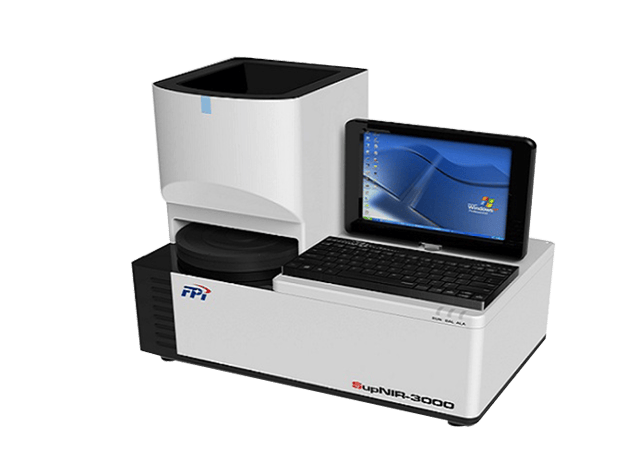 SupNIR-3000 series laboratory near-infrared analyzer
summary
The near-infrared analyzer sold by Beijing Jitian Instrument Co., Ltd. achieves rapid and non-destructive detection of material composition and properties through near-infrared spectroscopy technology combined with chemometric methods. Its core lies in spectral acquisition, data processing, and model building, which have the advantages of high efficiency, convenience, and non destructiveness, and are widely used in multiple industries.