-
E-mail
2822343332@qq.com
-
Phone
15810615463
-
Address
Mapo Xiangyue Sijisan District, Shunyi District, Beijing
Beijing Jingke Zhichuang Technology Development Co., Ltd
Piezoelectric Ceramics: Diversified Exploration of Materials and Forming Processes for ZJ-3 Precision D33 Tester
Date: 2025-10-17Read: 1
Piezoelectric Ceramics: Diversified Exploration of Materials and Forming Processes for ZJ-3 Precision D33 Tester
Piezoelectric Ceramics: Diversified Exploration of Materials and Forming Processes for ZJ-3 Precision D33 Tester
Data compilation: Beijing Jingke Zhichuang Technology Development Co., Ltd
Keywords: Precision D33 testing, PZT, Polarization, hysteresis loop
Piezoelectric ceramics, as a key branch of electronic ceramics, are functional ceramic materials that can achieve the conversion of mechanical and electrical energy. Its unique positive and negative piezoelectric effects make it play an important role in various fields such as piezoelectric sensors, drivers, ultrasonic transducers, piezoelectric buzzers, and filters. At present, piezoelectric ceramics mainly use solid solutions such as lead zirconate titanate (PZT) and lead magnesium niobate as raw materials. Although these materials have significant brittleness, they can be easily prepared into sheet-like piezoelectric ceramics through forming processes such as dry pressing, isostatic pressing, film rolling, and casting. At present, the mainstream and reliable instrument in the market: ZJ-3 precision D33 tester (developed by Chinese Academy of Sciences&Jingke Zhichuang, with functionsD31 block fixture, D15 block fixture, D15 circular tube fixture, D31 block fixture, thin film stretching fixture (new function), coplanar electrode function (new))PZT-JH10/4 piezoelectric polarization device (10KV, 4 channels), PZT-JH30/1 piezoelectric composite polarization device (thin film+block+air+silicone oil), FE-5000 ferroelectric tester (thin film+block+variable temperature+probe station), JKZC-03A piezoelectric impedance analyzer, these complete sets of equipment are included.
However, with the continuous improvement of device performance and practical applications, the structural design of piezoelectric ceramics has become increasingly complex and precise, and conventional molding methods are no longer able to meet these new demands. Therefore, how to effectively prepare piezoelectric ceramics with complex structures has become a common focus of attention among current researchers.
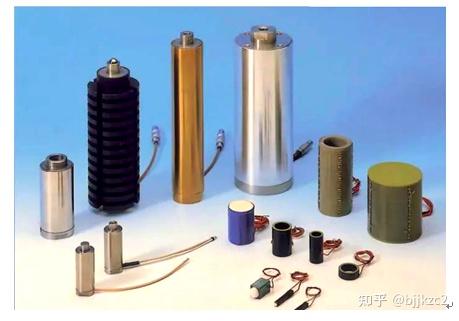
1. Principle and preparation process of piezoelectric ceramics
The piezoelectric effect of piezoelectric ceramics originates from the difference in charge distribution of ceramic crystals and the conductivity of electrodes. In its natural state, ceramic crystals exhibit electrical neutrality. However, when piezoelectric ceramics are subjected to mechanical stress or pressure, their crystal structure undergoes minor distortions, resulting in uneven distribution of positive and negative charges, which in turn generates an electric field. This electric field is then effectively collected by the electrodes and used by external circuits. Therefore, ceramic crystals and electrodes can be regarded as the core components of piezoelectric ceramics. The preparation process includes four key steps: the production of ceramic embryos, sintering, electrode coating, and polarization treatment.
2. Principle of piezoelectric effect
The piezoelectric effect is the core principle of piezoelectric ceramics. When piezoelectric ceramics are subjected to external forces such as mechanical stress or pressure, their crystal structure undergoes slight deformation, leading to the redistribution of positive and negative charges in the crystal and the generation of an electric field. This electric field can be effectively captured by electrodes and output to external circuits, achieving energy conversion and utilization.
★ Adopting key testing equipment:
At present, our country is paying more and more attention to material testing. Many units and research institutions have encountered significant problems in product identification. However, to truly test materials, it is necessary to choose a precise and reliable testing product. This will have a great impact on our testing results and research, and provide great guidance for our production.
ZJ-3 piezoelectric tester (static pressure coefficient d33 measuring instrument), PVDF piezoelectric film tester
Keywords: piezoelectric, ceramic materials, polymers, d33/d15

1、 Product Introduction:
The ZJ-3 piezoelectric tester (static pressure coefficient d33 measuring instrument) is a specialized instrument designed to measure the d33 constant of piezoelectric materials. It can be used to measure piezoelectric ceramics with large piezoelectric constants, piezoelectric single crystals with small piezoelectric constants, and piezoelectric polymer materials. In addition, it can also measure the equivalent piezoelectric d'33 constant of any oriented piezoelectric single crystal and certain piezoelectric devices. The instrument has a wide measurement range, fine resolution, high reliability, simple operation, and no special requirements for sample size and shape. Circular discs, rings, tubes, blocks, strips, columns, and hemispherical shells can be measured, and the measurement results and polarity are directly displayed on a three and a half digit panel meter. The ZJ-3 model has added functions such as discharge protection, discharge prompt, and waveform output for the tested components, enabling the instrument to provide high-voltage discharge prompt and protection when measuring non discharged (especially large-sized) piezoelectric components. This instrument is used in the production, application, and research departments of piezoelectric materials and piezoelectric components.
2、 Main application areas: non-destructive testing ultrasonic testing, medical ultrasonic testing, aerospace, oil and gas equipment, automotive IoT, industry, consumer programs, etc.
3、 Reference standards:
GB3389.4-82 "Testing Methods for Properties of Piezoelectric Ceramic Materials - Static Test of Longitudinal Piezoelectric Strain Constant d33"
GB/T3389.5-1995 "Testing methods for properties of piezoelectric ceramic materials - Circular thickness expansion vibration mode"
GB000? Tj1.1/T3389.4-1982 "Testing Method for Properties of Piezoelectric Ceramic Materials - Longitudinal Length Expansion Vibration Mode of Column"
GB/T 3389.7-1986 "Test Methods for Properties of Piezoelectric Ceramic Materials - Test for Strong Field Dielectric Properties"
GB/T3389.8-1986 "Testing Method for Properties of Piezoelectric Ceramic Materials - Test for Pyroelectric Coefficient"
4、 Main functions of the product:
Measure the d33 constant of bulk piezoelectric materials
Measurement of piezoelectric ceramics with large piezoelectric constants
Measurement of small piezoelectric constants in piezoelectric single crystals and piezoelectric polymer materials
Measure the equivalent piezoelectric d'33 constant of arbitrary orientation piezoelectric single crystals and certain piezoelectric devices
Measure the d33 constant of thin film materials such as PVDF
5、 Main technical indicators
D33 measurement range:
★× 1st gear: 10 to 2000pC/N, 20 to 4000pC/N, can be upgraded to 10000PC/N
★× 0.1 gear: 1 to 200pC/N, 2 to 400pC/N.
★ Can be used with PZT-JH10/4/8/12 piezoelectric polarization device
★ Can be used with ZJ-D33-YP15 voltage chip machine
Error: * 1 gear: ± 2% ± 1 digit, when d33 is between 100 and 4000pC/N;
D31 block fixture, D15 block fixture, D15 circular tube fixture, D31 block fixture, thin film stretching fixture (new function), coplanar electrode function (new)
★ Measurement calibration standard sample size: 18mm * 0.8mm, aging time: 2-3 years (one of the important criteria for evaluating the accuracy performance of piezoelectric testers)
± 5% ± 1 digit, when d33 is between 10 and 200pC/N;
0.1 gear: ± 2% ± 1 digit (when d33 is between 10 and 200pC/N)
± 5% ± 1 digit, when d33 is between 10 and 20pC/N.
Resolution: 1 gear: 1 pC/N; 0.1 gear: 0.1 pC/N.
Size: Force application device: Φ 110 × 140mm; Instrument body: 240 × 200 × 80mm.
Weight: Force application device: approximately 4 kilograms;
Instrument body: 2 kilograms.
Power supply: 220V, 50Hz, 20W.
★ Supplementary parameters:
| bandwidth | DC~7MHz |
| Y deflection coefficient | 10mV/div~5V/div, Divided into 9 levels |
| X deflection coefficient | 0.2μS/div~0.1S/div, Divided into 18 levels |
| X Expansion | ×2 |
| trigger source | Internal, External, and Television Field |
| synchronization method | Automatic, triggered |
| Effective display surface | 6div×10div(1div=0.6cm) |
| Use power supply | AC 220V/50Hz |
| Overall dimensions | 240B×100H×300Dmm |
3. Embryo preparation
The preparation of the embryo is a crucial step in the production of piezoelectric ceramics. In terms of raw material selection, lead zirconate titanate (PZT) system is currently mainly used, while lead-free systems such as barium titanate based (BTO), bismuth sodium titanate based (NBT), and potassium sodium niobate based (KNN) are also available for selection. The raw material ratios within these systems can be flexibly adjusted according to actual needs to ensure that the performance of the final product meets the requirements. After completing the raw material ratio, it is necessary to make it into a uniform and delicate slurry, and then shape the slurry into the desired shape of ceramic embryo through appropriate molding processes.
4. Sintering
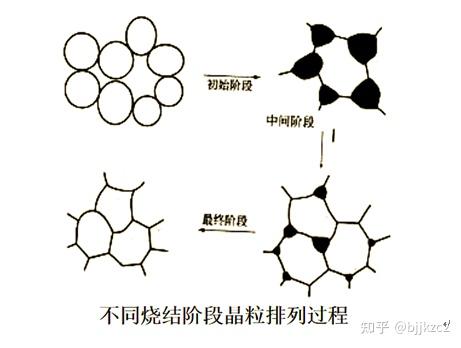
Sintering is another important step in the production of piezoelectric ceramics. It involves the rearrangement and proximity of particles, aiming to promote the densification of materials and the growth of grains. If the sintering temperature is too high, it may cause abnormal growth of ceramic grains or uneven microstructure. Conversely, if the sintering temperature is too low, it will affect the development of grains. These factors will all have adverse effects on the piezoelectric and mechanical properties of piezoelectric ceramic components.
Initial stage (particle binding stage, before 1050 ℃)
Mid stage (grain growth stage, 1050-1200 ℃)
Final stage (grain correction stage, optimal sintering temperature of 1200 ℃)
5. Upper electrode fabrication
In the production process of piezoelectric ceramics, the manufacturing of the upper electrode is a step. This involves covering the ceramic surface with a layer of conductive material, usually using metals such as Cu, Ag, Ni, Au, etc., through techniques such as sintering, chemical deposition, or vacuum coating. This step is crucial to ensure that piezoelectric ceramic components have excellent conductivity and performance.
6. Polarization processing
Polarization is a crucial step in the production process of piezoelectric ceramics. Although the grains inside ceramics have spontaneous polarization characteristics, namely ferroelectricity, the orientation of their spontaneous polarization domains is random, resulting in no macroscopic polarization strength. Therefore, after the production of piezoelectric ceramic components is completed, polarization treatment is necessary to exhibit the piezoelectric effect. This process is achieved by applying a high-voltage direct current electric field, which causes the electric domains to align in a specific direction. It is worth noting that even after the electric field is removed, this oriented arrangement can still be largely retained, thereby endowing the ceramic with piezoelectric effect.

★ Adopting key polarization devices:
PZT-JH10/4 High temperature piezoelectric ceramic polarization device (polarization of 1-4 pieces of piezoelectric ceramics below 10KV simultaneously)
Keywords: piezoelectric polarization, piezoelectric ceramic materials, 1-4 pieces
The PZT-JH10/4 high-voltage piezoelectric polarization device is mainly used for polarization treatment of piezoelectric ceramics or other piezoelectric materials below 10KV, and is widely used in universities and research and production units engaged in piezoelectric material research or production.
Key Features:
1. Able to polarize 1-4 samples simultaneously
2. Provide three sets of testing fixtures (capable of testing powders, single samples, and thin piezoelectric ceramic sheets)
2. Safe and reliable, fast temperature compensation, high temperature control accuracy
3. Each circuit has a cut-off protection function when the leakage current exceeds the specified value, which does not affect the polarization of other samples. Other circuits can complete polarization according to normal polarization time.
4. Any sample size of 3-40mm, whether it is a square or circular specimen, can be clamped
7. Working power supply: AC220V 50/60HZ
8. Rated power: 2.0kw
9. Polarization or voltage withstand test of piezoelectric materials: DC: 0-10KV (± 5%+2 words) continuously adjustable
10. Total current: 10mA
11. Cut off current for each channel: 0.5mA
12. Heating time: can be automatically set
13. Heating element: high-quality resistance wire
14. Number of test samples per test: 1-4 samples can be loaded
15. Rated temperature: ≤ 180 ℃
16. Maximum temperature: 200 ℃
17. Temperature control method: intelligent constant temperature control (imported meter), multi-stage program controllable
18. Sample size: 3-40mm square or circular sample
19. Dimensions: 875 * 470 * 400 (mm)
20. ★ Polarization probe: high-quality copper electrode (0.2mm)
21. ★ Standard polarized samples: 8 pieces (10mm * 1.5mm)
21. ★ Supporting equipment and devices: capable of measuring with ZJ-3 and ZJ-6 piezoelectric testers
22. ★ Supporting equipment and devices: can be configured with 10MM, 20MM, 30MM, and 40MM tablet pressing fixtures
1. Changes in domain orientation before and after polarization
During the polarization process of piezoelectric ceramics, the orientation of the electric domains undergoes significant changes. Unpolarized ceramics exhibit random orientation of their spontaneously polarized domains, resulting in no macroscopic manifestation of polarization strength. However, after being treated with a high-voltage direct current electric field, the electric domains are oriented in a specific direction. Although this oriented arrangement can still be largely preserved after the electric field is removed, thus endowing the ceramic with piezoelectric effect. This change is crucial for the performance and functionality of piezoelectric ceramics.
Key equipment for material testing
FE-5000 Ferroelectric Tester
Keywords: hysteresis loop, ferroelectric tester, voltage, frequency , electrical strain, butterfly curve

1、 Product Introduction:
FE-5000 Ferroelectric TesterIt is a high range ferroelectric performance material testing device that can be used for measuring the electrical properties of ferroelectric thin films and ferroelectric materials (both bulk materials). It can measure the hysteresis loop of ferroelectric thin films and measure the values of ferroelectric thin films with asymmetric hysteresis loops. It can perform electrical strain testing, has butterfly curve function, and can also expand functions such as high-temperature resistance, high-temperature dielectric, capacitance voltage curve, TSC/TSDC, etc. This instrument is one of the important equipment for the production, application, and research of piezoelectric materials and components, and has been widely used in major universities and research institutes.
2、 Main technical indicators:
1. Output signal voltage: ±10 kVScalable electrical response butterfly curve function
2. Temperature; Room temperature -200 ℃, temperature control accuracy: ± 1 ℃
3. Control the application frequency from 0.01 to 1KHz (ceramic, single crystal, thin film) and customize the settings through PC software control;
4. Control output current continuously adjustable from 0 to ± 50mA, with custom settings controlled by PC software.
5. Dynamic hysteresis loop test frequency range 0.01Hz-5kHz
7. The minimum pulse width holding time is 20us; the minimum rising edge time is 10us;
8. Fatigue test frequency 500kHz (amplitude 10 Vpp, load capacitance 1 nF); The maximum fatigue frequency after using a high-voltage amplifier is 5kHz;
9. Test speed: Measurement time<5 seconds/sample • temperature point
10. Sample specifications: block material size: diameter 2-100mm, thickness 0.1-10mm
11Main functions: dynamic hysteresis loop DHM, static hysteresis loop SHM, I-V characteristics, pulse PUND, fatigue fatigue, electrical breakdown strength BDM, leakage current LM, current bias, holding force RM,
10. Charge resolution not less than 10 mC;
Leakage current measurement range: 1pA~20 mA, resolution not less than 0.1pA;
12. Control method: Computer real-time control, real-time display, real-time data calculation, analysis and storage
13. Software collection: Automatic collection software, analysis can be compatible with other related mainstream software.
14. Test accuracy: ± 0.05%
15. Built in voltage: ± 20V
Expandable module:
Imprint imprint IM
Temperature variation test THM
POM module realizes polarization measurement function
CVM module implements small signal capacitance testing to obtain C-V curve
PZM module realizes piezoelectric characteristic testing
DPM module testing dielectric performance
RTM module testing resistance/resistivity performance
CCDM module realizes capacitor charging and discharging testing.
7. Preparation technology of piezoelectric ceramics with complex structures
In multidimensional motion and integrated applications, such as flexible robots and clamping devices, piezoelectric ceramics with complex structures play a role. This type of ceramic exhibits a multi-directional piezoelectric effect, enabling precise control of position and force. Its non-uniform distribution of thickness, electric field or mechanical stress, as well as integrated acoustic, mechanical, electrical and optical multifunctional characteristics, make it shine in special scenarios such as acoustic lenses, waveguides and resonant cavities. In addition, in applications that require adaptation to curved surfaces or tight fitting, such as body sensors, biomedical devices, and wearable technology, complex structured piezoelectric ceramics have also been widely used.

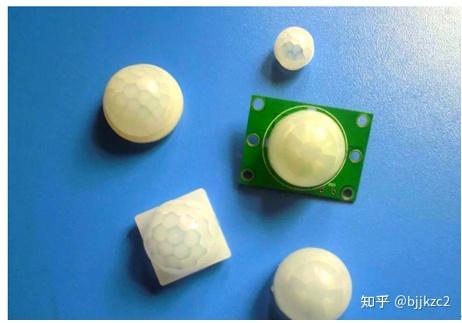

1. Flexible robots, acoustic lenses, human body sensors
When preparing piezoelectric ceramics with complex structures, the forming stage of the embryo preparation process does face significant challenges. Traditional molding processes, such as dry pressing, isostatic pressing, and tape casting, are mainly suitable for piezoelectric ceramics with simple structures. However, with the continuous progress of technology, some innovative molding methods, such as mold free molding (additive manufacturing) technology, gel injection molding and injection molding, have been successfully applied to the preparation of piezoelectric ceramics with complex structures. The introduction of these new technologies has greatly promoted the development of fields such as flexible robots, acoustic lenses, and human sensors.
8. Mold free molding technology
The moldless molding technology of piezoelectric ceramics, also known as additive manufacturing, is a high-precision molding method currently available in the market. It mainly relies on the accumulation or solidification of materials layer by layer after 3D modeling to construct the desired object, which not only has high molding efficiency, but also does not require the use of molds, thus flexibly meeting personalized, integrated, and complex manufacturing requirements.
9. Direct Writing Forming Technology (DIW)
Direct writing molding technology, as a type of additive manufacturing, uses a direct writing nozzle to extrude and deposit the pre configured ceramic slurry layer by layer, thereby forming an embryo. This technology has low environmental requirements and relatively simple equipment. The nozzle is usually driven by gas or mechanical devices and does not require additional conditions such as laser, heating, or ultraviolet radiation. Therefore, it has significant advantages such as low cost, high solid content, and high density, making it very suitable for preparing piezoelectric ceramics with large spans and hanging structures. In fact, direct writing molding technology has become an additive manufacturing method in the preparation of piezoelectric ceramics. However, due to the inability of DIW technology to achieve support design, the slurry used must have good viscoelasticity to ensure the formation of continuous and uninterrupted filaments under the shear action of the nozzle, thereby maintaining the integrity of the structure.
Ink direct writing PZT ceramic sintered parts display
By using direct writing molding technology and ink like ceramic slurry, PZT ceramic sintered parts were successfully prepared. This technology not only reduces costs but also improves production efficiency, providing new ideas for the preparation of piezoelectric ceramics.
10. Inkjet Printing Forming Technology (LJP)
Inkjet printing technology achieves rapid prototyping by spraying ceramic ink layer by layer onto a carrier. In this process, the mixing and preparation of ceramic powder, binder, and other organic additives are crucial, directly affecting the physical properties of the ink, such as viscosity, surface tension, conductivity, etc. In addition, a higher solid content and drying rate are also key factors in ensuring the quality of the molding. This technology is favored for its low cost and simple process, but it is mainly suitable for the preparation of small piezoelectric ceramic components. Like direct writing molding technology, it cannot design supporting structures, which limits its ability to print complex components and structural controllability.
11. UV curing technology
Light curing molding technology involves mixing ceramic powder with curable photosensitive resin, and then curing through partial UV scanning. This technology can be divided into stereolithography (SLA) and digital light processing (DLP). The latter is a later developed technology, in which the slurry solidifies in a small area between the previous forming layer and the bottom of the material cylinder, effectively avoiding the damage of high viscosity slurry shear force caused by scraper recoating in SLA to the formed part, and allowing for more precise control of the slicing height. However, due to the size of the forming cylinder, this technology is currently unable to be used to prepare large-sized piezoelectric ceramic components.
The advantages of photopolymerization technology lie in its short production cycle, excellent prototype surface quality, and achievable automation production. But at the same time, there are also some challenges, such as possible warping and deformation of the prototype, relatively high costs, and micro toxicity issues of photosensitive resins.

Example demonstration of digital light processing technology forming piezoelectric ceramics and its correlation with piezoelectric composite materials
We have successfully prepared piezoelectric ceramic components using digital light processing technology and conducted detailed research on them. Meanwhile, we also explored the potential applications of piezoelectric composite materials in the digital light processing molding process.
12. Fused Deposition Modeling (FDM) technology
The melting deposition molding technology mainly uses a mixture of thermoplastic resin and ceramic powder as raw materials. The process involves heating the raw materials to a temperature slightly above their melting point, transforming them into a fluid state. Subsequently, under the precise control of the computer, the fluid is gradually extruded and deposited on the carrier at the bottom, forming a green body through layer by layer stacking, and the final product accuracy can reach millimeter level.
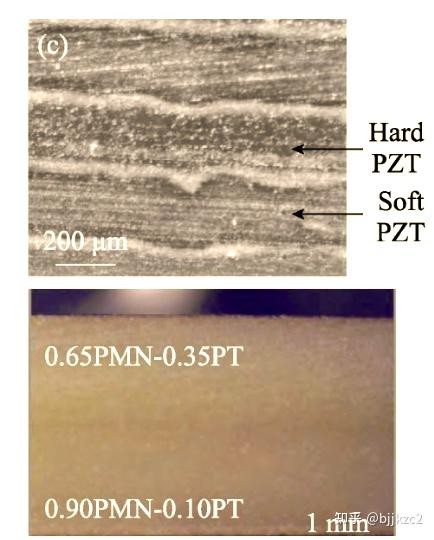
1. Cross section photo of melting deposition gradient piezoelectric ceramics
Melting deposition molding technology is known for its simple production process, cost savings, and design flexibility, while its equipment maintenance is also quite simple. However, due to the generally high melting point of ceramic materials, it is often not feasible to directly use FDM technology for molding. Therefore, ceramic particles are usually mixed with thermoplastic materials to create silk materials specifically designed for printing. This application method to some extent limits the range of materials that can be used. At present, there is still relatively little research on using FDM technology to prepare piezoelectric ceramics.
13. Injection molding technology
The injection molding process involves mixing powder and adhesive in a specific ratio, and then injecting them into the mold cavity at a certain speed to form a blank. After degreasing and high-temperature sintering, dense ceramic products can be obtained. This technology not only has a short production cycle and uniform finished products, but also is suitable for mass production and the operation is quite flexible. However, it is worth noting that the organic content in its finished product is relatively high, which may cause cracking during the degreasing process and affect its density.
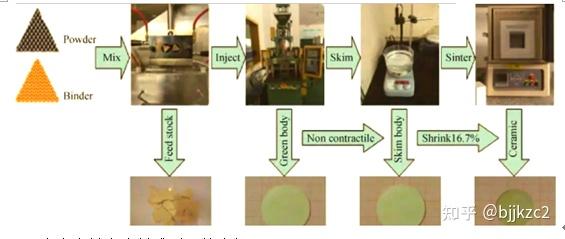
1. Process flowchart of piezoelectric ceramic powder injection molding
Currently, although injection molding technology has received widespread attention in the preparation of lead based piezoelectric composites and piezoelectric arrays, this technology is also applicable to the preparation of lead-free piezoelectric ceramics. With the continuous advancement of technology, it has become possible to achieve large-scale production of lead-free piezoelectric ceramics.
14. gel injection molding technology
Gel injection molding technology is a new emerging net size molding process after grouting and injection molding. It cleverly integrates the principles of polymer chemistry and rheology. Specifically, it is to add low concentrations of organic monomers and initiators to ceramic slurries with high solid content (volume fraction of over 50%) and low viscosity (less than 1Pa · s), and then pour them. Under specific conditions, organic monomers in the slurry will undergo in-situ polymerization reactions, forming a stable cross-linked network structure that promotes rapid in-situ solidification of the slurry, thereby achieving in-situ shaping of the ceramic body. After subsequent steps such as demolding, drying, adhesive removal (to remove organic matter), and sintering, the desired ceramic product can be obtained.
1. Application of gel injection molding technology in the preparation of ceramic parts
Using gel injection molding technology, ceramic parts with complex shapes can be easily prepared. This technology relies on stable, high solid content, and low viscosity ceramic slurries, which are key to achieving excellent injection molding effects. High solid content helps to reduce the drying shrinkage rate of the billet, thereby reducing the risk of deformation; Low viscosity ensures that the suspension can fully fill the mold during the injection molding process, while also facilitating the removal of trapped gases. The stable slurry further ensures the uniform microstructure of the billet, laying the foundation for obtaining high-performance products in the end.
The advantages of this technology lie in its excellent uniformity, high green body strength, simple operation process, and adaptability to mechanical processing, making it possible to prepare large and structurally complex piezoelectric ceramics. However, this technology also faces some challenges, such as relatively low automation and difficulties during the drying process.
15. Summary
With the rapid development of technology, the forming process of piezoelectric ceramics is becoming increasingly diverse and is moving towards the direction of rapid prototyping technology. However, these processes still face many challenges, such as the inevitable need to add organic compounds such as binders and dispersants in slurry preparation, which often leads to extended degreasing time, product deformation, and reduced density and strength. Therefore, in the future, the molding process of complex structured ceramics should strive to meet the requirements of molding quality while minimizing the use of organic matter to achieve better performance. In addition, the piezoelectric properties of ceramics can be further enhanced through doping modification, texture optimization, and application of composite materials.
Liu Kai, Sun Ce, Shi Yusheng and others discussed the current status and future prospects of additive manufacturing of piezoelectric ceramics, and the related content was published in the journal Inorganic Materials Science.
2. Zeng Wenzhu, Chen Yan, Yuan Maodan and others conducted a comprehensive review of the preparation process of complex structured piezoelectric ceramics, and the article was published in the journal "Chinese Ceramics".
3. Yan Bowu published a paper in the Journal of Instrument and Instrumentation, and studied the gel casting technology of PZT piezoelectric ceramics.
4. Liu Chunlin, Qin Shuai, Wu Dun and others explored the application of water-soluble degreased powder injection molding technology in the preparation of PLZT piezoelectric ceramics, and studied their piezoelectric properties. The relevant results were published in the Journal of Ceramics.
5. Xie Rui has carried out research on the new gel casting of fine structure PZT ceramic array in Central South University.