-
E-mail
85405976@qq.com
-
Phone
13955096002
-
Address
No. 20 Renhe South Road, Tianchang City
Anhui Tiankang (Group) Co., Ltd
Full guide for installation of bimetallic thermometers: standardized operation to ensure measurement accuracy and equipment safety
Date: 2025-08-18Read: 42
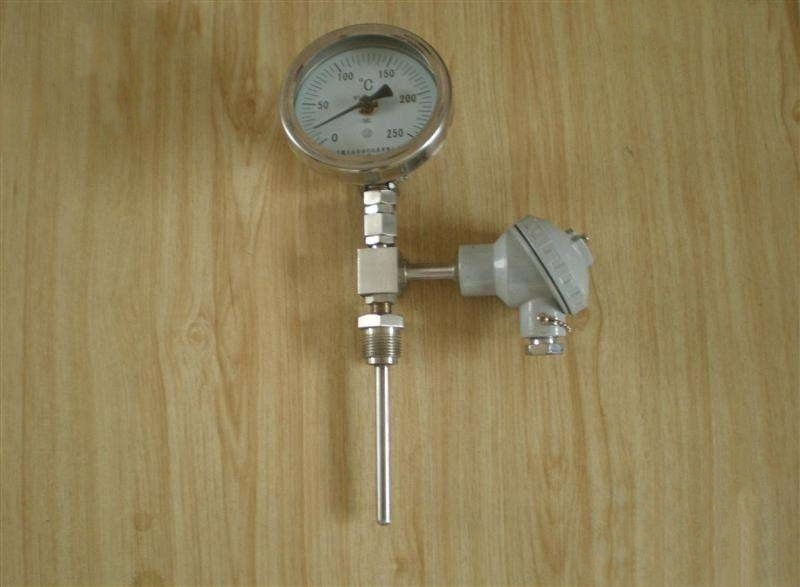
As a commonly used on-site temperature detection instrument in industrial process control, the core principle of bimetallic thermometers is to use a temperature sensing element composed of two metals with different thermal expansion coefficients stacked together, and to indicate temperature through deformation driven pointers. The installation method directly affects the measurement accuracy and equipment life, and needs to be selected comprehensively based on the characteristics of the medium, process conditions, and instrument structure. This article will systematically elaborate on three aspects: pre installation preparation, typical installation methods, and key precautions.
1、 Preparation before installation: laying the foundation for precise measurement
1. Selection and matching
Select a bimetallic thermometer with an appropriate range based on the temperature range of the measured medium (-50 ℃~600 ℃) to avoid overheating damage or reduced resolution caused by a too small range;
Confirm whether the protection level (such as IP65 dustproof and waterproof) and explosion-proof level (such as Ex d IICT6) meet the on-site environmental requirements.
2. Environmental inspection
The installation location should avoid vibration sources, strong magnetic fields, and corrosive gases to reduce external interference;
Ensure that the pointer of the instrument can rotate freely after installation, without any obstruction affecting the reading.
3. Tool preparation
Equipped with adjustable wrench, raw material tape, sealing gasket and calibration tools (such as standard temperature source) to ensure the sealing and accuracy of the installation process.
2、 Typical installation method: Suitable for different process scenarios
1. Threaded connection installation
Applicable scenarios: Fixed structures such as pipelines and container walls that can be perforated;
Operation points: Wrap 3-5 circles of raw material tape around the thread, and turn clockwise until the thread is fully engaged to avoid cross threading and leakage;
Depth control: The insertion depth should reach the length of the temperature sensing element (usually 50-150mm), ensuring that the temperature measuring point is located in the medium flow area.
2. Installation of flange connection
Applicable scenarios: High pressure, high temperature, or highly corrosive media;
Operation points: Select specifications that match the equipment flange (such as DN50, PN16), evenly tighten the bolts to the specified torque, and prevent flange deformation;
3. Sealing treatment: Apply high-temperature resistant sealant on the surface of the flange gasket to enhance the sealing effect.
Card sleeve installation
Applicable scenarios: Small diameter pipelines or temporary temperature measurement needs;
Operation points: Adjust the pre tightening force of the card sleeve to ensure that the temperature sensing element is in close contact with the inner wall of the pipeline and reduce thermal resistance.
3、 Key considerations: Ensuring safety and long-term stability
1. Vertical installation priority: If conditions permit, vertical installation is preferred to reduce the impact of medium precipitation on temperature measurement;
2. Avoid dead corners: When installing in pipelines, the temperature sensing element should be located in the straight pipe section beyond 10 times the diameter of the fluid after turning;
3. Regular calibration: Verify with a standard temperature source every 6-12 months, record the deviation value and adjust it in a timely manner;
4. Anti freezing and anti condensation: In low-temperature environments, it is necessary to install insulation sleeves or heat tracing belts at the rear of the instrument to prevent internal condensation from causing short circuits.
The installation of bimetallic thermometers should balance "precision" and "safety". Through scientific selection, standardized operation, and regular maintenance, its measurement reliability can be significantly improved, providing solid data support for industrial process control.