-
E-mail
3756537090@qq.com
-
Phone
15827310774
-
Address
Block A, Headquarters of Gaonong Biological Park, No. 888 Gaoxin Avenue, Donghu New Technology Development Zone, Wuhan City
Product Categories
Wuhan Nali Technology Co., Ltd

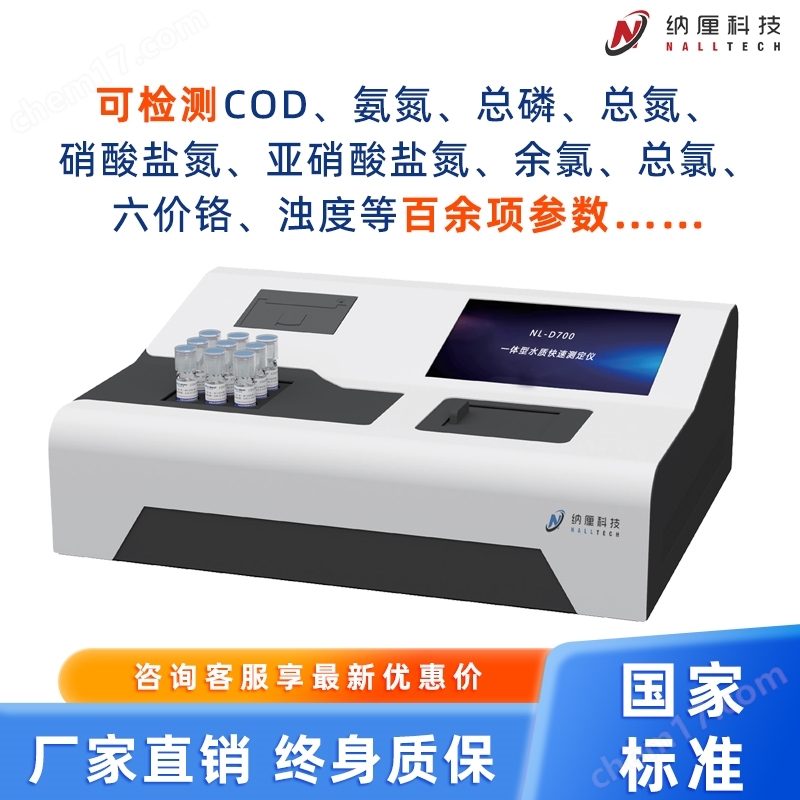


Wastewater quality detector
NegotiableUpdate on 02/09
- Model
- Nature of the Manufacturer
- Producers
- Product Category
- Place of Origin
Overview
The wastewater quality detector, as a core tool for environmental monitoring and industrial treatment, provides scientific basis for sewage treatment, ecological protection, and compliant discharge by accurately analyzing the concentration and physicochemical characteristics of pollutants in water bodies. Its application covers multiple fields such as industrial wastewater treatment, municipal sewage treatment plants, aquaculture, and drinking water safety, and is a key technical support for modern water resource management.
Product Details
The wastewater quality detector, as a core tool for environmental monitoring and industrial treatment, provides scientific basis for sewage treatment, ecological protection, and compliant discharge by accurately analyzing the concentration and physicochemical characteristics of pollutants in water bodies. Its application covers multiple fields such as industrial wastewater treatment, municipal sewage treatment plants, aquaculture, and drinking water safety, and is a key technical support for modern water resource management.
1、 Core functions and application scenarios
Industrial wastewater treatment
In high pollution industries such as chemical, pharmaceutical, and electroplating, detectors can monitor COD (chemical oxygen demand), ammonia nitrogen, heavy metals, and other indicators in real time, helping companies optimize their treatment processes. For example, a certain chemical enterprise dynamically adjusts the dosage of precipitants by monitoring the concentration of heavy metals in wastewater in real time, thereby improving the removal rate of heavy metals and reducing the cost of chemicals.
Municipal sewage treatment
In sewage treatment plants, detectors are used to evaluate the effectiveness of biological treatment units. By monitoring parameters such as dissolved oxygen and BOD (biochemical oxygen demand), the activity of activated sludge can be determined, and the aeration rate can be adjusted in a timely manner to avoid a decrease in treatment efficiency due to hypoxia. A sewage treatment plant in a certain city has improved the effluent compliance rate by introducing multi parameter detectors.
Aquaculture water quality management
In aquaculture, indicators such as dissolved oxygen, pH value, and ammonia nitrogen directly affect the survival of fish. The detector can provide real-time feedback on water quality changes. For example, a certain aquaculture farm can monitor dissolved oxygen concentration and automatically start the aerator during nighttime hypoxia to reduce fish fry mortality.
Ensuring the safety of drinking water
In waterworks, detectors are used to monitor indicators such as microorganisms and residual chlorine in raw and treated water. A certain water plant has shortened the detection time of raw water turbidity by introducing portable detectors to ensure water supply safety.
2、 Operation process: from sampling to data analysis
Sampling and preprocessing
Sampling point selection: It is necessary to avoid interference areas such as sewage outlets and stagnant water areas, and collect representative water samples. For example, setting up a sampling point 50 meters downstream of the industrial wastewater discharge outlet to avoid pipeline sediment affecting the results.
Preprocessing steps: Select preprocessing methods such as filtering and acidification based on the detection items. When detecting heavy metals, a 0.45 μ m filter membrane is needed to filter suspended solids; When detecting COD, sulfuric acid should be added to acidify to pH<2 to prevent the decomposition of organic matter.
Instrument calibration and testing
Calibration operation: Use standard solution for multi-point calibration. For example, before pH detection, it is necessary to calibrate the electrode with standard buffer solutions of pH=4.01, 6.86, and 9.18 to ensure that the measurement error is less than 0.1 pH units.
Detection process: Inject the preprocessed water sample into the detection tank, close the light shielding cover, and start the detection. Some instruments support multi parameter synchronous detection, such as simultaneously measuring pH, dissolved oxygen, and conductivity, which only takes a few seconds.
Data recording and analysis
Real time recording: The detection results should be marked with information such as sampling time, location, temperature, etc. For example, a certain enterprise uploads data to a cloud platform to generate daily reports and weekly trend charts to assist decision-making.
Exception handling: If the detection value exceeds the standard, re inspection and investigation of the cause are required. If a chemical plant discovers that the COD of wastewater exceeds the standard, it is determined through testing that the effluent from each section is directly discharged as untreated cleaning wastewater from a production line.
3、 Usage details: Avoid common misconceptions
instrument maintenance
Electrode maintenance: pH electrodes need to be regularly soaked in saturated chloride NA solution to avoid membrane drying; The dissolved oxygen electrode needs to have its membrane replaced weekly to prevent microbial attachment.
Cleaning requirements: Rinse the colorimetric dish with deionized water after testing to avoid residue interference with the next test. Due to the uncleanliness of the colorimetric dish, the deviation of ammonia nitrogen detection values exceeded 20% for three consecutive times in a certain laboratory.
environmental control
Temperature effect: The detection needs to be carried out in an environment of 20-30 ℃, as low temperature can cause the electrode response to slow down. During winter testing at a northern enterprise, the instrument was placed in a constant temperature chamber to ensure data stability.
Light avoidance requirements: Colorimetric testing should be conducted in a dark room or under shading conditions to prevent light interference. Due to the unclosed curtains in a certain laboratory, the chromaticity detection values were falsely high.
safety protection
Reagent management: Strong acid and strong alkali reagents should be stored separately and operated with protective gloves. A certain inspector suffered skin burns due to exposure to concentrated sulfuric acid without wearing gloves.
Waste liquid treatment: The tested waste liquid should be treated as hazardous waste and cannot be directly dumped. A certain enterprise was punished by the environmental protection department for illegally discharging chromium containing waste liquid.
4、 Future Trends: Intelligence and Integration
With the development of IoT technology, wastewater quality detectors are evolving towards intelligence. For example, some new instruments support 5G remote transmission and can upload data in real-time to the environmental protection department platform; AI algorithms can automatically analyze data anomalies and alert potential pollution risks. In the future, detectors will focus more on multi parameter integration and portability to meet the needs of emergency field testing.
The wastewater quality detector is not only the "gatekeeper" for compliant discharge, but also the "diagnostician" for sustainable utilization of water resources. By standardizing operations and managing details, its value can be fully realized, providing technical support for the construction of ecological civilization.

