-
E-mail
guyu.sh@163.com
- Phone
-
Address
Room 701, Building 36, Lane 1600, Ping'an Road, Minhang District, Shanghai
Product Categories
Shanghai Guyu Environmental Protection Technology Co., Ltd

Sanitary split current meter
NegotiableUpdate on 05/10
- Model
- Nature of the Manufacturer
- Producers
- Product Category
- Place of Origin
Overview
Sanitary split current meters are used for measuring various conductive liquids, such as tap water, sewage, mud, various beverages, chemical raw materials, viscous liquids, and suspensions.
Product Details
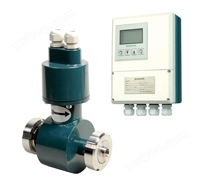
Sanitary split current meters are used for measuring various conductive liquids, such as tap water, sewage, mud, various beverages, chemical raw materials, viscous liquids, and suspensions.
 Instrument characteristics
The sanitary split current meter requires confirmation of the required cable length between the transmitter and sensor, and the cost will be charged separately
TECHNICAL INDEX
Working principle of sanitary split current meter:
Faraday's law of induction (referring to the induction potential generated inside a conductor when it passes through a magnetic field) is the fundamental principle for electromagnetic flowmeter measurement. This measurement principle can be applied to fluids with conductivity, which flow into a pipeline with a magnetic field perpendicular to the direction of the fluid. The potential induced in the fluid can be measured using two symmetrically arranged electrodes. The signal voltage UE is proportional to the magnetic induction intensity B, electrode spacing D, and average fluid velocity V. Due to the constant magnetic induction intensity B and electrode spacing D, the signal voltage UE is proportional to the average flow velocity V. The equation used to calculate volumetric flow rate indicates that the signal voltage UE is linearly proportional to the volumetric flow rate.
The induced signal voltage is converted into division, analog, and digital output signals in the converter.
Faraday's law of induction (referring to the induction potential generated inside a conductor when it passes through a magnetic field) is the fundamental principle for electromagnetic flowmeter measurement. This measurement principle can be applied to fluids with conductivity, which flow into a pipeline with a magnetic field perpendicular to the direction of the fluid. The potential induced in the fluid can be measured using two symmetrically arranged electrodes. The signal voltage UE is proportional to the magnetic induction intensity B, electrode spacing D, and average fluid velocity V. Due to the constant magnetic induction intensity B and electrode spacing D, the signal voltage UE is proportional to the average flow velocity V. The equation used to calculate volumetric flow rate indicates that the signal voltage UE is linearly proportional to the volumetric flow rate.
The induced signal voltage is converted into division, analog, and digital output signals in the converter.
Electromagnetic flowmeter standard normal working conditions:
Environmental temperature: -25 ° C to+60 ° C;
Relative humidity: 5% to 90%;
Power supply: single-phase AC power supply 85-250V, 45-63HZ; DC power supply 16VDC~36VDC;
Dissipative power: less than 20W.
Measurement accuracy of electromagnetic flowmeter: ± 0.5%
Main technical parameters of electromagnetic flowmeter
Measurement fluid: conductive liquid
Accuracy: ± 0.5%
Repeatability: 0.25%
Fluid temperature: -25 ℃ ≤ medium temperature < 200 ℃
Working pressure: 0.6Mpa, 1.0Mpa, 1.6Mpa, 2.5Mpa, 4.0Mpa, others
Flow velocity range: 0.5-10m/s
Conductivity: ≥ 5 μ s/cm (softened water requires ≥ 20 μ s/cm)
Flow direction: forward/reverse
Lining material: PFA
Electrode Material: Standard Configuration: Stainless Steel (optional Hastelloy (B.C.), Tantalum, Titanium, Platinum, Tungsten Carbide)
Electrode form: standard
Number of electrodes: Two pairs (measurement/grounding)
Measurement tube material: 304 stainless steel
Lining materials: hard rubber, chloroprene rubber, polytetrafluoroethylene (PTFE), and modified polytetrafluoroethylene (PFA)
Flange interface material: 304 stainless steel
Installation form: clamp/thread
Protection level: IP65 and IP68
Power supply: 220VAC ± 20% 60HZ. (24VDC. Optional)
Output: Standard is frequency pulse, 4-20mA output,
(HART communication, Modbus protocol, Profibus protocol can be selected)
Electrical interface: 2 × M20 * 1.5
Structural form: integrated or split type (to be selected)
Working environment: ambient temperature -25 ° C to+60 ° C, humidity ranging from 5% to 90%


