-
Phone
13701268558
-
Address
Room 107, Building 5, Zhongke Keyi Building, No. 13 Zhongguancun North Second Street, Haidian District, Beijing
Product Categories
Dechuangke Instrument (Beijing) Technology Co., Ltd

Plastic bending creep testing machine
NegotiableUpdate on 02/06
- Model
- Nature of the Manufacturer
- Producers
- Product Category
- Place of Origin
Overview
参考- ASTM E139-96 Standard Test Methods for Conducting Creep, Creep-Rupture and Stress-Rupture test of Metallic Materials
Product Details
DESCRIPTION
This product adopts the method of direct load loading on the sample. Generate tensile and bending deformation phenomena in plastic material samples, and use displacement sensors to deform the samples according to the required form for detection. Use a high-temperature chamber to control the temperature of the sample at 20-200 ℃, with a temperature sensor and controller placed in each chamber. The length of the tensile test specimen is 25mm as the standard specimen. The bending test maintains the span distance of the specimen at 50mm.
refer to
- ASTM E139-96 Standard Test Methods for Conducting Creep, Creep-Rupture and Stress-Rupture test of Metallic Materials
- ISO 204 Metallic materials- Uniaxial creep testing in tension-Method of test
Product specifications
host
The part that directly applies load to the sample
• Frame material: Square structural steel pipe STKM400
• Load consumption: 300kg/ch,
Load precision: ± 1%
• Use cylinder load loading method or use weights to directly load the load method
Installation methods for regulators, air solenoid valves, proportional control valves, and weighing sensor cylinders
Horizontal caster installation - height adjustable caster
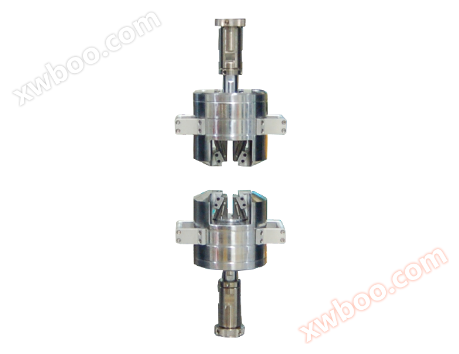
Stretching and bending fixtures
• Stretch fixture
- Capacity: 500kg
-Specimen thickness: Max within 8mm
- Type: Wedge action grip
- Jaw face rough machining
-Even with thinner specimens used for testing, it can sustain constant load loading
• 3-point bending fixture
-Span distance: 50mm
-Roll diameter: 10mm
-Roll surface coating treatment
-Sample Installation Guide
-The support point did not shake during the experiment
-Prevent impact collision between equipment and accessories
-Prevent deformation of accessories and measurement errors caused by temperature changes
Strain sensor
• Digital displacement sensor (bending)
- Stroke: 25㎜
-Resolution: 1 μ m
-Form: Digital Linear Table - No Calibration Required
-The battery can be used continuously for 7000 hours
-Pull rod material: STS 303, 17-18 (10-6/℃)
-External installation of high and low temperature box
High temperature box and temperature control device
High temperature test environment control device
• Temperature: 20~200 ℃, maximum 250 ℃, minimum 15℃
• Use ink cartridge heater
Internal dimensions: 250mmW x 250mmD x 250mmH x 4chamber
Two samples can be placed in one test chamber
Single phase, 220V, 50/60Hz, maximum, 5kW
Thermostat installation
• Temperature difference: ± 1 ℃ temperature difference between each sample
The overall interior of the high-temperature box: ± 2 ℃
Internal material: Polished STS 304
• External material: SS400&heat-treated coating
Noise standard below 50dB
Front internal observation window
Installation of internal LED lights
Installation of ink cartridge heaters with a capacity of 600W x 2set or higher
• 와류 발생 팬 장착
Thermocouples: K-type, 2/high temperature box
Thermocouple error: within ± 1.0 ℃ or ± 0.4% of the measured temperature
•KOLAS regulations stipulate that documents should be attached and pasted on Thermocouples and controllers
• Filling insulation materials (ceramic insulation block filling reinforcement)
Install a cooling radiator for each high-temperature chamber
Installation of refrigeration unit for cooling
-Water tank capacity: 45 liters
-Circulating pump: 300W
-Temperature range&Cooling: 5 ℃~30 ℃
-Power supply: AC 3-phase, 220V, 380V, 440V, 4.6kW
-Abnormal and safety devices: Low water, EOCR motor protectors (water pump, COMP, fan), low pressure cut-off, high pressure cut-off, high temperature box and temperature control device
temperature controller
• Digital temperature controller
For easy control of high and low temperature boxes (1), temperature confirmation (1), each high and low temperature box is equipped with two thermocouples and temperature controllers
Installation of temperature control rack
Refrigerator on/off, heater on/off, power switch
• Control connectors&wiring
50ms high-speed acquisition and ± 0.3% high-precision display
Heating and cooling control function simultaneously
• Computer communication support: RS 485
• Large screen display and high brightness LED for easier operation and viewing
• Heater disconnection alarm function
• Output control: Relay electric shock output
SSR output
current output
Control mode: On/Off, P/PI/PD/PID control
• Power supply: Voltage rating at 100 to 240 VAC (±10%), 50/60 Hz
• Temperature controller rack
• Alarm lamp
Creep testing machine controller
function
-Computer and SD card data storage: time, displacement, temperature of each channel
-Temperature controller and communication function (using a computer to set and control temperature)
-Automatic power-off function of high and low temperature chambers after the experiment is completed
-Test restart function corresponding to instantaneous power outage (computer with UPS installed, UPS provided by the user)
-Condition setting and emergency stop function
-Emergency stop button, high and low temperature box on/off button, LED on/off button
- National instrument
- DAQ : 100Hz
- A/D channel: 3
- Analog output: 2
- DIO Input/Output: 4
- Sensor data log output: 2
- Control type: PCI
Software and data acquisition system
function
• Data collection and storage - temperature, displacement, time, strain, inclination
Time and strain status display function for each channel (real-time/selected time, can be changed according to user requirements before delivery)
• Test information and test condition input (can be changed according to user requirements before delivery)
Time units (hr, min, sec), displacement (strain,%, mm), and basic settings can be made during the test setup
• Compatibility with Excel programs
• Temperature display
• Basic information input function at the beginning of the experiment
• Use programs to control devices
• Temperature correction function (can be changed according to user requirements before delivery)
Individual opening/closing of each channel (can be changed according to user requirements before delivery)
• Display of test time and end time
Time process setting function - preheating function setting
Start time setting
Test stop function when the end condition is met
• Data storage format setting function - data saving speed setting function (6 or more are one unit)
Displacement change element storage function
Time variation storage function
Process change data storage function
• Safety function settings - time, load, temperature
• Chart display function - time: displacement, time: strain
• Display function - test time, current temperature and average temperature, displacement, strain