-
E-mail
waterinst@163.com
-
Phone
15821255634
-
Address
Room 906, Building 2, No. 2388 Xiupu Road, Pudong New Area, Shanghai
Product Categories
Shanghai Water Instrument Technology Co., Ltd

Industrial online calcium ion electrode
NegotiableUpdate on 12/31
- Model
- Nature of the Manufacturer
- Producers
- Product Category
- Place of Origin
Overview
WS60CA622 calcium ion electrode, used for food, electroplating analysis, teaching research, drug analysis, etc
Product Details
1 WS60CA622Industrial online calcium ion electrode
II Technical parameters of WS60CA622 calcium ion electrode
model |
WS60CA622 |
type |
Composite type (measuring electrode+reference electrode) |
slope |
22-29mV25℃ |
response speed |
30S (95%) |
accuracy |
± 2% of full range (25 ℃) |
repetitiveness |
± 2% of full range (25 ℃) |
Operating Temperature |
0~40℃ |
pressure range |
0-1bar |
PH range |
2.5-11.5 |
interfering ion |
Pb2+. Hg2+,Cu2+,Ni2+ |
measurement range |
0.02-40,000 ppm |
main material |
POM |
Electrode thread |
PG13.5 |
Cable length |
1m/OEM |
Direct calibration method
Typical direct calibration curve
In the direct calibration method, the calibration curve is generated by the instrument program or semi logarithmic coordinate paper. Plot the potential and concentration of the standard solution on the y-axis and logarithmic x-axis, respectively. Within the linear region of the calibration curve, only two points are needed
A calibration curve can be determined. In the nonlinear region, more calibration points are needed to determine. When the electrode response is linear, the direct calibration method can be used; For measurements in nonlinear regions, please refer to
Low concentration calibration method.

fitting curve:

troubleshooting:
When problems arise, please follow systematic steps to identify the source of the error. Thoroughly inspect the measurement system for any issues one by one, and do not operate blindly or contact the supplier as soon as possible to obtain a solution.
ISE Standard Operating Reference (Data Equipment: ION2000 Online Ion Meter)
The instruments (optional) have been calibrated before leaving the factory, and the data is recorded on the product certificate. (Factory default standard solution 10ppm, 100ppm) (Newly used electrodes need to be soaked and activated in tap water for 1-2 days). If self calibration is required, please follow the steps in the instrument manual:
The order of using standard solutions is from low to high concentration, with each standard solution electrode soaking for about 8 minutes, based on stable mV signal.
The generation and avoidance of errors
Principle error: Due to the principle problem of the ion electrode, the temperature changes by 1 ℃, and the ion concentration will produce an error of approximately ± 2%. Therefore, using an ion electrode requires temperature compensation, or during calibration and testing, it is necessary to ensure that the test temperature is as consistent as possible;
Ionic strength adjustment: Corresponding equal amounts of ISA should be added to all test solutions to ensure that the sample and standard solution have the same ionic strength; (Due to the influence of ion strength on electrode measurement activity, calculation factors are affected; for example, activity a=concentration C × activity coefficient γ)
Standard solution or sample measurement: * * Applied for medium low speed stirring measurement;
Interference ions or unknown interferences: Please refer to the relevant ion selective electrode for the degree of interference, effective avoidance, or reasonable compensation; Or consult ISE suppliers.
Installation and flow rate of online electrodes
Suggested installation method: circulating installation;
Flow rate control: It is recommended to have a flow rate of 40L/h.
Notes:
New electrode slope:
Monovalent ions: 52~59 mV/(NH4+、K+、Li+、NO3-、Cl-、F-、Br-、I-、BF4-、ClO4-、CN-、SCN-、Ag+、NH3、CO2、Na+) ;
Divalent ions: 22-29mV/(Ca2+, Mg2+, Hardness, Cu2+, Ba2+, Pb2+, Cd2+, S2-) (25 ℃);
If the slope of the new electrode is not within the range described above, perform the following operations:
1. Prepare a newly prepared standard solution; Replace the electrolyte of the gas sensitive electrode;
2. Clean the electrodes with pure water, inspect sensitive components, electrode wiring joints, etc;
3. Repeat the calibration of the electrode once;
If the electrode still does not meet the requirements after performing the above operations, please contact the manufacturer's technical service department.

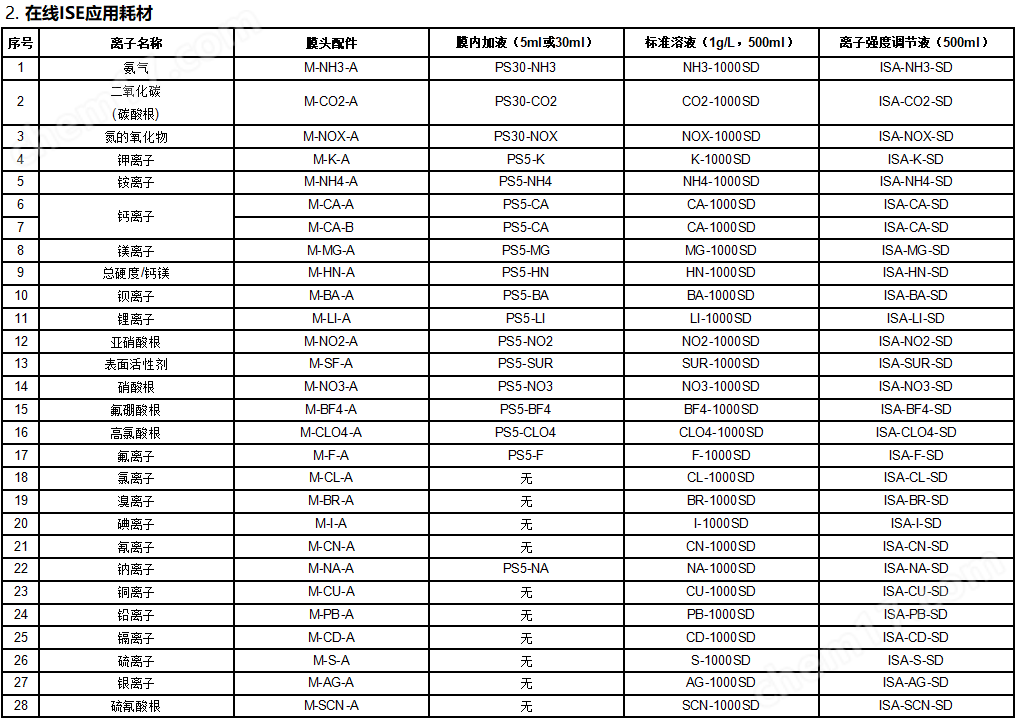
Theoretical Guidelines:
In the 1960s, many research institutions and electrode manufacturers developed ion selective electrodes (ISE) and applied them in practice. From then on, ISE became increasingly mature and became a fast and simple method for measuring ion activity or concentration. Nowadays, ISE users can use a range of reliable electrodes, ion meters, and practical accessories. A large number of applications have been developed for determining ion concentrations in various samples. For example, in many fields such as food, beverages, water, environment, pharmaceuticals, chemicals, aquaculture, wireless monitoring, etc.
The working mode of ISE
Ionic selective electrodes are divided into composite electrodes, single electrodes, and three in one electrodes. The sensitive membrane element of ISE is an ion selective membrane, which can generate different potentials under different ion concentration conditions. Therefore, the potential difference between the ion selective measuring electrode and the reference electrode changes accordingly, which can be measured using an ion meter. This potential difference is directly proportional to the activity of the relevant ions in the solution. The ion activity is related to the concentration and ion strength of the sample solution. The commonly used concentration units are mol/L, mg/L, or ppm.
The relationship between the Nernst equation and the measured values of ion activity and potential difference:
E=E0+2.3(RT/nF)•logai (ai=Ci•γ)
E electrode potential measurement value, mV E0 standard potential (specific electrode constant), mV
R gas constant, J/mol K T temperature, K (standard thermodynamic temperature 25 ° C (298.15 K))
Faraday constant of n-ion charge F, C/mol
AI measures the activity of ion i and Ci measures the concentration of ion i
Influence coefficient of gamma total ion strength
ISE's selectivity
Ionic selective electrodes are sensitive to measuring the activity of specific ions. However, they also respond to other ions to a certain extent. The influence of interfering ions is expressed as the selectivity coefficient K. For example, K (K+/Na+)=2.6 • 10-3. For potassium ISE, K+has higher selectivity, and the selectivity ratio of K+to Na+is 1:2.6 * 10-3 or 385:1. It can be understood that the selectivity of potassium ISE for K+is 385 times that of Na+. Therefore, the extension of the Nernst equation includes the effect of interfering ions on the potential measurement value E of ISE
E=E0+2.3(RT/niF)•log [ai +∑(Kij•aj ni/nj)]
∑ The sum of all Kij of all interfering ions j
Kij measures the selectivity coefficient of ion i compared to interfering ion j
AJ interferes with the activity of ion j
Ni measures the ion charge of ion i
Nj interferes with the ion charge of ion j
Response time of electrodes
The time required to reach a stable potential of 99% is fast in high concentration solutions, but may take several minutes in solutions as low as the detection limit. Normal response time for brand new and good ISE:
Crystal and glass film: 3 to 5 minutes
Polymer film: Stir at medium speed for 5 to 8 minutes
Ionic strength regulator (ISA)
When using ISE for ion measurement, it is important to use ISA solution. ISA solution or Total Ionic Strength Regulator (TISAB) needs to maintain relative consistency in ionic strength between different samples and calibration solutions. Add ISA solution in the same proportion to the sample and standard solution. For information on how to choose ISA solution, please refer to the relevant materials. In most cases, adding 2ml of ISA solution per 100ml of solution is sufficient to adjust the ionic strength of the sample and standard solution.
Conventional measurement applications
mining |
Monitor the urine fluoride, water calcium, and magnesium levels of aluminum production workers |
electroplating |
Fluorine, chlorine, copper, etc. in electroplating solution |
power generation |
Chloride ions, sodium, and calcium in emissions; Fluoride ions in nuclear fuel reprocessing |
chemistry |
Incoming inspection, quality control, and emission monitoring |
environment |
Monitoring pollution caused by fluoride ions, cyanide ions, chloride ions, and sulfur ions |
education |
Analytical chemistry training; Experiments on activity coefficient, solubility, equilibrium, etc |
agriculture |
Nitrate, potassium, calcium, and chloride ions in soil and plant materials; Nitrate ions in fertilizers |
detergent |
Calcium, barium, and magnesium used to study the effects of cleaning agents |
medicine |
Calcium, potassium, and chloride ions in serum, blood, and other body fluids; Fluoride ions in bones and oral structures |
food |
Nitrates in meat and meat preservatives; Sodium and chloride ions in meat, fish, dairy products, etc; Calcium in milk and dairy products; Nitrate in vegetables |
water |
Potassium, sodium, calcium, magnesium, chloride ions in drinking water or process water; Nitrate, chloride ions, and ammonia nitrogen in wastewater and emissions |
drink |
Sodium and chloride ions in fruit juice and beer; Potassium in fruit juice; Fluoride and chloride ions in soft drinks, tea, beer, and other substances |
ZY |
Fluoride ions, chloride ions, and nitrate ions in ZY and its explosive products |
Paper and pulp |
Sulfur and chloride ions in the slurry, recovery process, and emissions |
pharmaceutical |
The concentration of sulfur ions, ammonium ions, potassium ions, etc. in the samples used for research and quality control |
biology |
Concentration of ammonium ions in cellular metabolism, ammonium ions in seed culture, potassium ions, sodium ions, calcium ions, etc |
aquaculture |
Monitor ammonia nitrogen, water hardness, nitrite |
Application and Maintenance Guidelines
Refer to ISE performance parameters to confirm whether the selected product is compatible with the application environment; (such as pH application range, temperature range, presence of pressurized water, presence of electromagnetic interference on site, power supply interference, organic solvent corrosion, etc.)
Before use, please read the operation manual carefully,
Activation and Calibration: Before leaving the factory, the sensor has completed basic activation and calibration verification; Before calibration, please prepare the relevant equipment (such as ion meter/mV meter, beaker, washing bottle, stirrer, pipette, volumetric flask, etc.), power on and activate the sensor for at least 24 hours before starting the calibration operation. (For laboratory use, it is recommended to calibrate regularly or calibrate before use every day. Specific operations should follow laboratory standards and usage experience.)
Electrode preservation: short-term use, dry or soak in pure water; If not used for a long time, soak in low concentration standard solution or protective cap and regularly add water to ensure that the active membrane comes into contact with water or inquire with the supplier.
Notes:
Before calibration, it is necessary to confirm that the instrument's power connection electrode has been immersed in a water sample or other aqueous solution for more than 24 hours (electrodes immersed for more than 48 hours have good accuracy and stability of calibration data).
1. Electrode replacement: When the slope of the electrode is less than 80%, it is recommended to replace it with a new electrode or membrane head;
2. Electrode lifespan: ≥ 6 months (non harsh environment);
ISE maintenance:
Different types of ISE require different maintenance measures. In any case, sensitive membranes need to be handled with care to prevent any mechanical damage or chemical deterioration. Do not touch the polymer film. Set the mixing speed to a medium low level to prevent the magnetic stirring rotor from jumping.
Membrane type |
maintenance measures |
solid state |
according toISE application situation: choose water, ethanol, 1M citric acid, and use fine sandpaper, toothpaste, toothbrush, etc. specifically for cleaning or gently polishing surfaces above 2000 mesh, or use them in combination with the above methods |
PVC polymer |
according toThe application of ISE involves soaking and cleaning with water, ethanol water at a ratio of 1:1 (<30s), and 1M citric acid (<30s). Then, rinse quickly with deionized water and do not immerse ISE in organic solvents |
glass |
according toThe application of ISE should be cleaned with water, ethanol, 1M citric acid, and dried with low fluff paper towels to keep the glass film moist. Do not store it dry, and use activation solution to activate the surface of the film. If the glass film is damaged, please replace the electrode |


