-
E-mail
davidzhang@mx-industry.com
-
Phone
13816366481
-
Address
Room 315, Building 21, 481 Guiping Road, Xuhui District, Shanghai
Product Categories
Maoxin Industrial (Shanghai) Co., Ltd
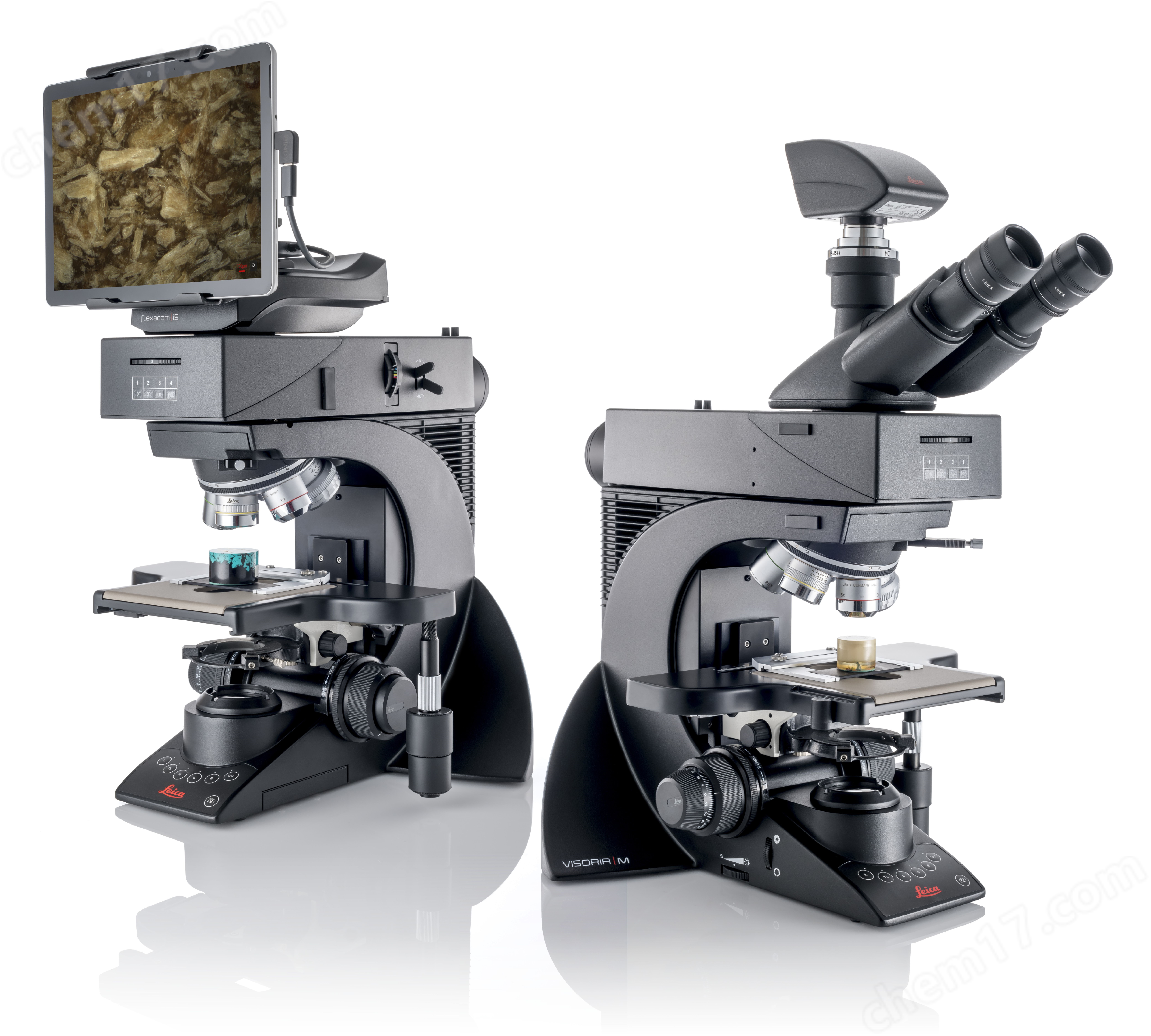


Hot stage microscope
NegotiableUpdate on 01/12
- Model
- Nature of the Manufacturer
- Producers
- Product Category
- Place of Origin
Overview
The Leica DM4 P hot stage microscope is a P-type hot stage microscope designed specifically for the field of materials science, integrating high-performance digital imaging systems. The system seamlessly integrates the optical performance of the Leica DM4 P upright research grade microscope, a precise temperature controlled thermal stage, and a high-resolution digital camera.
Product Details
The Leica DM4 P hot stage microscope is a high-performance, fully automated digital microscopy analysis system designed specifically for materials science research. Its core function is to enable researchers to observe and record the micro dynamic changes of samples in real-time under precisely controlled high or low temperature environments. It allows researchers to observe and record in real-time the microstructural changes of samples (such as metals, ceramics, polymers, etc.) during heating, cooling, or constant temperature processes, such as phase transition, crystallization, sintering, or melting, and is a key tool for achieving quantitative and automated thermal analysis.
Leica hot stage microscope helps you achieve high-quality results
Leica hot stage microscope helps you achieve high-quality results
You need some components to achieve polarization research goals. The following are important components:
1. Stress free optical components, as you need to ensure that the observed birefringence comes from the sample rather than the optical component
LED lighting is crucial because it can uniformly illuminate the sample and has a constant color temperature
3. Polarizers help you see birefringence, and a rotating table helps you align the sample with the optical axis
4. You also need a Burgundy mirror for conical observation of the optical axis and a compensator for measurement tasks
5. Professional microscope cold and hot stages for precise temperature control

Left image: Nylon fiber imaged using parallel polarized light. Right image: The same nylon fiber using orthogonal polarized light imaging displays typical high-order birefringence colors. Images captured using a DM4 P microscope, transmitted light, 20x Plan Fluotar objective, and polarized light.
Make full use of two types of lighting materials
You can configure the Leica polarizing microscope with either transmitted or reflected LED illumination, or you can configure it with both transmitted and reflected LED illumination.
When measuring reflectivity, incident light must be used, such as observing ores or coal.
When conducting birefringence measurements, it is necessary to use transmitted light, such as detecting geological thin sections, polymer films, or drugs.
In special applications such as geological research, both types of light are indispensable.
When the microscope is configured to use both incident and transmitted light, the relevant objective lens (with or without cover glass correction function) should be used starting from a magnification of>10x.
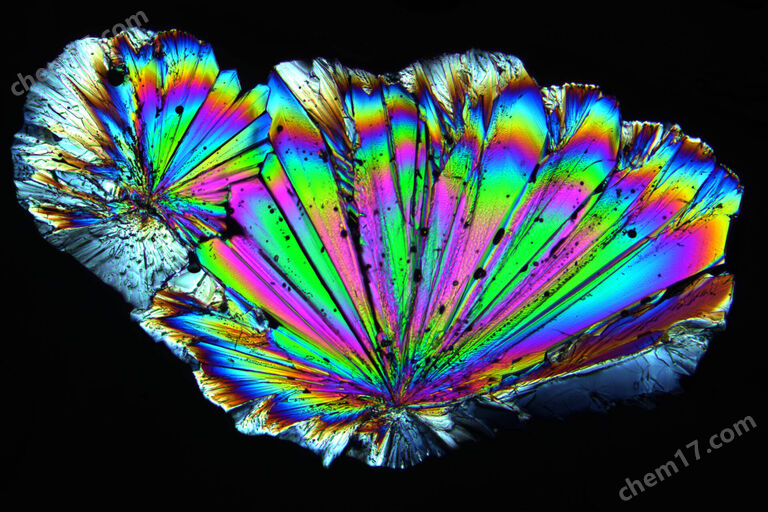
Radial growth of sugar crystals captured using circularly polarized light. Images captured using a DM4 P microscope, 10x Plan Fluotar objective, and polarized light.
Let the objective lens turntable handle it!
The objective turntable is equipped with 6 objective lenses with different magnifications to obtain rich sample information.
1. Use a 2.5-fold overview objective lens to identify macroscopic structures in the sample
If you want to conduct a detailed study of optical properties using the cone light method, you can switch to a magnification of 63 times
3. Switching to 100 times can verify phase reactions along particle boundaries
And the objective lens turntable is also encoded, providing you with intelligent support.
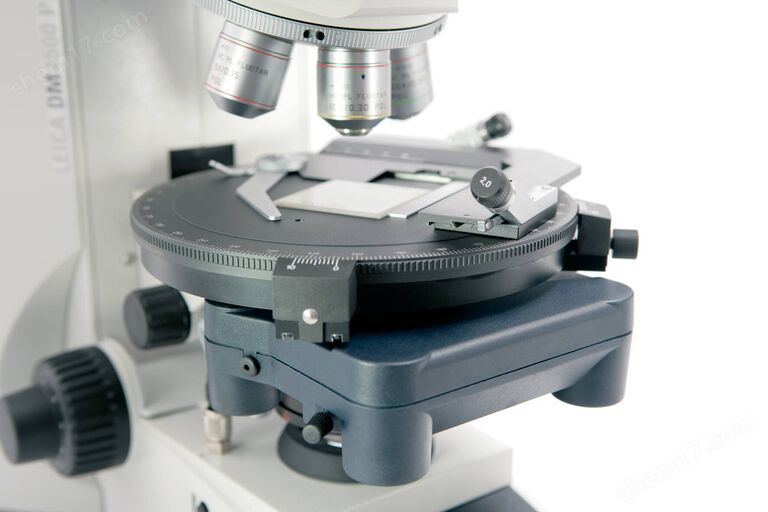
6 Eyepiece Nose Stand
Study optical properties
Cone light method is used to study interferograms. The shapes of these graphs and the modifications made by the compensator can generate information about the optical properties of the studied materials. You can determine the number of optical axes, optical axis angles, and optical properties of the material.
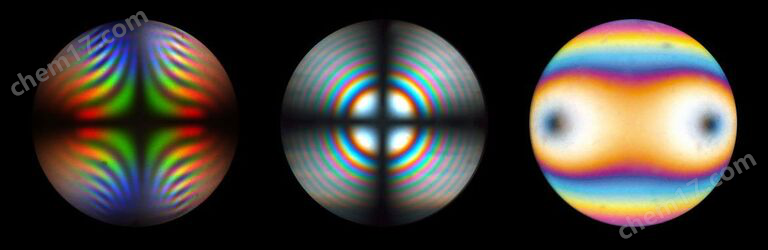
Strong scattered color Brookit (TiO2) cone light diagram
Uniaxial interference pattern of thick calcite slices, perpendicular to the optical axis
Circular polarized biaxial interference pattern of biotite crystal thin film, diagonal position. The position of the optical axis is clear and distinguishable
Leica DM4 P is highly suitable for cone light method
2. A stress free objective lens with high magnification and high numerical aperture is a prerequisite for this application.
3. Using a special 63x Leica objective lens, it can meet the highest requirement of polarization level 5, thereby obtaining high-quality results.
DM4 P microscope images captured using transmitted light, conical lens, 63x N Plan objective, and polarized light
| Visoria P Technical Parameters | |
| Microscope body | |
| Dimensions and Weight | Length: 410 millimeters, width: 331 millimeters, height: 505 millimeters, weight approximately 18 kilograms (depending on configuration) |
| support | Lighting switch button with status indicator light, image capture button, AgTreat antibacterial surface compliant with ISO 22196 standard |
| optical device | |
| objective turret | Encoding 5x (M25), can be centered |
| Eyepiece (FOV) | 20/22/25 millimeters |
| barrel | Camera port 50/50 with fixed port, 100/50/0 with fixed port, 100/50/0 with variable port |
| digital version | The digital version is equipped with a 10 inch display screen/tablet computer |
| Ergonomic accessories | Provide a variety of ergonomic accessories (ErgoTube, ErgoLift, ErgoModule) |
| Coded lighting management | Incident light and transmitted light: high-power white LED, encoded 4-color fluorescent lighting, other external light sources can be provided upon request (without encoding) |
| Incident axis | Manual coding, 4-digit fluorescent filter block turntable, color coding aperture assist device; Field of view and aperture stop, polarizer/polarizer slot, two filter block positions |
| Fluorescence axis | optional |
| Incident light (IL) | Method: Bright field (using bright field filter blocks or Smith reflectors), differential interference contrast, fluorescence, oblique illumination, polarization |
| Transmission axis | Equipped with a color coded aperture assist device, supporting manual, fixed, and flip style spotlight operation |
| Transmitting light (TL) | Method: Bright field, dark field, phase difference, differential interference, polarization |
| Operation Mode | 360 ° rotating polarization stage with cursor and brake; 360 ° rotating polarization stage with cursor, 45 ° card holder, and brake. The loading platform is replaceable and adjustable in height. Other platforms can be provided upon request. |
| Carrier platform | 5 x 50mm scanning stage, optional other manual xy stage, stage bracket, fixture for adapting third-party stage, sample bracket without point counting function, and sample bracket with point counting function |
| Focus driver | Height adjustable focusing knob with a travel range of 19 millimeters; The maximum total travel of the stage can reach 28 millimeters (depending on the type of stage and spotlight); Two gear focusing driver with 1 micrometer scale (coarse/fine adjustment); Three gear focusing driver (coarse/middle note/fine) with 140, 4 and 1 micron scale, supporting torque adjustment, and equipped with adjustable upper focusing limit device |
| accessories | |
| Conical mirror | Bo's mirror filter block, Bo's mirror module (A/B module), advanced cone lens module (adjustable focus) |
| Analyzer mirror | Fixed, 180 °, 360 ° |
| polarizing plate | Fixed, 0/45/90 °, 90 ° (with rotatable lambda plate), 360 °, fixed (with lambda plate) |
| compensator | Tilt compensator with up to 5 or 30 levels, quartz wedge, λ and 1/4 λ plates |
| Conventional Parameters | |
| power supply voltage | 100–240 V AC,50 / 60 Hz, Maximum power consumption 15 W |
| environmental conditions | The temperature range is 15-35 ° C, and the maximum relative humidity is 80% (without condensation) when not exceeding 30 ° C |


