-
E-mail
lina-he@zolix.com.cn
-
Phone
13810146393
-
Address
Feihong Road, Nanhu Avenue, Liangxi District, Wuxi City, Jiangsu Province
Product Categories
Jiangsu Shuangli Hepu Technology Co., Ltd

GaiaSky-mini3-NIR near-infrared hyperspectral imaging
NegotiableUpdate on 01/09
- Model
- Nature of the Manufacturer
- Producers
- Product Category
- Place of Origin
Overview
GaiaSky-mini3-NIR near-infrared hyperspectral imaging: using a built-in scanning system and a dedicated three-axis stabilization gimbal system developed based on DJI PSDK, it obtains images of the research object without geometric distortion while obtaining the true spectrum of each pixel. Cooperating with self-developed stitching software to achieve square kilometer level orthographic stitching, with no wrong stitching, no stitching marks, and no color difference, we provide customers with complete mid to low altitude hyperspectral remote sensing data. High sensitivity InGaAs detectors can obtain very good signals with very small integration times.
Product Details
GaiaSky-mini3-NIR near-infrared hyperspectral imaging
The new high-sensitivity InGaAs detector can obtain very good signals with very small integration time. At the same time as high-speed data collection, accurate measurement of data can be ensured, and the detector frame rate can be increased through the Binning setting of the camera. Unique optical path structure design, efficient communication method, and friendly acquisition and control interface. Software and hardware triggering functions facilitate system control and user secondary development. Quasi agricultural assessment; Environmental monitoring of water, oil spills, and land desertification; Military pseudo identification; Provide complete solutions for the application needs of ecological diversity assessment and other aspects.
Main Features
·Suitable for large-scale target image acquisition, with high spatial resolution, multiple spectral channels, and high spectral resolution;
·Powerful calibration functions: spectral calibration, radiometric calibration, uniformity calibration, lens calibration, reflectance calibration, etc;
·Powerful data stitching function: When obtaining information such as longitude, latitude, height, horizontal and vertical overlap rate of images, self-developed and designed stitching software can be used to complete image stitching of any area, obtaining highly accurate spatial and spectral test data.
·Application directions: monitoring of vegetation diseases and pests, monitoring of flame ignition points, pseudo identification of targets, geological and mineral exploration, monitoring of water pollution (oil spills).
GaiaSky-mini3-NIR near-infrared hyperspectral imagingTechnical Specifications
| model | GaiaSKy-mini3-NIR | ||
| Parameters of airborne hyperspectral camera | spectral range | 900-1700(nm) | |
| spectral resolution | 8nm(mean) | ||
| Number of spatial channels | 640 | ||
| Number of spectral channels | 224(1X),112(2X) | ||
| Spectral sampling interval | 3.5nm@224 | 7nm@112 | |
| Image resolution [1] | 640×512 | ||
| Imaging lens | 15mm (customized), 30mm | ||
| Image depth | 12 bit | ||
| output interface | USB3.0 | ||
| Working Voltage | 12v | ||
| power | 45w | ||
| Parameters of airborne hyperspectral imaging system | Shooting method | Unmanned aerial vehicle hovering with built-in push scan | |
| Equipped with a platform | DJI M350 | ||
| Installation interface [2] | Standard Skyport V2 interface | ||
| Auxiliary camera | 500W pixel real-time imaging | ||
| Lateral field of view angle | 35°@15mm | 23°@30mm | |
| Horizontal field of view width | 83 ﹙@ m 15mm﹐ 高度100m﹚ | 40m ﹙@30mm﹐高度100m) | |
| spatial resolution | 0.13m ﹙@15mm﹐高度100m﹚ | 0.065m ﹙@30mm﹐高度100m﹚ | |
| storage | 240G SSD (512G, 1T optional) | ||
| weight | 1.35kg | ||
Application Case Introduction
Rapid identification and classification of crops
Compared with the visible near infrared band, the image and spectral performance of targets such as land cover in the near-infrared band have special attribute expressions, which can analyze and judge the relevant information of targets such as atmosphere, water vapor, geology, vegetation, and pseudo infrared.

Figure 1 Hyperspectral test image (spliced, two sorties)

Figure 2 Target Feature Spectrum

Figure 3 Gray scale image at single wavelength (1440nm&1623nm)
Pseudo network monitoring
In modern military and security fields, pseudo networks are a common means of masking and concealment used to cover targets, facilities, or troops, making them difficult to detect in the infrared spectrum range. By utilizing 900-1700nm infrared drone borne hyperspectral technology, the limitations of traditional optical detection can be overcome, enabling accurate identification and analysis of pseudo networks at different heights. The flexibility and maneuverability of drones enable them to fly at different altitudes, providing data from multiple perspectives and spectral ranges, further improving the accuracy of pseudo network recognition. Helps to enhance target recognition capabilities in the military and security fields, and provides strong support for implementing effective tactical and security measures.

Figure 4 50m
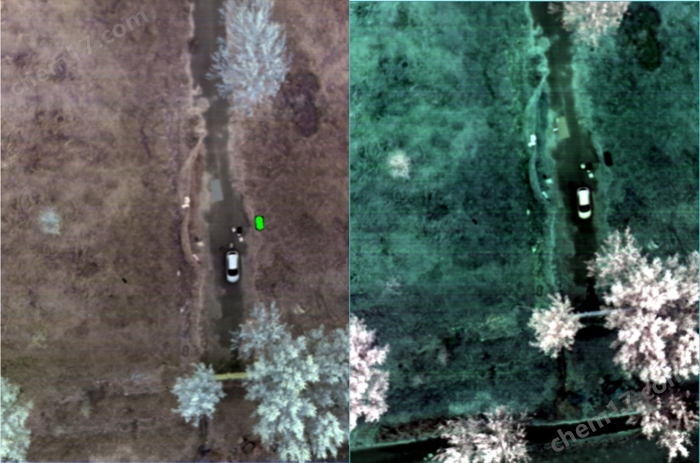
Figure 5 100m
Infrared mining area soil index
By utilizing 900-1700nm infrared unmanned aerial vehicle mounted hyperspectral imaging technology, high-precision spectral data collection of soil in mining areas can be achieved. This technology, equipped with an infrared spectral camera, can obtain spectral information of soil in a wider frequency range. This makes it possible to accurately analyze key parameters such as soil composition, organic matter content, and mineral content. Can accurately detect the mineral content in the soil, helping mining area managers understand the mineral resource potential of the soil; It can also evaluate the organic matter content of soil, providing scientific basis for ecological environment protection in mining areas. It has demonstrated enormous potential in soil composition analysis, quality assessment, and resource management, providing strong data support for mining area managers and assisting in the sustainable development of mining areas.


Vegetation biochemical parameter detection
Vegetation, as an important component of surface materials and terrestrial ecosystems, plays a crucial role in maintaining regional ecological environments and addressing global climate change. Hyperspectral data can record the selective absorption characteristics of various biochemical components in plants towards electromagnetic waves of different wavelengths. By using 900-1700nm infrared unmanned aerial vehicle (UAV) carried hyperspectral imaging technology, accurate and real-time data support can be provided for the detection of vegetation biochemical indicators, which helps to better understand and manage vegetation resources.


Figure 6 Distribution of Calcium Ion Content Figure 7 Distribution of Magnesium Ion Content
land cover classification
Airborne hyperspectral imaging technology can capture subtle spectral differences of ground objects, enabling more accurate identification of their types and thus improving the accuracy of ground object classification. Hyperspectral remote sensing image classification is widely used in agriculture, military, marine management, and geological exploration. Hyperspectral image classification technology has become an important component of modern technology.

Figure 8 Hyperspectral image

Figure 9 Classification Results
Similar Product Recommend


