-
E-mail
360009931@qq.com
-
Phone
13913683786
-
Address
No. 31 Xingdong Road, Wangshan Industrial Park, Wuzhong District Development Zone, Suzhou City
Product Categories
Suzhou Tuoce Instrument Equipment Co., Ltd
Forced convection oven
NegotiableUpdate on 01/12
- Model
- Nature of the Manufacturer
- Producers
- Product Category
- Place of Origin
Overview
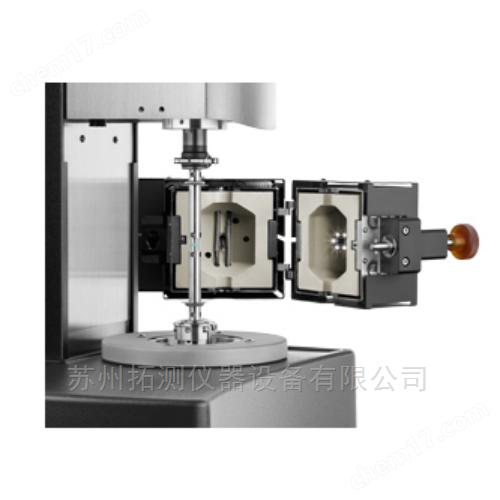
Forced convection oven FCO is a gas convection oven designed for use in -150 #176; C to 600 #176; Realize temperature stability, extremely fast heating and cooling, and ease of use within the temperature range of C. Mainly used for testing polymer melts, thermosetting materials, and solid samples, and providing excellent oxygen removal, making it an effective choice for high-temperature testing of polymers with poor oxidation stability. By using a dual element heater, temperature stability and uniformity were achieved, generating a reverse rotating airflow in the oven chamber to quickly heat the sample without thermal gradients.
Product Details
Forced convection oven
Forced convection ovenFCOIt is a gas convection oven designed to achieve a temperature range of -150 ° C to 600 ° C Temperature stability, extremely fast heating and cooling, and ease of use. This powerful heating mechanism can heat at a controlled rate of up to 60 ° C/min. By using available liquid nitrogen cooling systems, fast, uniform, and efficient cooling can be achieved at temperatures as low as -150 ° C. Alternatively, mechanical cooling systems can also be used to cool temperatures as low as -100 ° C without the need for liquid nitrogen. FCO is mainly used to test polymer melts, thermosetting materials, and solid samples, and provides excellent oxygen removal, making it an effective choice for high-temperature testing of polymers with poor oxidation stability. By using a dual element heater, temperature stability and uniformity were achieved, generating a reverse rotating airflow in the oven chamber to quickly heat the sample without thermal gradients.
FCO can be installed on both sides of the testing station and comes standard with long-life internal LED lights and window observation ports. The optional camera viewer can be used to record real-time sample images throughout the entire experimental process. This visual recording is helpful for data validation and sample condition validation. FCO offers a range of geometric shapes to choose from, including parallel plates, cone plates, solid twist, cone and partition plates (CPP), tensile viscosity fixtures (EVF), SER3-A universal testing platform, and a range of new linear DMA fixtures.
Features and advantages:
Forced convection design with high temperature stability and uniform temperature control
Dual resistance spray gun heater ensures fast response
DuTe's oven cavity design optimizes gas mixing and eliminates thermal gradients
Wide temperature range: -150 ° C to 600 ° C
The maximum heating rate is 60 ° C/min
You can choose liquid nitrogen or ACS mechanical cooler for secondary environmental testing
Provide various boards, cones, cross hatching, serrations, and disposable geometric shapes
The range of options for testing under torsion, bending, compression, tension, or tensile deformation
-
Optional built-in camera viewer
technology

The forced convection oven is designed to optimize temperature response time, uniformity, and stability. The gas passes through two resistive spray gun heaters and enters a specially shaped oven chamber to optimize gas mixing and uniformity. Up to five thermocouples are used in the oven for continuous temperature measurement - this data is used to determine the commanded power and gas flow rate for each heating gun to maintain an ideal thermal environment.
Active Temperature Control (ATC):
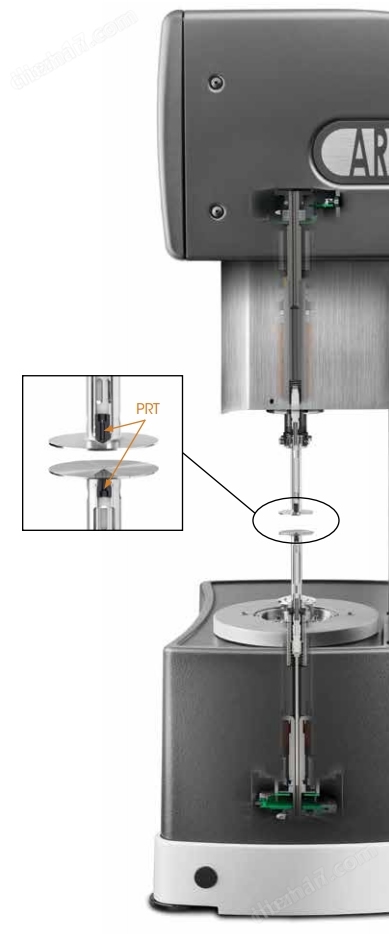
ARES-G2 adopts the obtainedzhuan liThe non-contact temperature sensor technology can actively measure and control the temperature of the upper and lower plates. Platinum resistance thermometer (PRT) is directly connected to the motor and sensor shaft. These PRTs are in close contact with the centers of the lower and upper measurement surfaces. The temperature signal is transmitted to the printed circuit board, and the temperature reading is transmitted to the secondary board in the motor and sensor through a non-contact (wireless) mechanism. These temperature readings can directly control the temperature of two plates, achieving more accurate and sensitive temperature control without vertical temperature gradients or the need for complex calibration procedures and offset tables to infer sample temperature.
Similar Product Recommend