- Phone
-
Address
Dawangshan Third Industrial Zone, Shajing Street, Bao'an District, Shenzhen
Product Categories
Shenzhen Puyun Electronics Co., Ltd
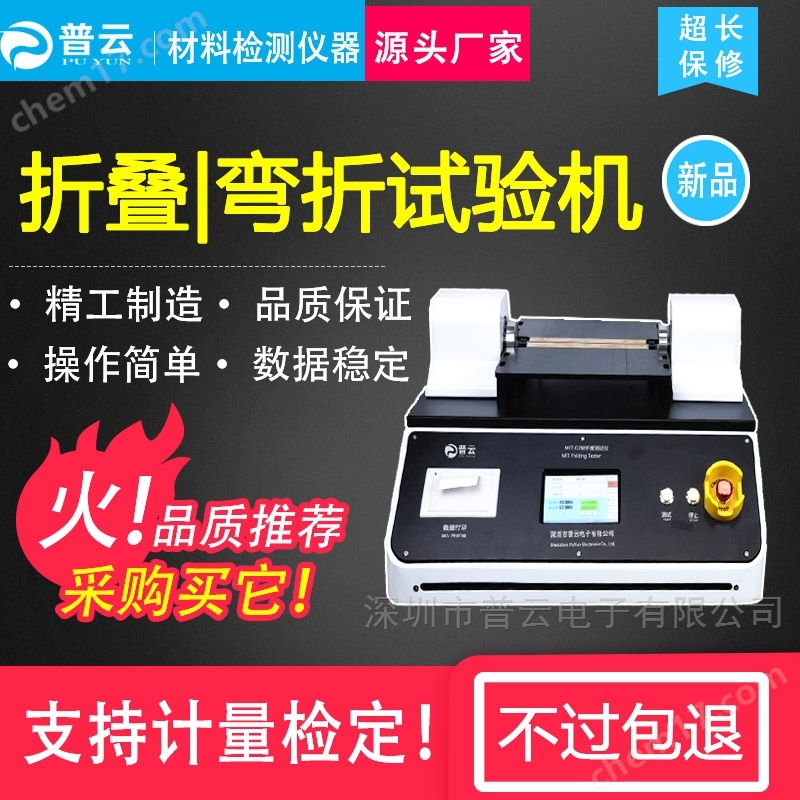


Folding screen folding fatigue testing machine - bending resistance tester
NegotiableUpdate on 05/07
- Model
- Nature of the Manufacturer
- Producers
- Product Category
- Place of Origin
Overview
The folding screen folding fatigue testing machine bending resistance tester produced by Shenzhen Puyun Electronics Co., Ltd., also known as PY-FZ-C flexible folding screen bending resistance tester, OLED flexible screen fatigue folding tester, flexible material repeated bending testing machine, dynamic bending testing machine, material flexibility testing equipment, FPC cyclic bending testing equipment, metal foil repeated folding testing equipment, is mainly used for 180 degree folding testing of flexible materials such as FFC, FPC, TP, flexible circuit boards, flexible films, flexible screens, graphene, flexible boards, UTG materials (bending resistance conductivity testing).
Product Details
Produced by Shenzhen Puyun Electronics Co., LtdFolding screen folding fatigue testing machine - bending resistance testerAlso known as PY-FZ-C Flexible Folding Screen Bending Resistance Testing Machine, OLED Flexible Screen Fatigue Folding Tester, Flexible Material Repetitive Bending Testing Machine, Dynamic Bending Testing Machine, Material Flexibility Testing Equipment, FPC Cyclic Bending Testing Equipment, Metal Foil Repetitive Folding Testing Equipment, it is mainly used for 180 degree folding testing of flexible materials such as FFC, FPC, TP, flexible circuit boards, flexible films, flexible screens, graphene, flexible boards, UTG materials (bending resistance and conductivity performance testing).
There are mainly two types: room temperature type and simulated high and low temperature environment type.
The flexible material folding life testing machine adopts a touch screen setting and display, and conducts repeated folding tests on a certain round rod, number of times, speed, and angle. The longitudinal and transverse directions, tension size, testing speed, and folding times of the sample can be set according to the experimental requirements.
reference standard
GBT 38001.61-2019
IEC 62715-6-1-2014 Flexible display devices-Part 6-1 Mechanical stress test methods
Technical parameters:
1. Folding angle: 0-180 degrees (can be set and displayed on the touch screen)
2. Test frequency: 0-9999 times (can be preset and power-off memory)
3. Test speed: 5-65 times/minute (touch screen adjustable and displayed)
4. Stay time: 0-99S (adjustable)
5. Folding countertop: 200 × 150mm (two, one front and one back)
6. Bending radius: R1mm, R1.5mm, R2mm (one set each for round bars)
7. Control system: touch screen+PLC
8. Drive system: servo motor+reduction system
9. Featured features: fracture shutdown record, with on/off function
10. Experimental function: Set angle, frequency, speed, etc., with good conductivity function, automatic stop counting function when disconnected, automatic search for origin, etc.
11. Human computer interface: LCD display, real-time display of test data
12. Print output: modular integrated thermal printer
13. Working environment: temperature (0~35) ℃, humidity<85%
14. Power supply: AC220V, 50Hz
15. Note: This machine supports non-standard customization.

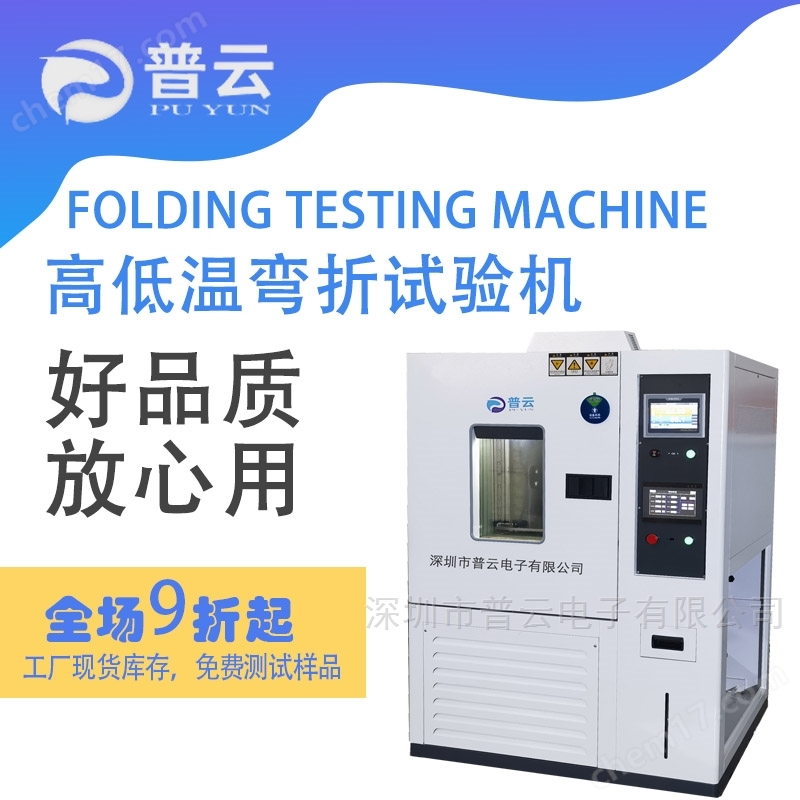
Simulated climate environment type: high and low temperature typeOLED flexible screen fatigue folding testerPY-E608D Flexible Material High and Low Temperature Folding Life Testing Machine, also known as Flexible Screen Fatigue Repeated Bending Testing Machine, Material Bending Testing Machine, Material Bending Strength Tester, Material Life Fatigue Testing Machine, Material Flexibility Testing Equipment,UTG Soft Glass Fatigue Folding TesterIt is a professional equipment used to test the bending performance and reliability of flexible screens and related flexible materials under different temperature environments. Widely used for bending and conductivity testing of flexible materials such as FFC, FPC, TP, flexible circuit boards, flexible films, flexible screens, graphene, flexible boards, UTG materials, etc. The flexible material high and low temperature folding life testing machine adopts a touch screen and PLC communication setting and display, and repeatedly flips and tests at a certain round rod, frequency, speed, and angle. The longitudinal and transverse directions, tension size, testing speed, and folding times of the sample can be set according to the experimental requirements.
High and low temperature typeFolding screen folding fatigue testing machine - bending resistance tester Technical parameters:
Standard internal volume of 252L customized according to customer requirements
Inner box size 600mm × 600mm × 700mm (W × H × D) customized according to customer requirements
External dimensions 1150mm × 1650mm × 1610mm (W × H × D) customized according to customer requirements. The external dimensions are mainly based on the actual product
Weight 350kg
Current 12A
Power 7.5kw
Power supply three-phase, 380V, 50HZ
Temperature range -40 ℃~+150 ℃ (50kg of steel stored in the inner box)
Humidity range 20%~98% R.H. (non-standard 5%~98% R.H. is possible)
control accuracy
Temperature resolution: 0.01 ℃ Humidity resolution: 0.1% R.H
Temperature deviation: ± 2 ℃ Humidity deviation: ± 2% R.H
Temperature uniformity: ≤ 2 ℃ Humidity uniformity: ± 3% R.H
Temperature fluctuation: ± 0.5 ℃ Humidity fluctuation: ± 2% R.H
Heating and cooling rate
Heating time: -40 ℃+150 ℃, with an average of ≥ 3 ℃/min throughout the entire process
Cooling time: 150 ℃ -40 ℃, with an average of ≥ 1 ℃/min throughout the entire process
Bending structure section:
1. Transmission: The servo motor drives the synchronous toothed belt, causing the inner and outer folding actuators to repeatedly perform folding and folding actions, achieving bending testing of flexible materials fixed on the fixture. The motor is installed outside the testing box.
2. Fixture: Composed of two flat plates with dimensions of 350 * 250mm, the angle of the plates can be adjusted, and the folded flat surface is installed inside the environmental box.
3. Bending angle: can be set arbitrarily between 0-180 °.
4. Bending radius: customized according to customer requirements for R1mm, R1.5mm, R2mm, etc
5. Bending speed: 5-60 times/minute, flexibly adjusted according to testing requirements.
5. Control: Microcomputer and integrated circuit control, automatic measurement and control, 7-inch display screen.

Mobile folding screen film UTG folding fatigue testerThe core is to use a dedicated machine to simulate the repetitive folding and bending movements in daily life.
During testing, the strip-shaped material sample will be fixed on the machine, and the machine will repeatedly fold it thousands of times according to the set angle, speed, and force. Researchers will continue to observe and record until the material experiences phenomena such as cracking, fracture, or decreased conductivity, in order to determine how resistant the material is to bending and how it will ultimately fail.
Simply put, it meansIn the laboratory, using scientific and controllable methods to quickly age and deteriorate materialsTo predict its lifespan and reliability in real use.
As a core component in the field of consumer electronics, foldable screens need to go through the process of daily useRepeatedly opening and closing thousands or even hundreds of thousands of timesThe structural reliability, material durability, and circuit stability directly determine the product's lifespan and user experience, therefore strict folding and dynamic bending tests must be conducted.
Folding test/dynamic bending test canHighly simulate real user usage scenariosContinuously conduct cyclic fatigue verification on the screen body, UTG ultra-thin glass, flexible display layer, FPC circuit, adhesive layer, and support structure under controllable bending radius, bending speed, and bending angle, exposing potential failure risks such as material cracking, delamination, creases, display abnormalities, touch failure, circuit breakage, or resistance drift in advance. Such defects are difficult to detect at room temperature and static conditions, and can only be effectively identified through dynamic fatigue testing.
Through the folding test of the system, it can be verifiedUTG cover plate, PI substrate, OCA adhesive, flexible OLED, conductive circuitThe tolerance of key materials and structures under long-term cyclic stress provides real and reliable data support for material selection, structural design, and process optimization. At the same time, foldable screens are high-value components. Once they are mass-produced and encounter problems such as screen body damage and display failure, it will bring huge after-sales costs and brand reputation losses. However, dynamic bending tests in the laboratory stage can significantly reduce such risks from the source.
In addition, mainstream terminal brands such as Huawei, Samsung, Xiaomi, etc. have clear requirements for the bending life of foldable screens, and the folding test data isSupplier admission, quality audit, and shipment certificationThe basis. It can be said that dynamic bending test is not only a "safety checkpoint" for folding screens from research and development to mass production, but also a core technical means to ensure long-term reliability of products and enhance market competitiveness.
Similar Product Recommend