- Phone
-
Address
Dawangshan Third Industrial Zone, Shajing Street, Bao'an District, Shenzhen
Product Categories
Shenzhen Puyun Electronics Co., Ltd




FPC copper-clad laminate FFC bending resistance testing machine
NegotiableUpdate on 05/07
- Model
- Nature of the Manufacturer
- Producers
- Product Category
- Place of Origin
Overview
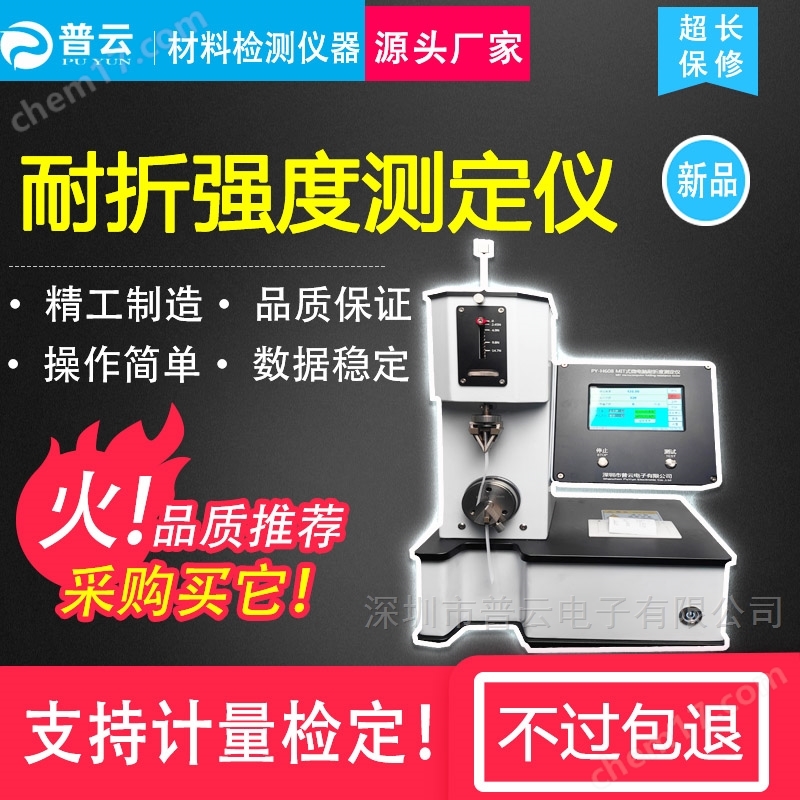
FPC copper-clad laminate FFC bending resistance tester PY-H608 MIT type bending resistance tester, also known as fatigue bending resistance tester, bending resistance tester, bending resistance tester, etc. Definition of Folding Durability: Refers to the number of double folds that paper or cardboard can withstand up to 135 degrees of reciprocating folding under a certain tension, expressed as the logarithm of the number of double folds in reciprocating folding or the number of double folds based on 10. Standard basis: GBT2679.5 Determination of paper and paperboard folding resistance (MIT folding resistance method), ISO 5626 Determination of paper folding resistance.
Product Details
FPC copper-clad laminate FFC bending resistance testing machinePY-H608 MIT style bending tester, also known as fatigue bending tester, bending tester, bending tester, etc. Definition of Folding Durability: Refers to the number of double folds that paper or cardboard can withstand up to 135 degrees of reciprocating folding under a certain tension, expressed as the logarithm of the number of double folds in reciprocating folding or the number of double folds based on 10. Standard basis: GBT2679.5 Determination of paper and paperboard folding resistance (MIT folding resistance method), ISO 5626 Determination of paper folding resistance.
Shenzhen Puyun Electronics Co., Ltd. PY-H608 modelFPC copper foil bending resistance testing machine MIT style flexural tester(also known as fatigue bending resistance testing machine)It is a high-precision bending performance testing equipment designed based on MIT standards, mainly used to test the bending life and fatigue performance of paper, film, metal foil (such as copper foil, aluminum foil), flexible materials, etc. under repeated bending. It is widely used in quality control and scientific research testing of packaging materials, electronic materials, printing paper products and other industries.
1、 Core functions and testing principles
This device simulates the scenario of repeated bending of materials in actual use, applies periodic bending stress to the sample, records the number of bending times before fracture or performance failure, and evaluates the material's flexural strength, flexibility, and fatigue resistance.
-Testing principle: Using the MIT bending test method, the sample is fixed between the upper and lower clamps, and the clamps are mechanically driven to bend back and forth at a set angle (such as 135 °) while applying a constant tension until the sample breaks. The bending times (i.e. bending resistance value) are automatically counted.
-Applicable samples: paper, cardboard, plastic film, metal foil (copper foil, aluminum foil), flexible circuit board substrate and other thin materials.
2、 Main technical parameters
| Measurement range: | 0~99999 times [Logarithms 0~lg4] | Folding angle: | 135 ° (15~180 °) ± 1 ° adjustable |
| Folding speed: | 175 ± 5 times/min (adjustable from 2 to 200 times/min) | Tension adjustment: | 4.91N/9.82N/14.73N |
| Standard clamp: | Spiral locking fixture with parallel specimen position | Upper clamping thickness range: | (0.1~2.30)mm |
| Upper clamping width range: | (0.1~16.0)mm | Upper clamping force area: | 7.8*6.60mm/51.48mm2 |
| Upper clamping force torque: | 19.95:5.76Wid 9.85mm | Parallel positioning height of the sample: | 16.0mm |
| Folding clamp: | Tension variation not exceeding 0.343N | The width of the lower folding head is: | (0.1~20.0)mm |
| Clamping method of the lower fixture: | Cylindrical rolling knob, more convenient for force clamping | Bend radius: | 0.38±0.01mm |
| Reproducibility: | 10%(when 30T), 8%(when 3000T) | Temperature change at the bend: | ≤1°C ,AFTER 4H |
| Sample length: | ≥140mm | Distance between upper and lower clamps: | 9.5mm |
| The distance between the folds and the seams: | 0.25mm/0.5mm/0.75mm/1.00mm | interface: | 5.0-inch color touch screen/dual system in Chinese and English |
| Ventilation system: | Self suction cooling system, suitable for fatigue testing | Print output: | Modular integrated thermal printer |
| Size and weight: | 300*300*450mm | Weight: | 30kg |

IIIFPC copper-clad laminate FFC bending resistance testing machine Equipment features and advantages
1. High precision testing: Using precision ball screw transmission, the bending angle error is ≤± 1 °, the tension control accuracy is ≤± 2%, ensuring the repeatability of test data (the same sample test deviation is ≤ 5%).
2. Automation operation: After the sample is clamped, it can be started with one click to automatically complete the bending, counting, and stopping processes. It is equipped with a high-definition display screen to display the bending times and tension values in real time, reducing manual intervention.
3. Multi functional adaptation: Supports custom tension and bending speed parameters, equipped with different specifications of clamps, can meet the testing needs of various materials such as paper and metal foil, especially suitable for testing the bending resistance of copper foil and aluminum foil in the field of flexible electronics.
4. Safety and durability: The body is made of high-strength steel with anti-corrosion treatment on the surface; Built in overload protection device, automatically shuts down when tension or bending force exceeds the set range, protecting equipment and samples.
4FPC copper foil bending resistance testing machineApplicable scenarios
-Packaging industry: Testing the folding resistance of cardboard and kraft paper, evaluating the anti damage ability of packaging during folding and transportation.
-Electronic materials: Testing the flexural life of copper foil and PET film used in flexible circuit boards to verify their reliability in wearable devices, foldable screens, and other products.
-Research field: Provide data support on flexural performance for material formulation optimization (such as paper reinforcement agents and metal foil annealing processes), and assist in the development of new flexible materials.
5、 Brief description of operation process
1. Cut the sample to standard size (15mm × 100mm), ensuring that the edges are flat and free of burrs;
2. Adjust the spacing between the clamps and the tension value, fix the sample between the upper and lower clamps, and ensure uniform force distribution;
3. Set the upper limit of bending times (optional), start the device, and observe the testing status in real time;
After the sample breaks, the equipment automatically stops, records the displayed number of bends, and completes the test.
Shenzhen Puyun Electronics Co., LtdPY-H608 typeMIT style flexural testerWith its precise, efficient, and stable performance, it provides reliable solutions for material flexural performance testing, meeting industry standards and scientific research needs. Shenzhen Puyun Electronics Co., Ltd. can provide customized services according to customers' special testing needs. Welcome to consult and cooperate.
-------------------------------------
The bending resistance test of copper-clad laminates, especially flexible copper-clad laminates (FPC), is an important means of evaluating their mechanical and electrical reliability under dynamic bending, folding, or repeated deformation conditions. Its core significance is reflected in the following aspects:
1. Verify the reliability of the product in real usage scenarios
·FPC often needs to withstand repeated bending, winding, or dynamic deformation in consumer electronics (such as foldable phones, smartwatches), automotive electronics (such as wiring harnesses, sensors), medical equipment (such as endoscopes), and other products. The anti bending test simulates these working conditions (such as 0-180 ° reciprocating bending, specific radius folding) to verify whether FPC will experience failures such as wire breakage, delamination, and solder joint cracking after long-term use.
2. Quantify the fatigue life of materials and structures
·The test is based on the principle of "Stress Cycle Number (S-N) Fatigue Curve", recording the number of cycles of FPC before failure under set bending conditions (radius, angle, frequency), as a quantitative indicator of fatigue resistance performance. ·For example, foldable screen FPC usually requires more than 500000 bending cycles without failure, while automotive grade FPC needs to meet more than 100000 cycles (calculated based on an average of 15 cycles per day and a 10-year lifespan).
3. Support design optimization and process improvement
Through failure mode analysis (such as wire breakage, substrate delamination, and cover film peeling), the root cause of the problem can be traced:
The wire breakage line width is too narrow, and the copper foil type is inappropriate (rolled copper should be selected instead of electrolytic copper);
·Poor adhesion of the layered covering film on the substrate or moisture absorption of the P substrate;
·Welding process parameters are unreasonable due to cracking of solder joints.
·Thus guiding material selection (such as high toughness P1, thin rolled copper foil), structural design (vertical bending direction of the circuit
Arc corners and process optimization (low-temperature slow pressing, flexible solder mask).
Similar Product Recommend