-
E-mail
3459631660@qq.com
-
Phone
13871339889
-
Address
Building A1, Area A, Optics Valley Core Center, No. 52 Liufang Avenue, Donghu New Technology Development Zone, Wuhan City, Hubei Province
Product Categories
- Zirconia oxygen analyzer
- Colorimeter/Turbidity/Suspended Matter Analyzer
- Laser online analysis system
- Gas online analysis system
- Rapid heavy metal analyzer for water quality
- Dust online monitoring system
- Water quality flowmeter instrument
- Air quality monitoring system
- PH/dissolved oxygen/conductivity meter
- Desktop rapid water quality analyzer
- E+H
- Heavy metal water quality online analyzer
- Remote sensing monitoring system for motor vehicle exhaust emissions
- Micro water quality monitoring station
- Biogas online analysis system
- Portable rapid water quality analyzer
- Online water quality detector
- other
Wuhan Zhengyuan Environmental Technology Co., Ltd

DUST-9702 laser dust detector
NegotiableUpdate on 03/15
- Model
- Nature of the Manufacturer
- Producers
- Product Category
- Place of Origin
Overview
Product Series: Laser Online Analysis System Product Introduction: DUST-9702 is based on the backscattering principle of smoke particles and is used for online continuous measurement of particulate pollutants from fixed pollution sources. DUST-9702 uses a 10mw, 650nm semiconductor laser, laser beam, and reflected light. Direct light entering the eyes can cause serious damage. Do not look directly at the laser beam and its reflected light. Without proper training, operations beyond the scope of this manual are not allowed.
Product Details
I. Overview
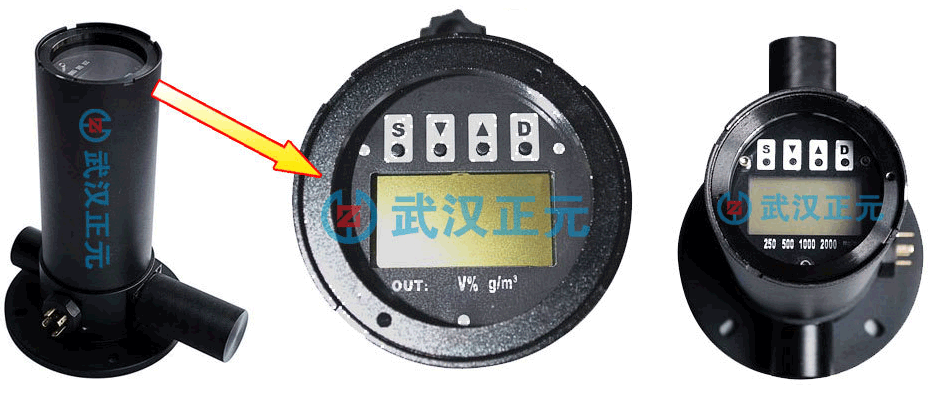
DUST-9702 is based on the principle of backscattering of smoke particles and is used for online continuous measurement of particulate pollutants from fixed pollution sources. DUST9702 uses a 10mw, 650nm semiconductor laser, laser beam, and reflected light. Direct light entering the eyes can cause serious damage. Do not look directly at the laser beam and its reflected light. Without proper training, operations beyond the scope of this manual are not allowed.
2、 Working principle
The working principle of DUST-9702 smoke detector is that the laser beam emitted by the laser emitter enters the pollution source and scatters suddenly with several smoke and dust vessels. The laser receiver detects the backscattered beam received, and the system's circuit and conditioning parts convert the signal into a standard signal output proportional to the depth of the smoke, thereby obtaining the emission concentration of smoke particles from the pollution source.
The DUST-9702 smoke detector consists of an optical part, a circuit and conditioning part, a calibration calibrator, and an air curtain protection part. The optical part includes laser light source and power control, photoelectric sensing, and scattered light receiving part. The 650nm beam emitted by the laser enters the emission source at a small angle, and the laser beam interacts with smoke particles to produce scattered light. The backscattered light enters the sensor through the receiving system and is converted into an electrical signal for processing. The circuit part realizes photoelectric conversion, modulation of laser beam, signal amplification, modulation, power control of light source, and V/I conversion functions. The calibrator is used to generate a stable optical signal for zero and span calibration of the instrument, while the air curtain protection part is used to protect the laser emitting and receiving lenses from contamination.

3、 Technical features
Adopting the principle of laser backscattering. Not afraid of mechanical vibration of the flue and beam oscillation caused by uneven refractive index due to uneven flue gas temperature;
Single end installation, no need for optical alignment. The instrument design process reduces the complexity of on-site installation. The installation of instruments and rainproof systems only requires a screwdriver for electrical connections, which can be completed within 20 minutes. Installation and maintenance are extremely simple, minimizing the many problems caused by on-site installation and debugging.
Adopting standard 4-20mA industrial standard current output, easy to connect;
The overall power consumption of the instrument is relatively low, about 5W;
• Local display setting function, which can be set locally through buttons. Place the calibrator on site to avoid confusion and loss:
High resolution, suitable for monitoring requirements of low concentration emissions, as well as for monitoring high concentration emissions;
Non point measurement with a large sampling area, suitable for use with chimneys of various diameters.
4、 Technical indicators

5、 Scope of application
DUST-9702 can be used for real-time continuous measurement of particulate pollutant concentrations from various pollution emission sources. It can be paired with a monitoring system and can be connected to a set of smoke and dust monitoring networks by one or several units, sharing a front desk. The instrument can be used for monitoring smoke and dust in power plants, steel mills, cement plants, etc. It can also be used for process control of dust removal equipment and other powder engineering.