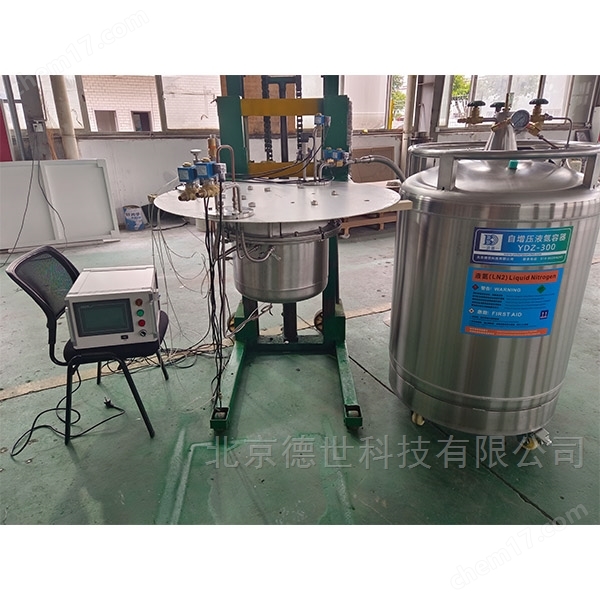
The core goal of the constant temperature control system for liquid nitrogen refrigeration low-temperature equipment is to solve the industry pain points of high cost of existing compressor refrigeration low-temperature equipment and difficulty in constant temperature control of ordinary liquid nitrogen refrigeration equipment. It can adapt to both small-scale laboratory low-temperature requirements and large-scale engineering operation scenarios.
Constant temperature control system for liquid nitrogen refrigeration low-temperature deviceThe core goal is to solve the industry pain points of high cost of existing compressor refrigeration low-temperature equipment and difficulty in constant temperature control of ordinary liquid nitrogen refrigeration equipment, and to adapt to both small-scale laboratory low-temperature requirements and large-scale engineering operation scenarios.

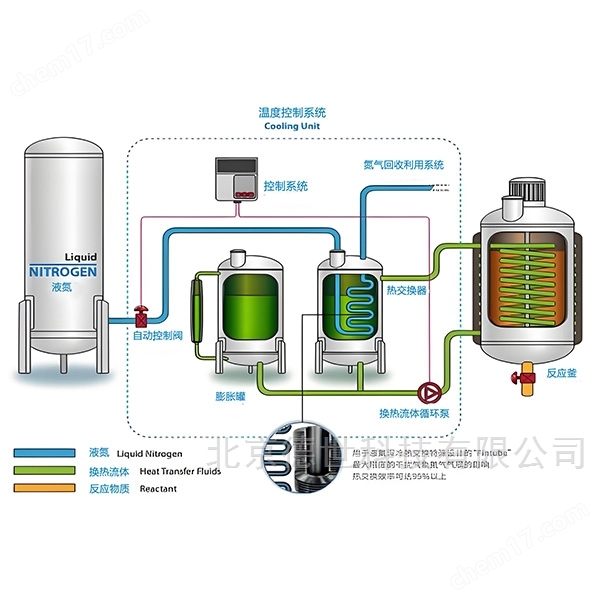
The device achieves efficient refrigeration and precise temperature control through modular design, with clear and closely coordinated functions of each core component. The specific composition is as follows:
Refrigerant supply systemThe core is a self pressurized liquid nitrogen tank, which serves as a storage and supply source for liquid nitrogen and is connected to the discharge port of the low-temperature container through a liquid nitrogen pipeline. Among them, stainless steel corrugated pipes are used for the liquid nitrogen pipeline, and the outer wall is wrapped with insulation layer; There is also a low-temperature solenoid valve dedicated to liquid nitrogen in the pipeline, and the valve body is also wrapped with insulation layer, which can effectively prevent liquid nitrogen from vaporizing prematurely due to heat absorption during transmission, ensuring refrigeration efficiency.
Low temperature container systemIt consists of a cylinder and a detachable top cover, both of which adopt a sandwich structure (the sandwich is vacuum like or filled with expanded perlite). This design can reduce the transfer of cold from the container to the outside, reduce heat loss, and avoid frostbite accidents when personnel touch the outer wall of the container. The container is also equipped with an organic medium injection pipe (for injecting cooling medium) and an organic medium discharge pipe (for discharging discarded or replaced medium), and a stainless steel wire mesh partition is installed near the liquid nitrogen pipeline mouth to buffer the liquid flow impact during liquid nitrogen injection, making the heat exchange between the cold and hot media smoother and more uniform, reducing the temperature gradient inside the container, and further improving the heat exchange efficiency.
Temperature control systemWith temperature control alarm as the core, two platinum resistance temperature probes (the first temperature probe and the second temperature probe) are equipped, both located inside the low-temperature container, and the height of the second temperature probe is lower than that of the first temperature probe. Among them, the first temperature probe is fixed 0.8-1.2cm below the top cover, mainly used to monitor the upper limit of the cooling medium liquid level. If excessive liquid nitrogen filling causes the medium to submerge the probe (the temperature will quickly drop to 77K), the alarm will immediately close the liquid nitrogen solenoid valve to prevent liquid nitrogen overflow and trigger a safety alarm; The second temperature probe is used for real-time monitoring of the temperature of the cooling medium and is a key component for achieving constant temperature control. Through its monitoring data, it controls the on/off of the solenoid valve and adjusts the injection amount of liquid nitrogen.
Sample storage and data monitoring systemIncludes sample container and data logger. The sample container is placed in a low-temperature container and made of stainless steel container or flexible organic bag, which can prevent the cooling medium from infiltrating the container and contaminating the sample; The sample container is connected to a data logger through a pipeline, which can display and record the sample temperature in real time, providing support for experimental data traceability or engineering operation monitoring.
This device uses liquid nitrogen as the refrigerant and organic solutions (such as ethanol, isobutanol, methanol, etc.) as the cooling medium. Through a closed-loop process of "initial refrigeration constant temperature insulation cyclic temperature control", it achieves a stable low-temperature environment in a wide temperature range (room temperature~-196 ℃). The specific steps are as follows:
preliminary preparationLoad the sample that needs to be kept at low temperature into the sample container, open the top cover of the low-temperature container, and place the sample container into the cylinder; Then open the organic medium filling tube and close the discharge tube, inject ambient temperature organic solution into the cylinder until the solution submerges the sample container and the second temperature probe, and the liquid level is lower than the first temperature probe. Close the filling tube and fasten the top cover. The available organic compounds include non-toxic alcohols such as ethanol (melting point -115 ℃), isobutanol (melting point -108 ℃), methanol (melting point -97 ℃), isopropanol (melting point -88 ℃), etc. By replacing organic compounds with different melting points, different low-temperature control targets can be achieved.
Initial coolingTurn on the temperature control alarm and the self pressurized liquid nitrogen tank separately. The alarm senses that the cooling medium is at room temperature through the second temperature probe, and then controls the liquid nitrogen solenoid valve to open; Under pressure, liquid nitrogen is injected into a low-temperature container through a stainless steel corrugated tube and undergoes heat exchange with an organic solution, gradually reducing the temperature of the solution.
constant temperature insulationWhen the second temperature probe detects that the solution temperature is 1-1.5 ℃ lower than its melting point, the temperature control alarm immediately controls the liquid nitrogen solenoid valve to close, and the liquid nitrogen injection stops; At this point, the organic solution transforms into a solid phase due to continuous cooling, entering a constant temperature and insulation state. By utilizing the high latent heat of liquid-solid phase transition, it can maintain a low-temperature environment for a long time.
Loop temperature controlIf the second temperature probe detects that the temperature of the solid phase medium has risen to 1-1.5 ℃ above its melting point, the alarm will reopen the liquid nitrogen solenoid valve. The liquid nitrogen will be re injected and heat exchanged with the medium. When the temperature drops to 1-1.5 ℃ below the melting point, the solenoid valve will close again and the medium will return to the solid phase insulation state; By repeating this cycle, long-term stable low-temperature constant temperature control can be achieved.

Constant temperature control system for liquid nitrogen refrigeration low-temperature device
Significant cost advantageNo need to rely on expensive refrigeration equipment such as compressors, with low initial investment costs; At the same time, it eliminates the power consumption of large components such as compressors and circulation pumps, and the energy consumption cost during operation is much lower than that of compressor refrigeration equipment.
High temperature control accuracy and stabilityCompared with the problems of difficult gasification control, slow heat exchange, and difficult constant temperature in ordinary liquid nitrogen refrigeration equipment, this device can achieve precise constant temperature in a wide temperature range from room temperature to -196 ℃ through the linkage control of dual temperature probes and solenoid valves, combined with the characteristics of organic matter liquid-solid phase transition; The buffering effect of the stainless steel wire mesh partition and the insulation design of the container interlayer further reduce temperature fluctuations and improve temperature control stability.
Excellent safety and operabilityThe insulation design of the interlayer in low-temperature containers can prevent personnel from being exposed to frostbite; The "overflow alarm" function of the first temperature probe can effectively prevent the risk of liquid nitrogen leakage; The overall structure of the device is simple, the operation steps are clear, and there is no need for complex professional skills to get started. At the same time, the material selection of the sample container can avoid sample contamination, and the data recorder is convenient for process monitoring.
Wide range of applicationsWhen compact in size, it can meet the needs of small-scale low-temperature experiments in laboratories. After expansion, it can also adapt to large-scale industrial engineering operations, covering low-temperature scenarios in multiple fields such as petrochemicals, electronic instruments, biotechnology, medicine and health, life sciences, light industry and food.
Research experiment sceneProvide constant temperature experimental field sources for the petroleum, materials, biological, pharmaceutical, and food industries; Used for constant temperature and low-temperature stirring reaction bath experiments in glass reaction vessels, as well as scientific research activities that require stable low-temperature environments such as physical property testing and chemical analysis.
Industrial equipment cooling scenarioLow temperature cooling of the heating parts of industrial machinery devices; Provide a low-temperature environment for equipment such as electron microscopes, molecular pumps, ion pumps, diffusion pumps, etc; It can also be used for temperature control of instruments such as electrophoresis apparatus, viscometer, medical cold cap, cooling blanket, electron microscope power/light source, etching device motor, etc.
In summary, the "low-temperature device using liquid nitrogen refrigeration" has strong practical value and promotion potential in the field of low-temperature refrigeration due to its low cost, high precision, high safety, and wide applicability. It can effectively replace some expensive compressor refrigeration equipment in the market demand gap of "low cost+high stable low temperature", and provide efficient solutions for the low-temperature needs of scientific research and industrial fields.