-
Phone
3005409899
-
Address
B336, 3rd Floor, Building B, Mingyou Industrial Product Exhibition and Procurement Center, Baoyuan Road, Xixiang Street, Bao'an District, Shenzhen (Line 1 Pingzhou Station, Line 11 Bihaiwan Station)
Product Categories
- Wireless comprehensive testing instrument
- Photovoltaic simulation power supply
- Spectrum analyzer
- oscilloscope
- FloEFD thermal simulation software
- CA
- video signal generator
- AC power supply
- Power Quality Testing System
- Ball Bubble Lamp Online Testing System
- LIBS system
- COLOR ANALYZER
- electronic load
- Surge Generator
- Transient Conducted Immunity Simulator
- integrating sphere
- Leader (Layton)
- Lamp Aging Monitoring and Testing System
- Intest
- Uniform light source
- Chroma8000 power testing system
- Safety tester
- Transformer tester
- digital power meter
- Lamp distribution photometer
- LCR table
- goniophotometer
- Optical accessories
- other
Shenzhen Maion Technology Co., Ltd
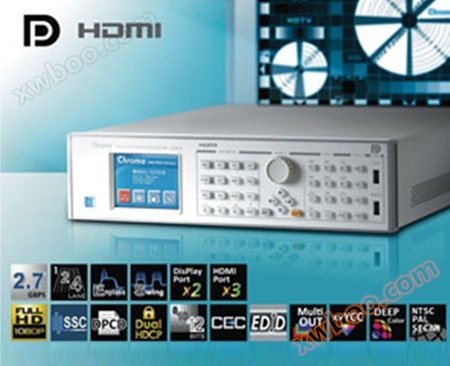
Chroma 2233-B Video Signal Graphic Generator
NegotiableUpdate on 02/11
- Model
- Nature of the Manufacturer
- Producers
- Product Category
- Place of Origin
Overview
Chroma 2233-B programmable video signal graphic generator is a multifunctional measuring device that combines Analog/DVI/HDMI/DisplayPort
Product Details
Chroma 2233-B Video Signal Graphic Generator
Chroma 2233-B programmable video signal graphic generator is a multifunctional measuring device that combines signals from Analog/DVI/HDMI/DisplayPort/SDTV/HDTV, providing high-resolution testing quality and support for multiple output types, offering a complete testing solution.
In the digital signal part: TMDS output, with a point frequency of 25-330MHz, the resolution of the test image can support more than UXGA. In addition, for higher frequency signal testing, this machine supports DVI Dual HDCP testing and can support dual channel DVI testing applications.
In response to the trend of large-scale and high-definition video industry, Chroma 2233-B supports the latest high-resolution multimedia digital audio and video transmission interface HDMI V1.3 specification, providing higher bandwidth and color depth, supporting 24,30,36 bits (RGB or YCbCr) and the new generation color standards xvYCC and SYCC, Adobe RGB, Adobe YCC (CEA-861E), achieving true natural color and high-resolution image display.
DisplayPort is a new generation of video output interface approved by the Video Electronics Stand ards Association (VESA), which is an open and extensible interface standard that can be adopted by the industry. The purpose of its development is to reduce platform design costs and provide a digital connectivity interface for interoperability between personal computer platforms and components. It, like HDMI, can receive high-definition digital audio and video through a digital video transmission line, with a maximum transmission bandwidth of up to 10.8Gb/s. The sufficient bandwidth can meet the higher resolution requirements of future and large-sized display devices.
Chroma 2233-B provides the DisplayPort standard format, which has the following main features:
The connection of DisplyPort consists of three types of signals: main channel, AUX CH, and hot swappable (HPD). The main channel is composed of four lines (1, 2, 4Lane), each of which can support transmission rates of 2.7Gbps or 1.62Gbps, and the four lines can achieve a maximum of 10.8Gbps.
DPCD (Display Port Configuration Data) is the main function of Display Port communication, providing a communication bridge between source and sink. Chroma 2233-B can provide manual or automatic parameter adjustments (such as Lane, Main link rate, etc.) after linking. The signal attenuation that may occur during long-distance transmission of DisplayPort can also be adjusted by adjusting the voltage of Pre emphasis and Swing.
In addition, Chroma 2233-B also provides SSC (Spread Spectrum Clock) testing support, which can significantly reduce electromagnetic interference between displays and component interfaces, simplifying the complexity of product design for engineers.
At the same time, to meet the needs of users for multi port output testing applications, this machine is equipped with 3 HDMI ports, 2 DisplayPorts, and 2 SCART ports, which can greatly shorten the testing time and complete the testing program in the fastest way possible.
Similar Product Recommend


