- Phone
-
Address
No. 38 Yaxi Road, Yaxi Community, Luoshe Town, Huishan District, Wuxi City, Jiangsu Province
Product Categories
Jiangsu Quanyi Metrology Technology Co., Ltd


Automatic working force gauge calibration device
NegotiableUpdate on 05/19
- Model
- Nature of the Manufacturer
- Producers
- Product Category
- Place of Origin
Overview
The ZCLB-100B fully automatic working force gauge calibration device is the latest development by Wuxi Zice Tuoxin Metrology Technology Co., Ltd. The machine adopts servo control technology, combined with intelligent PID control algorithm, and has the characteristics of high control accuracy, good reliability, high detection efficiency, low noise, and can work continuously for a long time. The high-precision measurement system is used to collect standard sensor signals, ensuring high precision and stability of the force value accuracy of the machine. It can be used to calibrate working force measuring instruments such as force measuring rings and force gauges.
Product Details
The ZCLB-100B fully automatic working force gauge calibration device is the latest development by Wuxi Zice Tuoxin Metrology Technology Co., Ltd. The machine adopts servo control technology, combined with intelligent PID control algorithm, and has the characteristics of high control accuracy, good reliability, high detection efficiency, low noise, and can work continuously for a long time. The high-precision measurement system is used to collect standard sensor signals, ensuring high precision and stability of the force value accuracy of the machine. It can be used to calibrate working force measuring instruments such as force measuring rings and force gauges.
Technical Specifications:
1. Measurement range: 0-100kN
2. Accuracy level: 0.3 level
3. Force measurement method: tension compression direction.
4. Framework form: Double column type, dual space.
5. Loading method: Fully automatic loading.
6. Repeatability error of force value: 10% FS or above, ≤± 0.1%
7. Load fluctuation (power source stability): 10% FS or above ≤± 0.05%
8. Test travel: 500mm
9. Stable holding time of force value (min): 0-30 can be set according to requirements.
10. Unit display: N, kN, kg, g can be switched freely, and the conversion coefficient can be customized.
11. Real time display of test curves.
12. Sampling frequency: greater than 1500Hz (set as needed).
13. Operating system: Linux operating system.
14. Wireless communication: WiFi, Bluetooth.
15. Communication: Ethernet RS485、RS232。
16. Display screen: 7-inch high-definition touch screen (capacitive screen).
17. Compression test space (length x width x height) (mm): 150 x 300 x 400
18. Power supply: AC220V/50HZ
19. The loading speed can be set within the range of 0.03% -10% FS/s.
Product Features
1. Test types: Single point testing, multi-point automatic testing, and fatigue testing of force sensors can be customized according to requirements.
2. Testing wrench types: force sensor, working force gauge, force measuring ring, etc.
3. The instrument comes with built-in measurement of environmental temperature, humidity, and atmospheric pressure.
4. The device comes with Ethernet and WiFi, which can synchronize sample information, calibration data, etc. in real-time with the measurement management platform through the local area network.
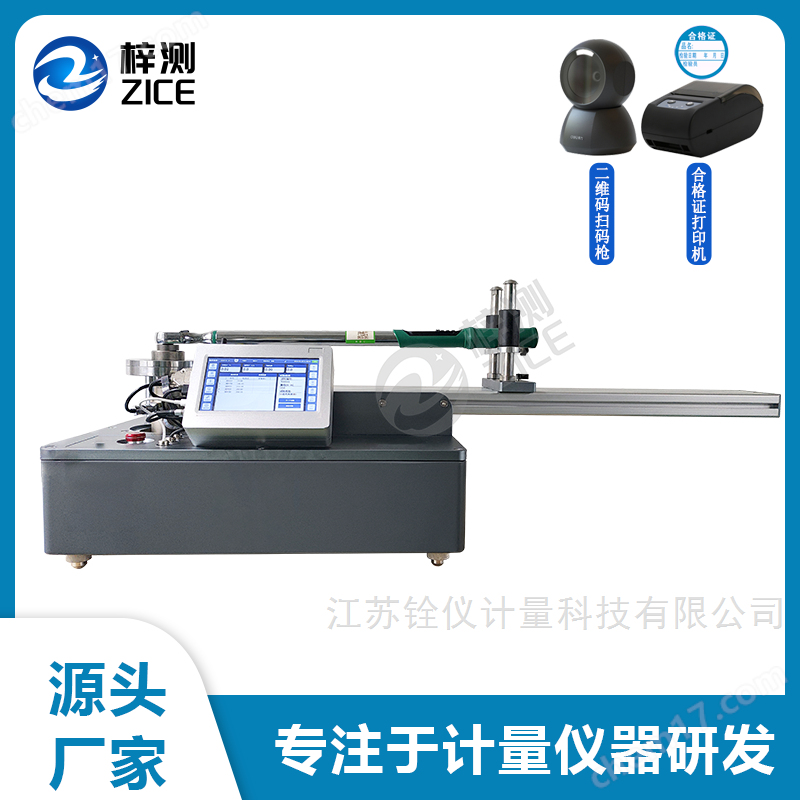
5. The device can be connected to a barcode scanner, which can extract instrument information by scanning QR codes or barcodes. After the QR code printer is calibrated, it can automatically print qualified labels.
6. Host dimensions: 650mm * 650mm * 1900mm
Measurement management platform:
The metrology management platform is a comprehensive software platform that integrates data input, processing, analysis, and report generation. It aims to help enterprises achieve automation, informatization, and intelligence in metrology work. Its main functions include data input and storage, data processing and analysis, report generation and export, etc. It is widely used in metrology management work in various industries.
1. Homepage: including login information, notifications and announcements, to-do list, approval progress, recent experiments, today's experiments, experiment statistics, equipment expiration, etc.
2. Basic information: Management of relevant basic data for experimental operation, management of commissioning units, storage location information, and sample information.
3. Equipment ledger: Due to the variety of measuring instruments, complex sources, allocation from other projects, subcontracting, and procurement from different regions in the project, it is particularly important to establish a measuring instrument ledger and instrument file, which is also the fundamental work of measuring instrument management.
4. Calibration and verification: Certificate editing supports multiple data entry methods, such as automatic device upload, manual input, and file import, ensuring fast and accurate data entry. Certificate viewing allows for the review and approval of certificates. Certificate printing supports generating reports in various formats according to user needs, including tables, charts, etc. Users can also export reports to common file formats for convenient data sharing and transmission.
5. Statistical query and analysis: Equipped with various data processing and analysis tools, it can automatically process, statistically analyze, and trend predict the entered measurement data, helping users quickly obtain valuable information.
6. Quality assurance management: project initiation and qualification management, calibration standards, printing templates and other quality data management.
7. Logistics management: facilitates the management of company logistics related data by users, such as company documents, information materials, procurement management, supplier management, etc.
8. System management: Basic data management for system operation, role management, department management, user management, menu management, system settings, etc.
9. Customer service system: WeChat system, QR code progress inquiry system, online inquiry system, customer measuring instrument management system, certificate verification system, self-service download system, complaints and suggestions, etc.
Similar Product Recommend