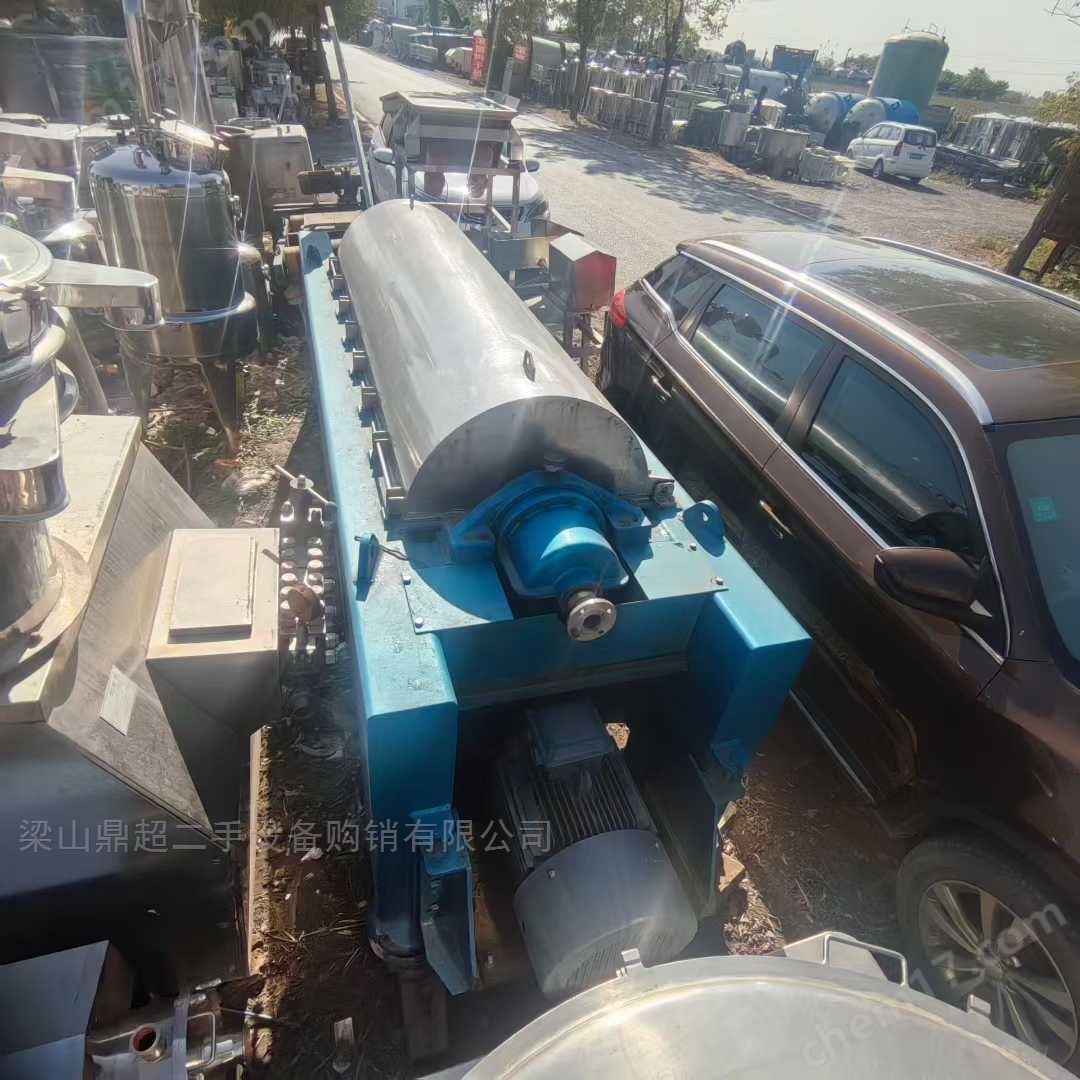
The horizontal spiral settling centrifuge is a common industrial equipment for solid-liquid separation and can also be used for liquid-liquid solid three-phase separation.
The horizontal spiral settling centrifuge is a common industrial equipment for solid-liquid separation and can also be used for liquid-liquid solid three-phase separation. Here is a detailed introduction:
working principleThe equipment consists of a drum, a screw conveyor, a differential, and main and auxiliary motors. The main motor drives the drum to rotate at high speed, and the material enters the drum through the feed pipe. Under the action of centrifugal force, solid particles with a higher density deposit on the inner wall of the drum. The screw conveyor rotates in the same direction as the drum but has a different speed. Its spiral blades can continuously scrape off the deposited solid particles and push them to the slag discharge port at the cone end of the drum for discharge. The separated clear liquid flows out through the opening of the weir plate at the large end of the drum, thus achieving separation.
structural characteristicsUsually using a monolithic rack, the structure is compact and the footprint is small. Key parts such as the spiral feeding surface and the slag outlet of the rotary drum are generally sprayed or welded with a hard alloy wear-resistant layer. The parts in contact with the material are mostly made of high-quality high-strength austenitic stainless steel or duplex stainless steel to ensure corrosion resistance and wear resistance.
technical advantage
Strong processing abilityIt can operate continuously for 24 hours, and processes such as feeding, separation, and unloading can be automatically carried out at full speed, with a large processing capacity to meet the needs of large-scale production.
High degree of automationGenerally controlled by PLC and other systems, with multiple safety protection mechanisms such as torque protection and power control, reliable operation, usually only one person is needed per shift to complete the operation, with low labor intensity.
Good operational stabilityThe vibration intensity is usually less than 5mm/s, the operating noise is less than 85dB (A), the operation is stable, and the impact on the operating environment is small.
Wide adaptabilitySuitable for suspensions containing solid particles with a particle size greater than 0.005mm, a concentration range of 1-40%, and a temperature ≤ 100 ℃, it can meet the separation needs of different materials by adjusting parameters such as differential speed and overflow plate diameter.
Application fieldWidely used in chemical, pharmaceutical, food, petroleum, environmental protection and other fields. For example, it can be used for dehydration and slag removal of coal tar and oilfield crude oil, dehydration of starch and soy protein, sludge treatment of industrial and urban domestic sewage, as well as separation and classification in the production of chemical raw materials such as polyvinyl chloride resin.