- Phone
-
Address
2nd Floor, Building D, Lane 518, Xiangjiang Road, Jiading District, Shanghai
Product Categories
Tiko (Shanghai) Biotechnology Co., Ltd


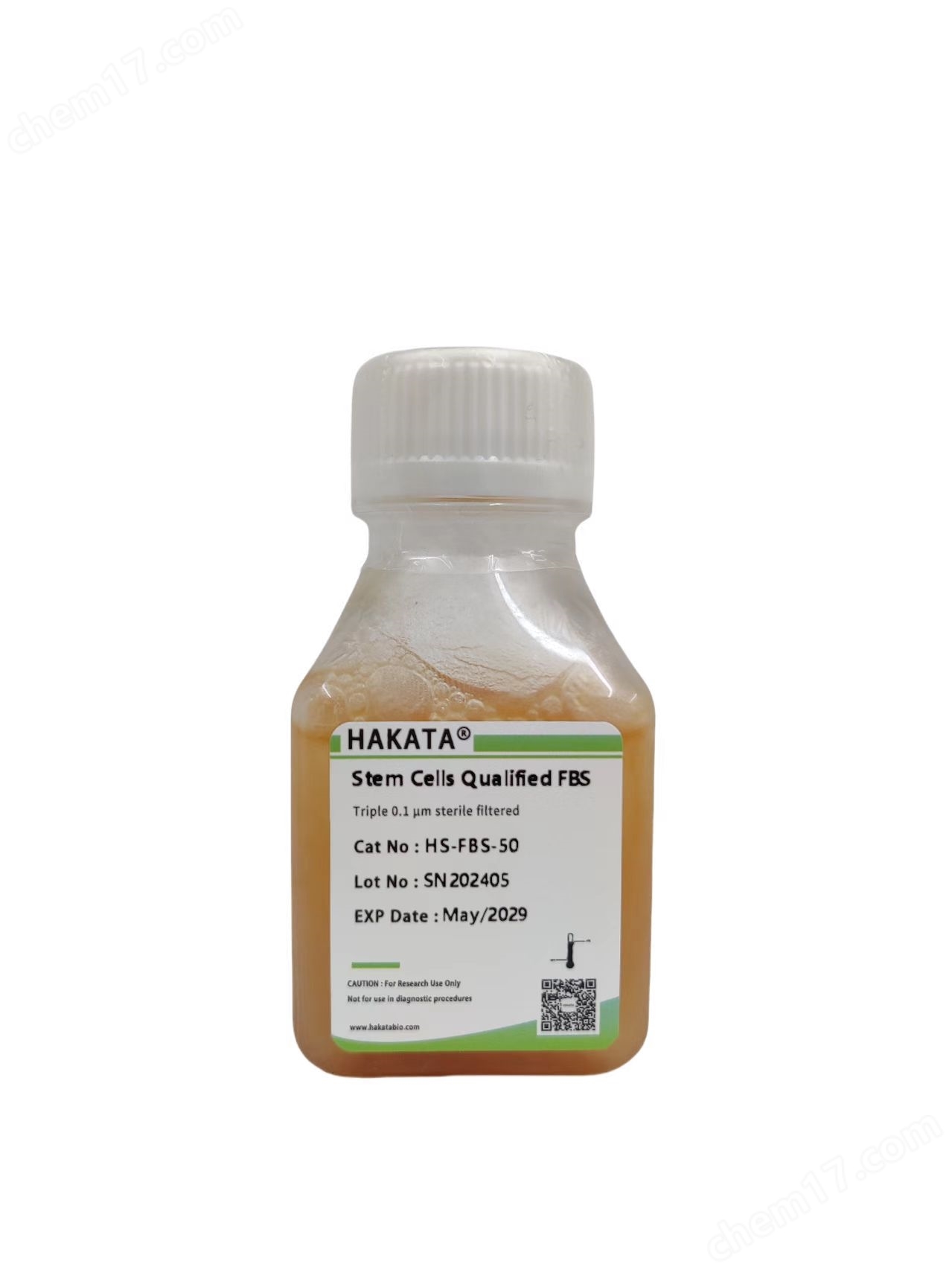
Stem cell specific fetal bovine serum
NegotiableUpdate on 05/06
- Model
- Nature of the Manufacturer
- Producers
- Product Category
- Place of Origin
Overview
Stem cells are the least differentiated cells, and many common biomolecules in serum can induce unnecessary differentiation, while also providing basic growth needs for these cells in culture. HAKATA stem cell specific fetal bovine serum has been proven to be ES grade through tests including immune cell chemical identification of multifunctional proteins such as OCT4. After cell culture testing, embryonic stem cells, mesenchymal stem cells, insect cells, and neural cells can all use this product.
Product Details

【Product Introduction】
Stem cells are the least differentiated cells, and many common biomolecules in serum can induce unnecessary differentiation, while also providing the basic needs for growth in these cell cultures, HAKATAStem cell specific fetal bovine serumThe serum was confirmed to be ES grade through tests that included identification of multipotent proteins such as OCT4 using immunohistochemistry. After cell culture testing, it was found that embryonic stem cells, mesenchymal stem cells, insect cells, and neural cells can all use this product.
【Product Features】
1. Low endotoxin content, three times of nanoscale filtration
2. Strictly control batch differences
3. Reliable and traceable source
4. Inspection and quarantine reports are provided for each batch
5. Suitable for various conventional cell cultures
6. Dry ice transportation, recommended storage temperature is -20 ℃ to -10 ℃
HAKATAStem cell specific fetal bovine serummain function
Providing basic nutrients such as amino acids, vitamins, inorganic substances, lipids, nucleic acid derivatives, etc., are essential for cell growth.
Provide hormones and various growth factors: insulin, adrenal cortex hormones, steroid hormones (estradiol, testosterone, progesterone), etc. Growth factors such as fibroblast growth factor, epidermal growth factor, platelet growth factor, etc.
Providing binding proteins: Binding proteins carry important low molecular weight substances, such as albumin carrying vitamins, fats, and hormones, while transferrin carries iron. Binding proteins play an important role in cellular metabolism.
Provide contact promoting and stretching factors to prevent cell adhesion from mechanical damage.
It has a certain protective effect on cells in culture: some cells, such as endothelial cells and bone marrow like cells, can release proteases, and serum contains anti protease components that neutralize them. This effect was discovered by chance, but now there is a deliberate use of serum to terminate the digestion of Yi protease. Because Yi protease has been widely used for digestion and passage of adherent cells. Serum proteins form the viscosity of serum, which can protect cells from mechanical damage, especially during suspension culture agitation, where viscosity plays an important role. Serum also contains some trace elements and ions that play important roles in metabolism and detoxification, such as SeO3, selenium, etc
Serum preservation
Serum should be stored at -5. C to -2O.C. If stored in 4. At C, the shelf life is reduced to one month. If you are unable to use up one bottle at a time, it is recommended to aseptically pack the serum into an appropriate sterilization container and then put it back in the freezer.
Thawing serum
After removing the serum from the freezer, place it in 2-8 first. Dissolve it in a refrigerator and then fully dissolve it at room temperature. However, it must be noted that during the dissolution process, it must be shaken regularly and evenly.
Notes:
1. When thawing serum, please follow the recommended step-by-step thawing method (-2OC to 4).
C to room temperature), if the temperature change during serum thawing is too large (e.g. -20 ° C to 37 ° C). C), Experiments have shown that it is very easy to produce sediment.
2. When thawing serum, please shake it evenly at any time to ensure uniform temperature and composition, and reduce the occurrence of precipitation
3. Do not place the serum at 37. C is too long. If it's at 37. If C is left for too long, the serum will become turbid, and many unstable components in the serum will also be damaged, which will affect the quality of the serum.
4. Thermal inactivation of serum can easily lead to an increase in sediment, and this step may not be necessary unless necessary.
5. If serum heat inactivation is necessary, please follow 56. C, The principle is 30 minutes, and shake evenly at all times. Excessive temperature, prolonged exposure, or uneven shaking can all lead to an increase in sediment. [5] What should be done if flocculent sediment is found after serum thawing? To remove these flocculent precipitates, the serum can be divided into sterile centrifuge tubes and centrifuged slightly at 400g. The supernatant can then be added to the culture medium and filtered together. But it is not recommended to remove these flocculent precipitates by filtration, as it may clog the filtration membrane.
What is heat inactivation?
Generally, thawed serum is processed at 56C for 30 minutes. This heating step can deactivate complement, which participates in reactions such as cell lysis, smooth muscle contraction, histamine release from mast cells and platelets, enhanced phagocytosis, and chemotaxis and activation of lymphocytes and macrophages.
Is it necessary to do heat inactivation?
Experiments have shown that properly processed heat inactivated serum is not necessary for most cells. The serum treated in this way only has a slight promotion of cell growth, or has no effect at all, and is often reduced in cell growth rate due to the high temperature treatment affecting the quality of the serum. After heat treatment, the formation of precipitates in the serum will significantly increase. These precipitates, observed under an inverted microscope, such as' small black dots', often lead researchers to mistakenly believe that the serum has been contaminated. Placing the serum in a 37 ° C environment will further increase the formation of these precipitates, leading researchers to mistakenly believe that it is the division and expansion of microorganisms.